
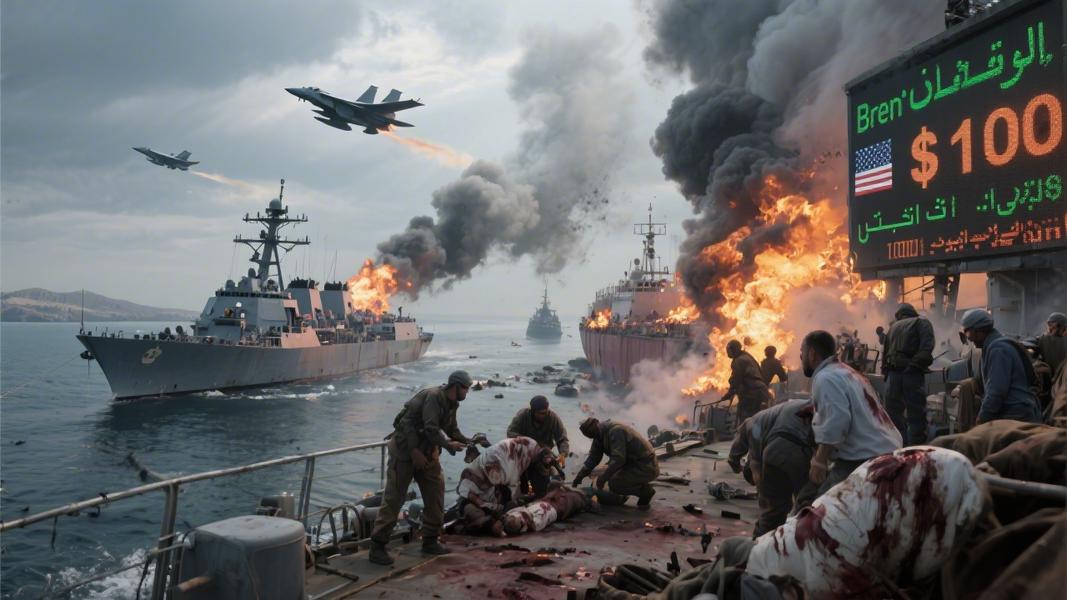
Oil prices are surging again — and this time, the world’s most critical maritime chokepoint is at the center of it. Brent crude jumped nearly $8 in a single day, and traders are now watching the Strait of Hormuz with the kind of white-knuckle attention usually reserved for central bank press conferences.
As of 9 a.m. ET on March 12, 2026, Brent crude had climbed to $98.76 per barrel — up $7.80 from the previous session and a staggering $27 higher than a year ago, according to data tracked by Fortune. That’s not a blip. That’s a market sending a message.
The Hormuz Factor
The immediate driver is the deepening Iran conflict and what it means for global oil flows. Iran has reportedly threatened to close the Strait of Hormuz — the narrow waterway through which roughly 20 percent of the world’s oil supply passes — and open new military fronts, rattling energy markets in a way that hasn’t been seen in years. Barchart noted that April WTI crude briefly spiked to a 3.75-year high of $119.48 before pulling back, a sign of just how volatile intraday trading has become.
Just 24 hours earlier, the picture looked considerably calmer. On March 11, Brent was sitting at $90.96 per barrel at 9:15 a.m. ET — actually down slightly from the day before, as shown in the prior session’s data. One day later, that relative calm is gone. Markets moved fast, and they moved hard.
Analysts Divided on Where This Goes
Here’s the thing, though: not everyone on Wall Street is convinced this is the beginning of a sustained rally. The Hormuz crisis has injected real fear into the market, but the underlying supply-demand fundamentals — before the geopolitical fireworks — were telling a much quieter story.
J.P. Morgan, for one, isn’t abandoning its longer-term bearish outlook. The bank had projected Brent averaging just $60 per barrel for 2026, citing a global oil surplus that was already visible in January data. “Oil surplus was visible in January data and is likely to persist,” said Natasha Kaneva, head of Global Commodities Strategy at J.P. Morgan — a forecast that now looks either prescient about fundamentals or stubbornly out of step with geopolitical reality, depending on who you ask.
The U.S. Energy Information Administration is taking a more nuanced middle path. Its latest outlook, published recently, forecasts Brent staying above $95 per barrel for the next two months, before dropping below $80 in the third quarter and sliding further to around $70 by year-end. In other words: brace for near-term pain, but don’t cancel your summer road trip just yet.
Futures Markets Tell Their Own Story
Still, the futures curve is doing something worth watching. CME Group’s Brent crude futures show May 2026 contracts priced at $87.80, declining steadily to $78.44 for September 2026 — a classic backwardation structure that suggests traders expect prices to cool once the immediate crisis either escalates into something defined or fades into diplomacy. Markets are essentially pricing in a crisis premium today while betting it won’t last forever.
That’s the catch. Nobody knows whether the Hormuz threat is a bargaining chip or a genuine prelude to something worse. If the strait closes — even partially, even briefly — the $119 WTI spike seen intraday on March 12 could start to look like a preview rather than an anomaly. The global economy, still navigating uneven post-pandemic footing, has very little appetite for another energy shock of that magnitude.
What Comes Next
For now, energy analysts are doing what they always do in moments like this: modeling scenarios, hedging forecasts, and watching the news wires with one eye and the futures board with the other. The gap between J.P. Morgan’s $60 average and today’s near-$99 spot price is a reminder that geopolitics doesn’t negotiate with supply-demand models.
Whether this is a brief, violent spike or the opening chapter of a prolonged energy crisis may well depend on decisions being made in Tehran — and in Washington — over the coming days. As Kaneva’s words linger in the background, the market’s message today is unmistakable: the surplus can wait. The Strait can’t.
