
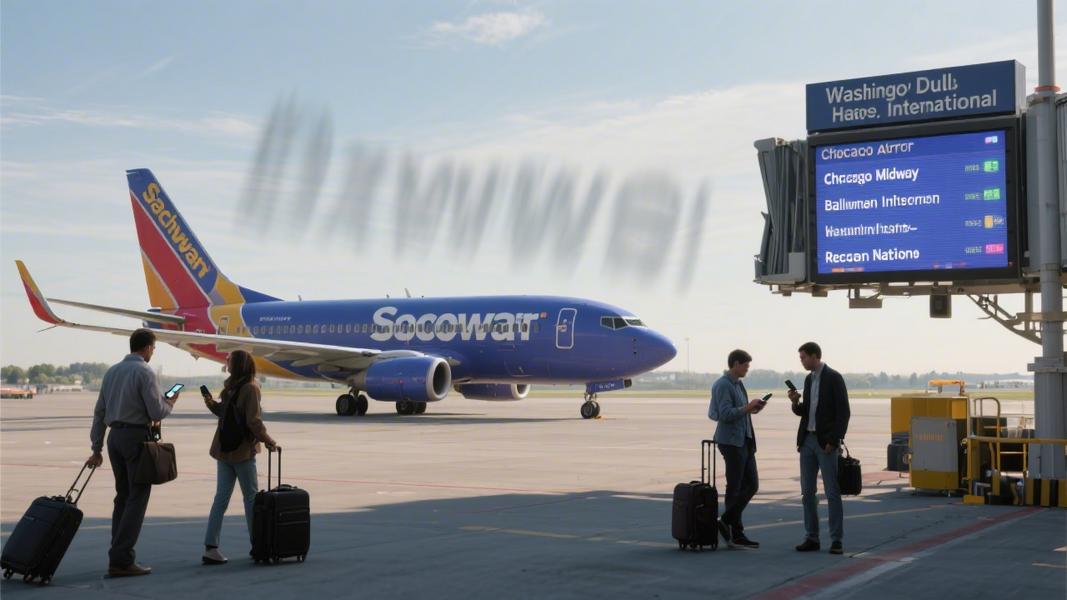
Southwest Airlines is pulling out of two major airports — and this time, it’s not coming back. The carrier confirmed Friday it will end all service at Washington Dulles International Airport and Chicago O’Hare International Airport effective June 4, 2026, closing the book on what amounted to two of the airline’s quietest and, ultimately, least successful urban experiments.
The move is significant not just for Southwest’s route map, but for what it signals about the limits of the low-cost carrier model in slot-constrained, legacy-dominated markets. A rebooking notice posted on the company’s website Friday morning confirmed the departures, offering affected passengers a path forward — but not the one they originally booked.
A Washington Footnote
At Dulles, the retreat is almost anticlimactic. Southwest’s footprint there had already shrunk to a shadow of its former self — just two remaining routes, to Phoenix and Denver. The carrier has long treated Baltimore-Washington International as its true Washington-area hub, and Dulles always felt more like an afterthought than a strategic anchor. Nearly 20 years of service at the airport, dating back to October 2006, will end quietly, with almost no one left to notice the gates go dark.
Still, the symbolism stings a little. Two decades is a long time to keep a presence alive, even a diminished one. Southwest didn’t exactly fight to hold on.
O’Hare Was Different — Or Was Supposed to Be
Chicago O’Hare is the more complicated story. Southwest came in swinging in late 2021, launching with more than 800 monthly departures and service to roughly a dozen destinations — a genuine, aggressive push into one of the country’s busiest airports. The idea, presumably, was to finally crack a market long dominated by United and American, who treat O’Hare essentially as sovereign territory.
It didn’t work. By late 2024, departures had halved. By the end of 2025, they’d declined further still. What began as a bold expansion across nearly three years of market penetration ended up looking less like a strategic beachhead and more like an expensive lesson in competitive realism. Southwest already has Midway — Chicago’s other major airport — and that’s where its loyalists go. O’Hare, it turns out, wasn’t waiting for them.
What Happens to Stranded Passengers?
Passengers holding tickets on affected flights aren’t entirely out of luck. Southwest is offering rebooking to a range of nearby alternatives — O’Hare travelers can shift to Midway, Milwaukee, or Indianapolis, while Dulles passengers have options including Reagan National, BWI, Philadelphia, or Richmond. A full refund is also on the table for those who’d rather walk away entirely. It’s a relatively generous set of options, all things considered, though the inconvenience of replanning travel around airport changes is real.
The O’Hare Problem Nobody Fully Solved
Here’s the thing: Southwest isn’t the only one struggling with O’Hare right now. The Federal Aviation Administration recently announced that the airport’s planned summer 2026 schedules significantly exceed its practical capacity — a finding that prompted what officials described as unprecedented federal intervention. The FAA’s projections are stark: an estimated 50,400 preemptive cancellations across the industry between May and September 2026, with ticket prices expected to climb 15 to 30 percent as a result.
That context matters. Southwest’s exit from O’Hare doesn’t happen in a vacuum — it happens against a backdrop of an airport that’s already straining under the weight of its own ambitions. The FAA’s warning, detailed in recent reporting, paints a picture of a system under pressure heading into what could be a genuinely chaotic summer travel season.
For Southwest, leaving now — before June — might actually be the smartest operational call it’s made at O’Hare in years. Less exposure, fewer headaches, a cleaner story to tell investors. Whether it’s a strategic retreat or simply an acknowledgment of defeat depends on who you ask. But either way, the gates are closing.
Sometimes the loudest thing an airline can say is nothing at all — just a rebooking notice on a Friday morning, and two airports quietly crossed off the map.
