
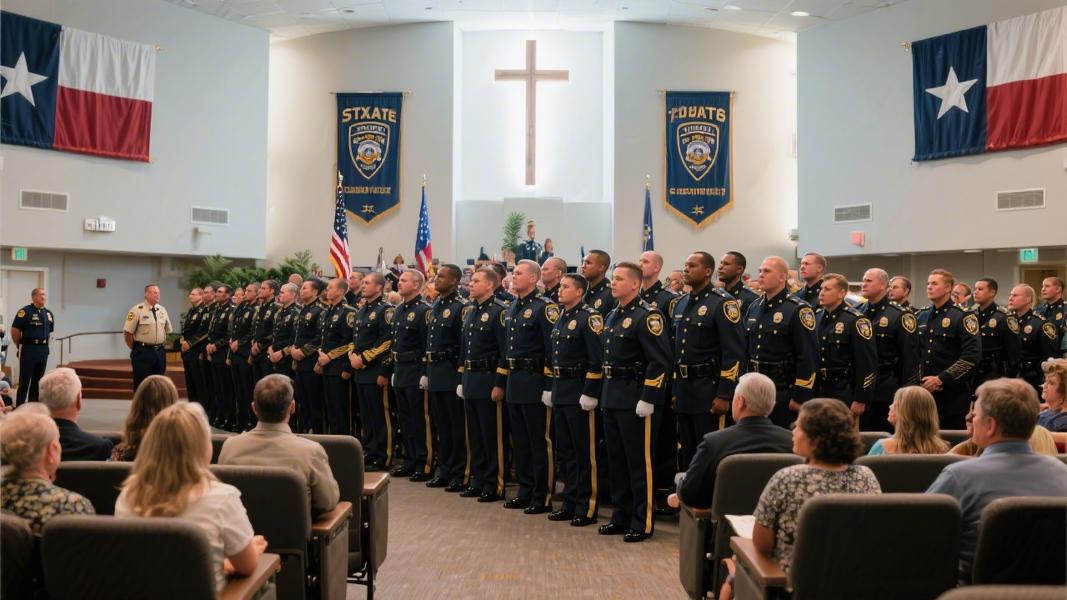
One hundred and twenty-two new Texas Highway Patrol troopers raised their right hands on March 20, 2026 — and the man telling them what comes next had once stood exactly where they were standing.
The Texas Department of Public Safety graduated Recruit Class C-2025 in a ceremony marking the department’s 180th graduating class, adding 122 freshly badged troopers to the ranks of law enforcement spread across the Lone Star State. It’s a milestone that speaks to both the scale of Texas policing and the grueling road it takes to get there. The keynote speaker, Houston Police Chief J. Noe Diaz, knew that road personally — he’d been walking it since 1996, when he was the one in the recruit uniform.
A Long Road to the Podium
Diaz’s story isn’t the typical law enforcement biography. He didn’t come up through a university criminal justice program or land a cadet slot straight out of high school. “I didn’t have the ability to go to college, so I went to work,” Diaz has said. “I started in a state prison, and most of my formal education was on the job.” That was 1987. He spent nearly a decade as a correctional officer before earning a spot in DPS Academy Class A-1996, eventually assigned as a trooper to the Katy Highway Patrol.
From there, the career built itself the hard way — a stint in the Narcotics Division, then an appointment as a Texas Ranger in 2008, one of the most storied distinctions in American law enforcement. By the time Houston Mayor John Whitmire tapped him to lead the Houston Police Department, Diaz had logged nearly four decades across nearly every corner of Texas public safety. So when he stood before Class C-2025, it wasn’t a ceremonial gesture. It was a relay pass.
“I’ve walked the road you’re about to take,” Diaz told the graduates. “The miles will be long, but the honor of serving Texas will make every one of them worth it.”
122 Out of 1,685 — Do the Math
That number is worth sitting with for a second. Of the 1,685 people who applied for Class C-2025, only 136 were accepted to begin the 30-week Training Academy on August 24, 2025. Then the attrition continued. By graduation day, 122 had made it through. That’s a completion rate of roughly 7 percent from the original applicant pool — a filter that’s as much psychological as it is physical.
What those 30 weeks look like is no small thing. The academy packs in more than 1,204 hours of instruction, covering criminal and traffic law, crash investigation, crisis intervention, use of force, and Tactical Emergency Casualty Care — the kind of field medicine that can mean the difference between a colleague living or dying on the side of a Texas highway. This isn’t a certification course. It’s closer to a transformation.
DPS Colonel Freeman F. Martin didn’t undersell it. “Class C-2025 is the most skilled, best prepared class of recruits the Texas Department of Public Safety has ever turned out,” he declared. “We are incredibly proud to have each of these 122 men and women sitting here today, ready to head out to duty stations across the state of Texas and get to work protecting the communities and people that need them most.”
Who They Are
The class itself reflects a Texas that’s broader than any single stereotype might suggest. Of the 122 graduates, 99 are male and 23 are female, ranging in age from 21 to 51. Thirty-three are military veterans. A striking 68 are multilingual — a practical asset in a state where Spanish, Vietnamese, and dozens of other languages are spoken daily across communities that troopers will now serve. And the class isn’t entirely homegrown: graduates hailed from Arkansas, California, New Mexico, and Virginia, suggesting that the pull of Texas DPS reaches well beyond state lines.
That diversity matters — not as a talking point, but as a function of the job. A trooper who can speak directly to a frightened crash victim in their first language, or who has navigated the chain of command in a combat zone, brings something to the highway that a credential alone can’t replicate.
What Comes Next
Still, graduation is only the beginning. These 122 troopers will now fan out to duty stations across a state that spans 268,000 square miles — a place where the distance between a call and backup can be measured in uncomfortable amounts of time. The training was rigorous. The real work is something else entirely.
Chief Diaz, who built a career on exactly that kind of work, probably put it best when he reflected on his own beginnings — not in a classroom, not in a ceremony, but inside a state prison in 1987, learning the job one shift at a time. Thirty-nine years later, he was the keynote speaker at a ceremony honoring the next generation of Texas law enforcement. Sometimes the road really does take you somewhere.
