
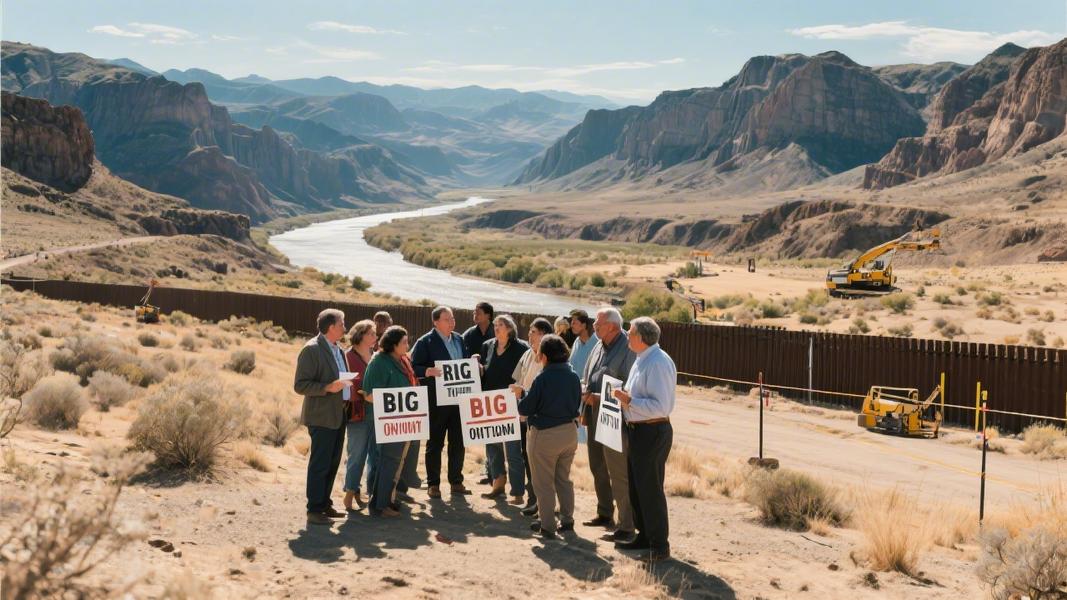
A border wall is coming to one of the most remote and wild stretches of the American Southwest — and the people who live there aren’t sure anyone in Washington is listening.
The Trump administration is pushing forward with plans to construct more than 150 miles of border wall along the Rio Grande, cutting through some of Texas’s most iconic and economically fragile landscape. The proposed route runs from Fort Quitman to Colorado Canyon, skirting the edges of Big Bend National Park and threading through Big Bend Ranch State Park. For local officials, ranchers, and conservationists, the project raises urgent questions about what gets sacrificed in the name of border security — and who gets to decide.
The Steamroller Starts Rolling
The legal groundwork was laid quietly but decisively. DHS Secretary Kristi Noem waived 28 federal laws to expedite construction in the region, a move that alarmed environmentalists and local leaders alike. The funding is no abstraction either — the One Big Beautiful Bill Act, signed in July 2025, appropriated a staggering $46.5 billion for border wall construction nationwide. That money is already starting to move.
On the ground, the signs are hard to miss. Federal contractors have been fanning out across the Big Bend region, asking landowners about available leases and scouting locations for construction staging areas and so-called “man camps” — the temporary housing clusters used to billet large workforces in remote areas. Brewster County Judge Greg Henington put it plainly: “The steamroller seems to be moving,” he said. “Contractors are swarming our area, asking questions about man camps and leases … there hasn’t been a whole lot of transparency.”
Tourism vs. The Wall
Here’s the thing about Brewster County: it doesn’t have oil wells or a manufacturing base to fall back on. It has sky, silence, and some of the most spectacular desert terrain in North America. Brewster County Sheriff Ronny Dodson didn’t mince words when asked about the proposal. “It’ll ruin this county,” he warned. “If it’s a real wall, it will devastate us. We don’t have oil and gas, we have tourism.”
That’s not hyperbole — it’s economics. The National Parks Conservation Association estimates that Big Bend visitors generated more than $60 million in local spending in 2024 alone. “Visitors have a significant economic impact to the local communities,” the group noted, “totaling more than 60 million dollars in spending in 2024.” A wall that scars the landscape, restricts access, or simply signals that the region is a construction zone could quietly hollow out the one industry keeping these small communities alive.
A Border Without a Crisis
So what exactly is being secured? That’s a harder question than it sounds. Charlie Angell, a Presidio County landowner with property directly on the Rio Grande, said that in more than a decade of ownership he has never witnessed an illegal crossing on his land. His experience isn’t unusual for this stretch of the border — the terrain itself is the obstacle, a brutal combination of desert heat, canyon walls, and sparse water that has historically made the Big Bend corridor one of the least-trafficked crossing points along the entire southern boundary.
Still, the administration’s position is that every mile matters. And there’s no sign the project is being reconsidered in any fundamental way — even as its scope shifts slightly at the edges.
A Quiet Reversal at the Park Line
Not everything is moving in one direction. In a notable development, U.S. Customs and Border Protection recently updated its online mapping tool to show detection technology — rather than physical barriers — within Big Bend National Park itself, reversing earlier indications that the park would see hard infrastructure. It’s a meaningful carve-out, at least on paper. But the broader 175-mile corridor from Fort Quitman to Colorado Canyon remains in active planning, and the wall’s path through Big Bend Ranch State Park — the largest state park in Texas — has not been removed from the table.
The distinction between a national park and a state park may matter legally, but on the ground, in terms of scenery and ecology, the line is almost invisible. The Rio Grande doesn’t know the difference.
“Something I Never Thought We Would See”
The human dimension of all this keeps surfacing in unexpected ways. Terrell County Sheriff Thaddeus Cleveland, whose jurisdiction sits in one of the most sparsely populated counties in the continental United States, seemed genuinely stunned by where things stand. “It’s something I never thought we would see,” he told reporters. It’s the kind of remark that lands differently coming from a law enforcement officer in a border county — someone whose job, after all, is border security.
The administration has the money, the legal waivers, and apparently the will. What it doesn’t seem to have — at least not yet — is a serious conversation with the people whose lives and livelihoods sit directly in the path of the bulldozers. In a region where the landscape is the economy, and where the border has been quiet for years, the question hanging over the Big Bend isn’t just whether the wall will be built. It’s whether anyone will still want to come once it is.
