
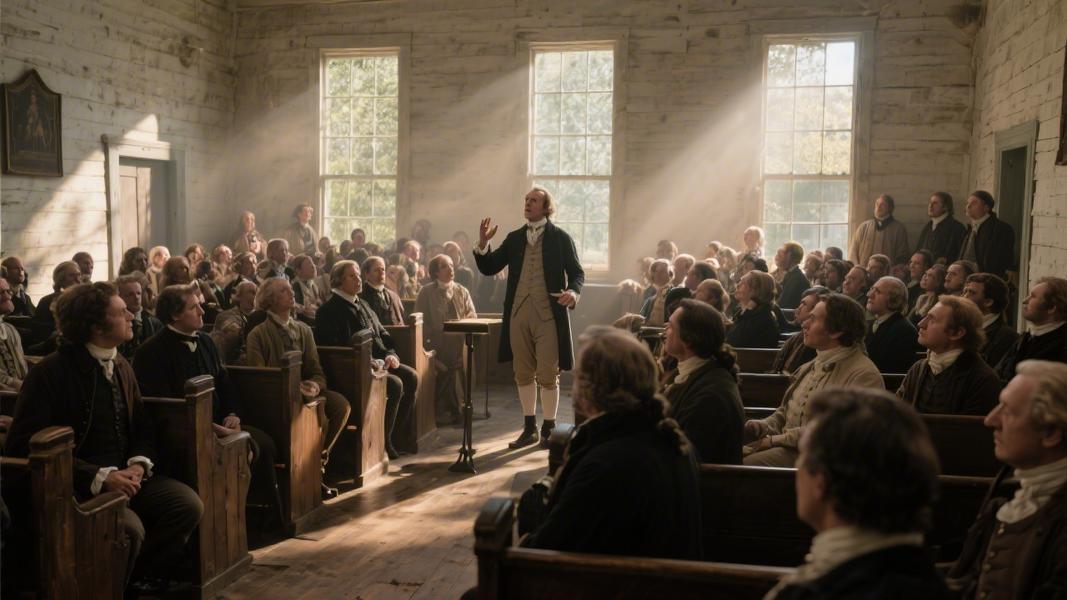
Two hundred and fifty-one years later, the words still land like a fist on a table. On March 23, 2026, the White House marked the anniversary of one of the most consequential speeches in American history — a furious, desperate plea for armed resistance that helped push a reluctant colony toward revolution.
The occasion was the 251st anniversary of Patrick Henry‘s “Give Me Liberty or Give Me Death” address, delivered on March 23, 1775, at the Second Virginia Convention in Richmond, Virginia. A Presidential Message from the White House commemorated the milestone, drawing a direct line between Henry’s defiance and the founding ideals the country still claims as its own. It’s a speech that’s been quoted, dramatized, and occasionally weaponized in political rhetoric for over two centuries — and it doesn’t show any signs of fading.
A Room Full of Reluctant Men
To understand why the speech mattered, you have to understand what Henry was walking into. The Second Virginia Convention had drawn more than 100 Virginia patriots to debate a single, combustible question: should the colony arm its militias against British rule? It wasn’t a crowd of firebrands. Many delegates still held out hope that diplomacy could work, that the Crown might yet listen to reason. Henry, by most accounts, thought that was dangerously naive.
Standing before a room that included George Washington, Thomas Jefferson, and Richard Henry Lee, Henry didn’t ease into his argument. He dismantled the opposition’s optimism piece by piece. The colonies had tried everything else, he insisted. They had, as his transcript shows, “petitioned, remonstrated, supplicated” — they had “prostrated ourselves before the throne and implored.” And none of it had worked. Britain hadn’t budged. The time for supplication, Henry argued, was over.
History, he warned, offered no comfort. There “was no way of judging the future but by the past,” he told the delegates, and the past was grim. Worse, he insisted, they were already past the point of no return — “the war had actually begun.” The only question left was whether Virginia would fight or surrender.
The Line That Echoed Everywhere
What happened next is the stuff of legend — and, admittedly, some historical embellishment. Henry reportedly closed his speech with a declaration so stark it left the room stunned. “I know not what course others may take; but as for me, give me liberty or give me death!” The resolution to arm the Virginia militia passed — narrowly, according to records from the Library of Virginia — but it passed. Henry had moved enough minds in that room to change the direction of a colony, and arguably, a continent.
The speech itself, as preserved through transcription, is a masterwork of rhetorical escalation. Henry doesn’t begin with fire — he builds to it. He acknowledges the gravity of opposing his colleagues. He frames inaction not as caution but as cowardice dressed up as prudence. And then, step by deliberate step, he argues that fighting British oppression isn’t just the brave choice. It’s the only choice. Peaceful reconciliation, in his framing, wasn’t a path. It was a trap.
Why It Still Gets Commemorated
So why does a 251st anniversary merit a Presidential Message? Fair question. Round numbers get the big ceremonies — the 250th, the centennial, the bicentennial. But the White House marked last year’s 250th with a formal proclamation that cited the speech’s delivery at St. John’s Church in Richmond, the backdrop of the Boston Massacre and the Intolerable Acts, and Henry’s direct challenge: “If we wish to be free… we must fight!” The follow-up acknowledgment a year later signals that, for this administration at least, Henry’s legacy isn’t a one-time talking point.
That’s not entirely surprising. Henry has always been a malleable symbol — claimed by libertarians, nationalists, civil liberties advocates, and anti-government movements alike. His words carry a certain voltage that makes them useful across a wide political spectrum, which is either a testament to their universality or a warning about how easily founding-era rhetoric gets stripped of its original context. Probably both.
What the Speech Actually Was
Strip away the mythology for a moment. What Henry gave on March 23, 1775, was not a polished oration prepared for posterity. It was a floor speech — urgent, unscripted by most accounts, delivered to a skeptical audience in the middle of a genuine political crisis. The tensions surrounding it were real: British troops were massing, colonial assemblies were being dissolved, and the Intolerable Acts had made clear that London wasn’t interested in negotiation. Henry wasn’t performing. He was arguing for his life, and for the lives of everyone in that room.
That rawness is part of what’s kept it alive. The speech isn’t elegant in the way that Jefferson’s prose is elegant. It’s blunt, almost brutal in its logic. You’ve tried everything else. It hasn’t worked. The enemy is already at your door. What exactly are you waiting for?
Two hundred and fifty-one years on, it’s still a question worth sitting with.
