
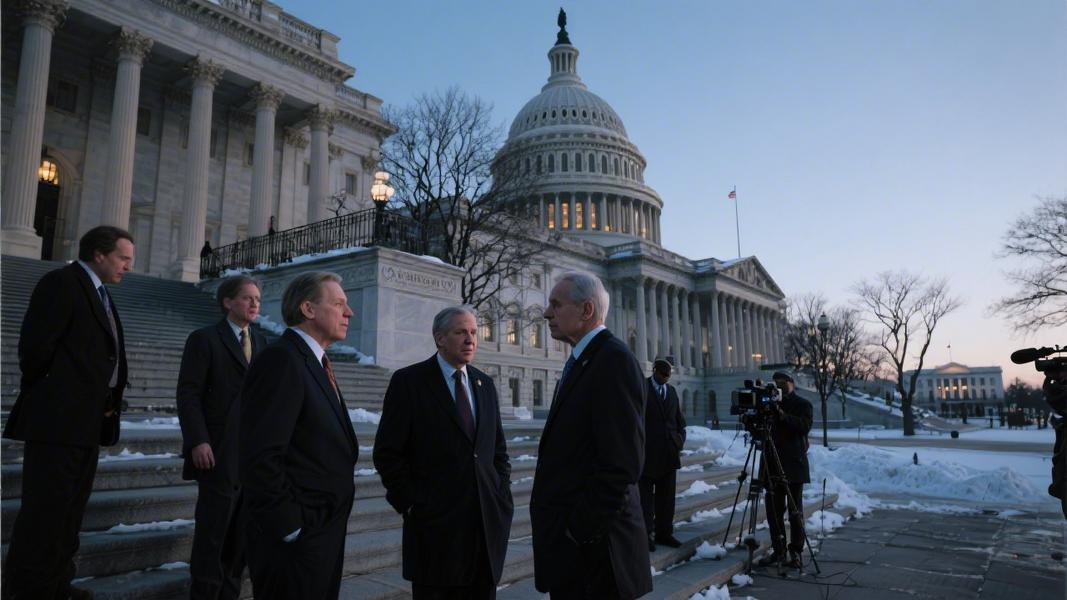
After nearly six weeks of stalemate, the Senate appears to be inching — cautiously, haltingly — toward a deal that could finally reopen the Department of Homeland Security and end one of the most disruptive partial shutdowns in recent memory.
The emerging framework would fund most of DHS’s major agencies — including TSA, FEMA, and the Coast Guard — while deliberately carving out ICE deportation operations, which would instead be pursued through the budget reconciliation process alongside the SAVE America Act. It’s a creative workaround, and whether it holds together is another question entirely.
How We Got Here
The shutdown began on February 14, after Senate Democrats refused to advance full-year DHS funding without meaningful reforms to immigration enforcement. Their demands were triggered by two deadly shootings involving federal agents in Minneapolis in January — incidents that hardened Democratic opposition and gave them a political rationale for blocking what had otherwise been a bipartisan House-passed bill.
That bill, which cleared the House 220-207 on January 22, 2026, as part of a $1.2 trillion spending package, included funding for body cameras, de-escalation training, FEMA, TSA, the Coast Guard, and CISA. Republicans were furious when Senate Democrats stalled it. “This shutdown is driven by the Democrats in the Senate,” House Homeland Security Republicans declared on February 13. “DHS funds more than just ICE. DHS pays the salaries of 260,000 men and women over 22 different agencies. The men and women at DHS are just now digging out of last year’s shutdown.”
The Senate had actually passed a short-term patch on January 30 — a 71-29 bipartisan vote that funded most of the government through September but gave DHS only two weeks of runway while negotiations continued. Those negotiations, it turned out, would drag on far longer than anyone anticipated. The Senate has now rejected DHS funding bills five separate times since the shutdown began in mid-February, most recently on March 20, when a vote failed 47-37.
The White House Steps In
Things started to shift — or at least appeared to — after the White House released a letter on March 17 outlining five policy concessions on DHS reforms aimed at satisfying Democratic demands. A senior administration official, speaking anonymously to describe the private talks, said the offer was meant to signal genuine intent. “We feel that this offer is serious — that it is a good faith attempt to continue to try to come to a reasonable and expeditious conclusion to the shutdown, which we are now seeing is becoming ever more disruptive on Americans’ travel plans, as well as the security mission at the department,” the official told reporters.
A White House meeting followed, bringing President Trump together with a group of Republican senators — Katie Britt of Alabama, Steve Daines of Montana, Bernie Moreno of Ohio, and Lindsey Graham of South Carolina — as they worked to finalize legislative text they hope to produce later this week. Border czar Tom Homan also met separately with bipartisan lawmakers as part of the push to break the logjam.
Still, skepticism abounds. Independent Sen. Angus King of Maine put it plainly after Monday’s meetings: “We’re waiting to see something in writing to see exactly what the proposal is. So I’m hopeful that we can get through this and fund these agencies.” Hopeful. Not confident. There’s a difference.
The ICE Question Isn’t Going Away
That’s the catch. The deal being floated essentially punts the most politically toxic piece — ICE deportation funding — into a separate legislative vehicle. Republicans have already secured a massive win on that front: ICE received $75 billion over a decade through the so-called “Big Beautiful Bill.” So the pressure to include it in a DHS continuing resolution has eased somewhat, at least from the right flank.
Sen. Katie Britt, who sits on the appropriations committee and was in the room for the White House meeting, suggested she could live with the approach. “If the pathway exists that we get these five bills done and then we have time to continue to review Homeland [Security], I’m here for it,” she said.
Sen. Susan Collins of Maine, who has been one of the key negotiators, sounded cautiously upbeat. “I’m more optimistic that by the end of the week we will fund the Department of Homeland Security,” she said — a notable shift in tone from a process that has felt, at times, like it was spinning in place.
What’s Actually at Stake
How bad is it, really? Consider this: 260,000 DHS employees spread across 22 agencies have been operating under shutdown conditions for nearly six weeks. TSA staffing strains have begun rippling into airport wait times. FEMA’s disaster response capacity has been squeezed. The Coast Guard — which doesn’t exactly get to pause its work during a funding fight — has been doing more with less since February.
And yet Congress has failed to advance a fix five times. The Senate’s March 20 vote, the most recent failure, came even after Homan’s bipartisan outreach and the White House’s written offer three days earlier. Senate Majority Leader John Thune acknowledged the difficulty before that vote, saying only: “They’ve just got to figure out if there’s … deal space in there, and I think we’ll find out soon.” Thune offered no timeline and no guarantees.
The House, for its part, had already done its job. Lawmakers passed the DHS funding bill back in January. It’s been sitting in Senate limbo ever since — a fact Republicans have not been shy about pointing out, and one Democrats don’t entirely dispute. Their argument has never been that DHS shouldn’t be funded. It’s been about how it’s funded, and what guardrails, if any, get placed on the agencies doing the enforcement.
What Comes Next
Senators are aiming to finalize legislative text by the end of the week. That’s the plan, anyway. Given the track record of the past five-plus weeks, “the plan” deserves at least a raised eyebrow. But the contours of a deal — fund most of DHS now, handle ICE separately through reconciliation — represent a genuine conceptual breakthrough, even if the details still need to be hammered out.
Democrats will want to see those details before signing on. Republicans will want assurances that the ICE funding pathway through reconciliation is real and not a procedural dead end. And the White House will need to hold together a coalition that has, at various points, been pulled in multiple directions by competing pressures on immigration enforcement, government spending, and election-year politics.
Nearly 260,000 federal employees, and millions of American travelers, are waiting to find out if this time is actually different — or just the sixth attempt at something that keeps falling apart at the seams.
