
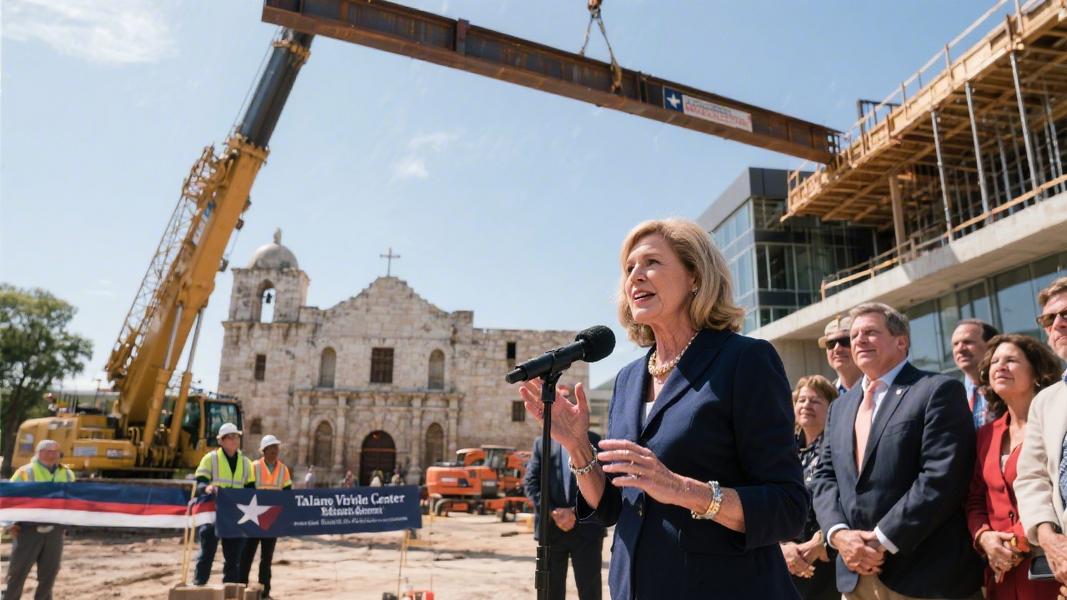
The last steel beam went up Tuesday, and for the people who’ve spent years fighting over what the Alamo should become, that’s no small thing.
On March 25, 2026, officials gathered at the construction site adjacent to one of America’s most mythologized landmarks for a Topping-Out Ceremony — the moment the final structural beam was hoisted into place on what will become the Alamo Visitor Center and Museum. It’s a milestone that signals the sprawling, long-debated reimagining of the Alamo complex in San Antonio, Texas is no longer just a plan on paper. It’s a building.
A 300-Year Story, Finally Getting the Space It Deserves
Texas Land Commissioner Dawn Buckingham, M.D., was on hand for the ceremony and didn’t hold back on the symbolism. “This marks an exciting milestone in preserving and sharing the story of our beloved Alamo,” she said. “The new Alamo Visitor Center and Museum will ensure that the full 300-year history of this sacred site — from its earliest days as a mission to the heroic stand in 1836, and how it continues to influence Texan culture today — can be experienced by future generations.”
It’s the kind of statement that lands differently when you’re standing next to a half-finished building rather than a rendering. Buckingham added that the Alamo “is where Texas’s story changed forever,” and that the museum would “ensure that story continues to inspire the world for centuries to come.” Ambitious language. But then again, this is Texas.
What’s Actually Being Built
The numbers are worth pausing on. The new facility will span nearly 160,000 square feet — a substantial footprint for a site that’s long struggled to accommodate millions of annual visitors in spaces that were never designed for them. Plans call for a 4D theater, a café, dedicated event spaces, and immersive exhibits that will, for the first time, give the Alamo’s full history room to breathe. The complex will also house Phil Collins’ renowned Alamo collection, a trove of artifacts the Genesis frontman spent decades amassing and eventually donated to the state of Texas, because apparently that’s the kind of thing Phil Collins does.
The project also includes the preservation and restoration of the iconic Alamo Church and the Long Barrack — the two structures that most visitors picture when they think of the site. Those efforts have been underway for years, quietly running alongside the louder construction drama surrounding the broader complex.
On Schedule — At Least for Now
So when does it open? Alamo Trust CEO Hope Andrade has been consistent on the timeline. “We expect the construction to be done by 2027 and the museum opening in 2028,” Andrade confirmed. That tracks with what the Alamo Trust has been telling the public for months — construction completion in 2027, doors open to the public in Spring 2028.
That’s the plan, anyway. Anyone who’s covered a major public construction project knows that “on schedule” is a phrase best received with cautious optimism. Still, the topping-out ceremony is a tangible marker — structurally, at least, the building is doing what buildings are supposed to do.
Education Gets Its Own Space, Too
The museum isn’t the only new addition taking shape around the historic grounds. The Texas Cavaliers Education Center, which broke ground back in 2023, is on track to open in 2026. It’s a purpose-built facility featuring a welcome theater, breakout classrooms, and hands-on learning opportunities — the kind of infrastructure that’s been missing from a site that draws school groups from across the state and beyond.
Together, the education center and the museum represent a significant shift in how the Alamo presents itself — less a dusty relic you shuffle past in twenty minutes, more a destination you spend a day inside, actually learning something.
Why This Moment Matters
The Alamo has been many things to many people over the years — a battlefield, a tourist trap, a political flashpoint, a symbol that means entirely different things depending on who’s telling the story. The debate over how to expand and modernize the site has been contentious, stretching back well over a decade and touching raw nerves around history, memory, and whose version of Texas gets told.
That debate hasn’t gone away. But with steel now rising above Alamo Plaza and an opening date less than two years out, the argument is shifting from whether this happens to what it looks like when it does.
Commissioner Buckingham put it plainly enough: it is, she said, “a tremendous honor to help protect the Shrine of Texas Liberty.” Two years from now, visitors will decide for themselves whether the finished product lives up to that weight.
