
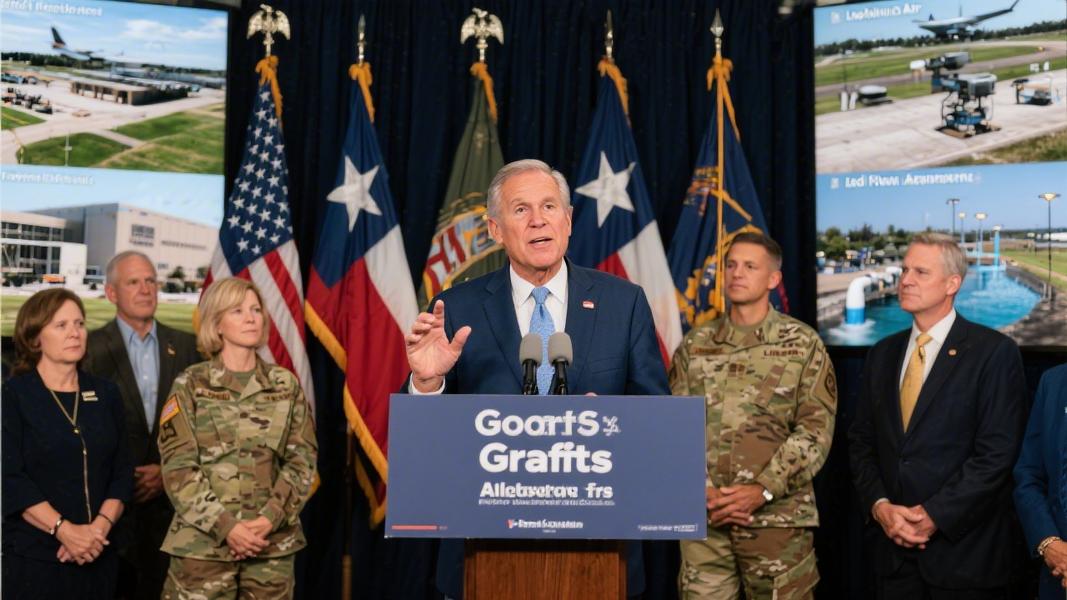
Texas is writing big checks to protect its military communities — and this time, the total has crossed a milestone worth paying attention to.
On March 26, 2026, Governor Greg Abbott announced more than $26 million in grant funding for infrastructure projects serving military installations across the state, the first round of fiscal year 2026–2027 awards through the Texas Military Preparedness Commission’s Defense Economic Adjustment Assistance Grant, or DEAAG, program. The announcement pushed the program’s cumulative total past $172 million in grants awarded since 2015 — a figure that reflects just how seriously Texas has leaned into its identity as a military state over the past decade.
Why This Program Exists — And Why It Keeps Growing
The DEAAG program wasn’t built for peacetime ribbon-cutting. It was designed to cushion the blow when the Department of Defense reshuffles its footprint — base realignments, mission changes, troop reductions — events that can gut local economies almost overnight. Grants range from $50,000 to $5 million per project, and communities have to move fast: applications for the current cycle were due by October 17, 2025, with awards announced in January 2026.
That timeline matters. Military communities don’t always get a long runway when federal priorities shift, and the state program is explicitly meant to fill that gap — funding the kind of unglamorous infrastructure work that keeps bases functional and surrounding towns economically viable.
Abbott’s Words, and the Numbers Behind Them
“Texas is home to over 1.7 million veterans and active duty, reserve personnel, and their families,” Abbott said in the announcement, a line that doubles as a political statement and a demographic reality. Texas isn’t just friendly to the military — it’s structurally dependent on it in ways that most states simply aren’t.
The scale of that dependence is hard to overstate. In a prior funding cycle, Abbott’s office noted that military installations across Texas contribute more than $114 billion to the state economy annually. That’s not a rounding error. It’s a core pillar of the Texas economic story, sitting alongside energy and technology in a way that often goes underreported. “Texas has long been a home for military families and missions,” Abbott said when announcing the prior cycle’s $15.4 million in DEAAG awards for FY 2024–2025 — language that’s consistent enough across announcements to sound almost scripted, but backed by funding that’s very real.
On the Ground in Corpus Christi
So where does the money actually go? One of the more interesting allocations this cycle landed in Corpus Christi, where the city secured $990,000 for the Corpus Christi Army Depot to install four Atmospheric Water Generation units — technology that pulls drinkable water from ambient air. It’s the kind of forward-looking infrastructure investment that sounds almost futuristic until you remember that South Texas has serious long-term water security concerns. The city also received additional DEAAG dollars for wastewater projects at Naval Air Station Corpus Christi.
Still, it’s worth asking: is $26 million — spread across multiple installations and communities statewide — really enough to move the needle? That’s not a cynical question. It’s a structural one. These grants are targeted interventions, not wholesale infrastructure overhauls. They’re designed to complement federal investment, not replace it.
A Decade of Commitment — Or a Decade of Necessity?
The $172 million cumulative figure since 2015 is genuinely significant, but context is everything. Spread across eleven years and dozens of installations in one of the largest states in the country, it averages out to roughly $15 million a year — meaningful, but not transformative on its own. What the DEAAG program really represents is a sustained political and institutional commitment to treating military communities as economic partners rather than passive recipients of federal largesse.
Texas has made that bet consistently, across multiple budget cycles and regardless of what’s happening in Washington. The announcement of this latest round suggests that bet isn’t going anywhere soon.
In a era when federal defense priorities can shift with an administration — or a memo — that kind of state-level consistency might be the most valuable thing Texas is actually funding.
