
Nearly six decades after he charged through enemy fire with a broken leg and a shrapnel-torn abdomen to save his nine-man team in the jungles of Vietnam, James Capers Jr. is finally getting the recognition the United States government once let slip through the cracks of bureaucracy and, some believe, racial bias.
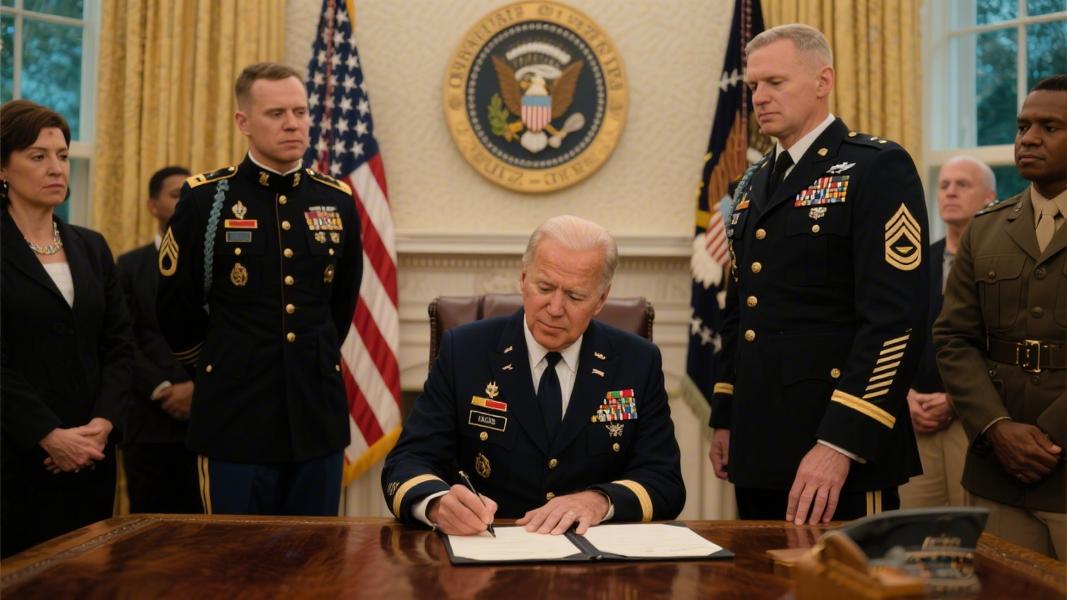
On March 26, 2026, President Biden signed H.R. 3377 into law, authorizing the Medal of Honor for Capers — a retired Marine major whose extraordinary valor during a four-day ambush near Phu Loc, South Vietnam, in the spring of 1967 had gone unrewarded at the nation’s highest level for reasons that have haunted him, and those who served alongside him, ever since. The signing also authorized Medals of Honor for Army veteran Nicholas Dockery, under H.R. 7194, for valor in Afghanistan, and for Marine Colonel John W. Ripley, under H.R. 7211, for his own actions during the Vietnam War.
A Four-Day Fight No One Was Supposed to Survive
Here’s the situation Capers walked into — or rather, was dropped into. From March 31 to April 3, 1967, Capers led Team Broadminded, a nine-man Force Reconnaissance patrol, deep into contested territory near Phu Loc. They were ambushed by a vastly superior enemy force. What followed was the kind of sustained, close-quarters hell that defies clean retelling.
Despite sustaining severe abdominal wounds and a broken leg, Capers refused evacuation. He charged into the ambush to free his pinned-down men, personally ensuring every member of his team reached safety. All nine survived. Every single one of them. That’s not a footnote — that’s the story.
“If I was going to die there in Vietnam, I was going to die fighting,” Capers said, words that cut straight to the bone of who this man is. He didn’t say it boastfully. He said it plainly, the way a Marine does when something is simply true.
The Recommendation That Died in a Helicopter Crash
How does a man do all of that and walk away with a Bronze Star? It’s a question that has dogged this case for decades. After visiting the wounded team, Major General Bruno Hochmuth reportedly intended to recommend Capers for the Medal of Honor. But Hochmuth was killed shortly afterward in a helicopter crash, and with him went the momentum behind that recommendation. The result was a downgraded Bronze Star — an honor that, under any other circumstances, would be something to be proud of, but in this context, felt like an asterisk.
Capers has said as much himself. In a 2018 interview, he noted that while he was proud of his Silver Star, receiving the Medal of Honor would help quiet a nagging concern — that the color of his skin had something to do with what he didn’t receive. It’s a difficult thing to say out loud. It’s a more difficult thing to live with for nearly sixty years.
A Record That Speaks for Itself
Still, the record is staggering. Capers arrived in Vietnam in May 1966, volunteering for the Third Force Reconnaissance Company, where he conducted missions that included underwater diving operations before leading the Phu Loc patrol. Over the course of the war, he led more than fifty long-range reconnaissance missions with Team Broadminded — the kind of deep-penetration operations that most people don’t come back from once, let alone fifty-plus times.
His decorations tell part of the story: the Silver Star, two Bronze Stars with Combat V, three Purple Hearts, the Vietnam Cross of Gallantry, and a string of other commendations. He was also, it should be noted, the first Black enlisted Marine to receive a battlefield commission and the first Black Marine to command a Force Reconnaissance company — milestones that speak to a career defined as much by excellence as by the barriers he quietly demolished along the way.
Congress Moves — Unanimously
The legislative path to this moment wasn’t fast, but when it moved, it moved with rare unanimity. The Senate approved H.R. 3377 unanimously on March 5, 2026, waiving the statutory time restrictions that would have otherwise made Capers’ Medal of Honor consideration legally impossible. That kind of bipartisan consensus doesn’t happen by accident — it happens when the case is, frankly, airtight.
Capers’ story had been championed by advocates, veterans’ organizations, and historians for years. The Pritzker Military Museum & Library, among others, had documented his oral history, ensuring his account wouldn’t be lost to time the way his original recommendation nearly was. Slowly, the machinery of official recognition caught up with what the men of Team Broadminded already knew in April 1967.
What Took So Long
That’s the uncomfortable question underneath all of this. The U.S. military has, in recent decades, conducted extensive reviews of Medal of Honor cases involving Black, Hispanic, and Asian American veterans — reviews that have resulted in posthumous and belated upgrades for dozens of service members whose valor was documented but whose recognition was, at best, delayed and, at worst, deliberately diminished. Capers’ case fits a pattern that the Pentagon has acknowledged, even if no official has ever put it quite that bluntly in a press release.
That said, Capers is alive to receive this honor. He’ll stand — or sit, as he has earned the right to do — and receive the medal from a sitting president. That’s something. That matters enormously, in a way that posthumous recognition, however meaningful, simply can’t replicate.
The Bigger Picture
The three Medal of Honor authorizations signed into law on March 26 — for Capers, Dockery, and Ripley — represent a broader, ongoing national reckoning with how America honors those who served in its name. Ripley, famous for single-handedly destroying the Dong Ha Bridge in 1972 to stop a North Vietnamese armored advance, died in 2008. Dockery’s actions in Afghanistan are part of a more recent chapter in a long line of American wars. Together, the three honorees span generations of service and sacrifice.
But it’s Capers’ story — the nine-man team, the broken leg, the charge into enemy fire, the general who didn’t survive to make his recommendation — that carries the particular weight of history’s unfinished business.
He once said he was going to die fighting if it came to that. It didn’t come to that. And now, fifty-nine years later, the country is finally, officially, saying: we know what you did out there. We always should have.
