
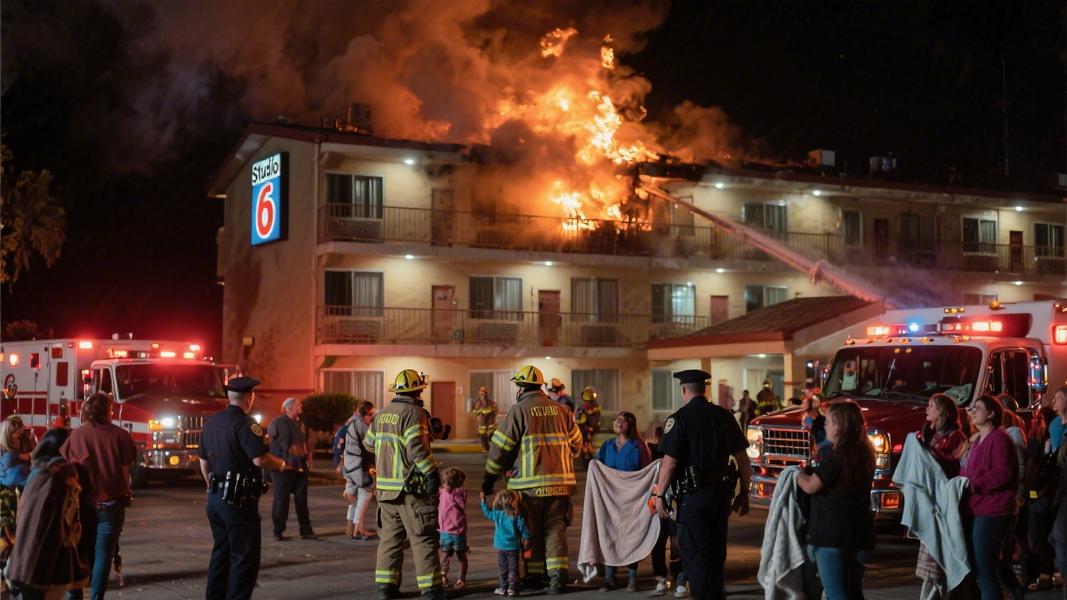
A fast-moving fire tore through a Studio 6 motel late Thursday afternoon, leaving roughly 150 residents without a place to sleep and sending two police officers to the hospital — a chaotic scene that raised urgent questions about safety conditions at extended-stay properties housing some of the region’s most vulnerable residents.
The blaze broke out around 5 p.m. at the Studio 6 location on West Freeway, according to fire officials, and spread quickly through the structure before crews could contain it. By nightfall, displaced residents — many of them long-term tenants who had no other housing option — were standing in parking lots with whatever they’d managed to grab on the way out. For a lot of them, that wasn’t much.
Officers Down, Residents Scattered
Two police officers were hospitalized following the incident. Authorities haven’t released detailed information about the nature of their injuries, but both were reportedly exposed to conditions inside or immediately around the burning structure. It’s a detail that underscores just how dangerous the scene became in those early minutes — before the full scope of the fire was even clear.
The sheer number of displaced residents — 150 people, by the fire department’s count — is what makes this more than a routine structure fire. Extended-stay motels like Studio 6 function, in practice, as de facto affordable housing. The people living there week-to-week aren’t tourists. They’re families, working adults, and individuals in transition who often have nowhere else to turn. When a building like this goes up in flames, it doesn’t just displace people temporarily. It can unravel whatever fragile stability they had.
A Scene That Moved Fast
How quickly did it escalate? Fast enough that emergency responders were still managing active flames while simultaneously trying to account for residents who’d fled in different directions across the property. Coordinating a mass displacement of that scale — in real time, at dusk, with two of your own officers down — is not a clean operation under any circumstances.
Fire crews worked to bring the blaze under control as the evening wore on. The cause of the fire had not been officially confirmed as of late Thursday, and investigators were expected to begin their assessment once the scene was declared safe enough to enter. That’s standard procedure, but it means answers — real ones — could still be days away.
The Bigger Picture
Still, it’s hard to look at an incident like this in isolation. Extended-stay and budget motel fires have drawn increasing scrutiny from fire safety advocates in recent years, who argue that aging properties with high occupancy rates and transient resident populations present a specific — and often underregulated — category of risk. These aren’t buildings designed for long-term habitation, and yet that’s exactly how they’re being used, in city after city, as affordable housing options disappear.
That’s not a knock on any single property or company. It’s a structural problem. And Thursday’s fire is, unfortunately, a vivid illustration of what happens when that problem intersects with a bad day.
What Comes Next
Local emergency management and Red Cross volunteers mobilized to assist displaced residents Thursday evening, working to connect people with temporary shelter resources. Whether those resources are adequate — or whether some of those 150 people end up in genuinely precarious situations over the coming days — remains to be seen.
The two hospitalized officers were listed in stable condition, according to preliminary reports, which is about the best news to come out of an otherwise grim evening on West Freeway.
Investigations into the fire’s origin are ongoing. City officials had not issued a formal statement as of press time, though that’s expected to change as the story develops. Residents and community advocates, meanwhile, aren’t waiting around for a press conference. Some of them are sleeping in cars tonight.
There will be time for official findings and policy conversations later. Right now, the most pressing story is simpler and harder than any of that — 150 people just lost their homes, and most of them didn’t have a backup plan.
