
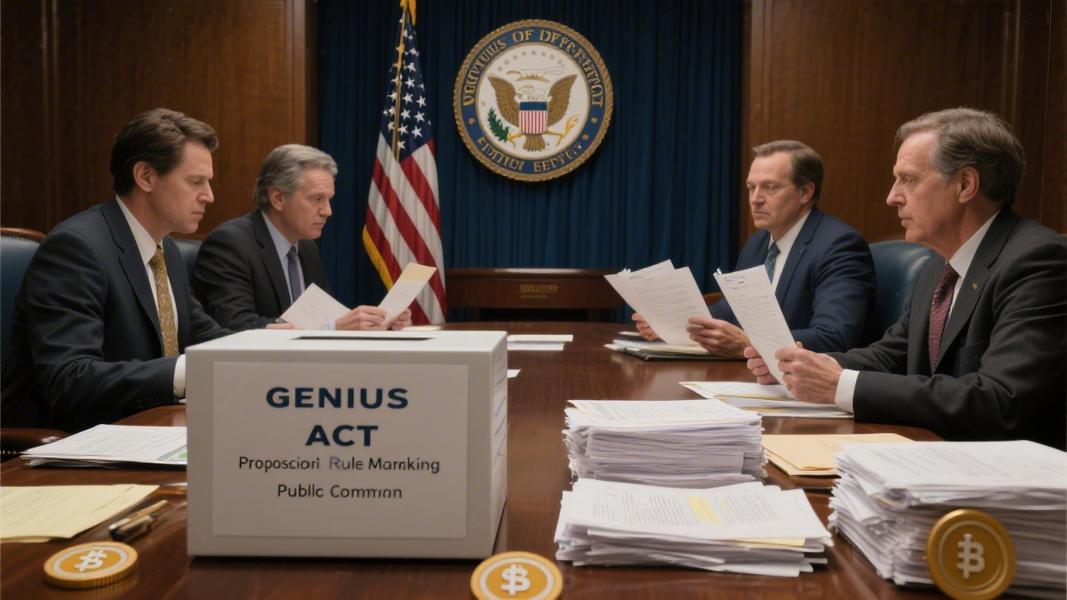
Washington moved fast — and for once, so did the paperwork. The federal government’s rollout of regulations under the GENIUS Act has accelerated into a multi-agency sprint, reshaping how stablecoins will be issued, supervised, and backed in the United States for years to come.
At the center of it all is a landmark piece of legislation that didn’t exist two years ago. President Trump signed the Guiding and Establishing National Innovation for U.S. Stablecoins (GENIUS) Act into law on July 18, 2025, creating the first comprehensive federal framework for payment stablecoin issuers — companies now formally designated as PPSIs. Since then, federal regulators have been racing to fill in the details, and the picture that’s emerging is far more complex than a simple set of rules.
A 376-Page Answer to a Simple Question
How do you regulate digital money that isn’t quite money? Apparently, you start with 376 pages. The Office of the Comptroller of the Currency (OCC) dropped its notice of proposed rulemaking on February 25, 2026, a sweeping document designed to implement nearly every aspect of the GENIUS Act that falls under the agency’s jurisdiction. That’s a lot of ground to cover — examination standards, supervision protocols, capital requirements, revocation procedures, and more.
What the OCC’s proposal doesn’t cover is also worth noting. As the agency made clear in its own bulletin, the rule “addresses all of the regulations the OCC is required to promulgate under the GENIUS Act other than those related to the Bank Secrecy Act, anti-money laundering, and Office of Foreign Assets Control sanctions, which will be addressed in a separate rulemaking in coordination with the Department of the Treasury.” In other words, the BSA and sanctions piece is still coming — just not yet. A separate coordinated rulemaking with Treasury will handle that chapter.
What Counts as a Reserve?
One of the thorniest debates in stablecoin regulation has always been this: what actually backs the coin? The OCC’s February proposal gets specific. It identifies eight permissible reserve asset types for PPSIs — including cash, demand deposits, U.S. Treasury securities with maturities of 93 days or less, and certain repurchase agreements. The requirement is strict: a 1-to-1 backing of outstanding issuance value at all times. No creative accounting, no leverage. Every dollar of stablecoin must be matched by a dollar of qualifying assets, full stop.
That’s a deliberate design choice, and it has real implications for how stablecoin issuers structure their balance sheets. Critics of earlier stablecoin models — think of the 2022 TerraUSD collapse — will recognize the philosophy here. Regulators clearly aren’t in the mood to gamble on algorithmic stability. The framework leans hard into conservative, liquid assets for a reason.
The State vs. Federal Tension
Still, not every stablecoin issuer will fall under the OCC’s direct supervision — and that’s where things get genuinely complicated. The GENIUS Act allows PPSIs with consolidated total outstanding issuance of no more than $10 billion to opt into state-level regulation, provided that the state’s regime is deemed “substantially similar” to the federal framework. It’s a carve-out that could matter enormously for smaller issuers who’d rather deal with Albany or Sacramento than Washington.
But what does “substantially similar” actually mean? That’s exactly what the U.S. Department of the Treasury tried to address on April 1, 2026, when it issued its own notice of proposed rulemaking seeking public comment on the principles that would guide that determination. The notice is essentially an invitation — regulators asking the public and industry to help define the line between a state regime that qualifies and one that doesn’t. The stakes for state-chartered entities couldn’t be higher.
Under the law, eligible entities for PPSI status include subsidiaries of insured depository institutions, federal qualified issuers — such as national trust companies and OCC-regulated nonbanks — and state qualified issuers operating under those substantially similar regimes. The full list published in the Federal Register makes clear this isn’t a one-size-fits-all structure. Different institutions will enter the framework through different doors.
Credit Unions Join the Conversation
It’s not just banks and OCC-regulated entities getting into the game. The National Credit Union Administration (NCUA) announced on February 11, 2026, that it was proposing its own rule governing applications for credit unions seeking to become permitted payment stablecoin issuers. Comments on that proposal were due by April 13, 2026. The announcement was a signal that the GENIUS Act’s reach extends well beyond Wall Street — into the credit union sector that serves tens of millions of everyday Americans.
That’s a notable expansion of the regulatory perimeter. Credit unions aren’t typically the first institutions that come to mind when people think about digital assets. But the NCUA’s move suggests regulators want a broad tent — and that the stablecoin economy, if it takes off, won’t be the exclusive territory of major banks and fintech giants.
Risk Assessments and What Comes Next
Treasury hasn’t just been writing rules. In March 2026, the department also published National Risk Assessments examining illicit finance threats tied to stablecoins — a document that frames the entire regulatory effort in terms of what can go wrong if oversight fails. It’s a reminder that this isn’t purely a financial innovation story. Money laundering, sanctions evasion, and fraud are very much part of the conversation, even if the BSA/AML rulemaking is still pending.
The Sullivan & Cromwell team tracking the legislation has noted the complexity of the $10 billion threshold and the state-election mechanism, calling it one of the more consequential structural choices embedded in the Act. Davis Polk analysts, meanwhile, have flagged the sheer scope of the OCC’s February proposal as a sign that the agency is moving to establish itself as the dominant federal supervisor in this space — at least for the near term.
The comment periods are closing. The rules are taking shape. And the stablecoin industry — which has spent years operating in a regulatory gray zone — is finally learning what it actually means to be regulated. Whether that’s a relief or a reckoning may depend entirely on which side of the $10 billion threshold you happen to sit on.
