
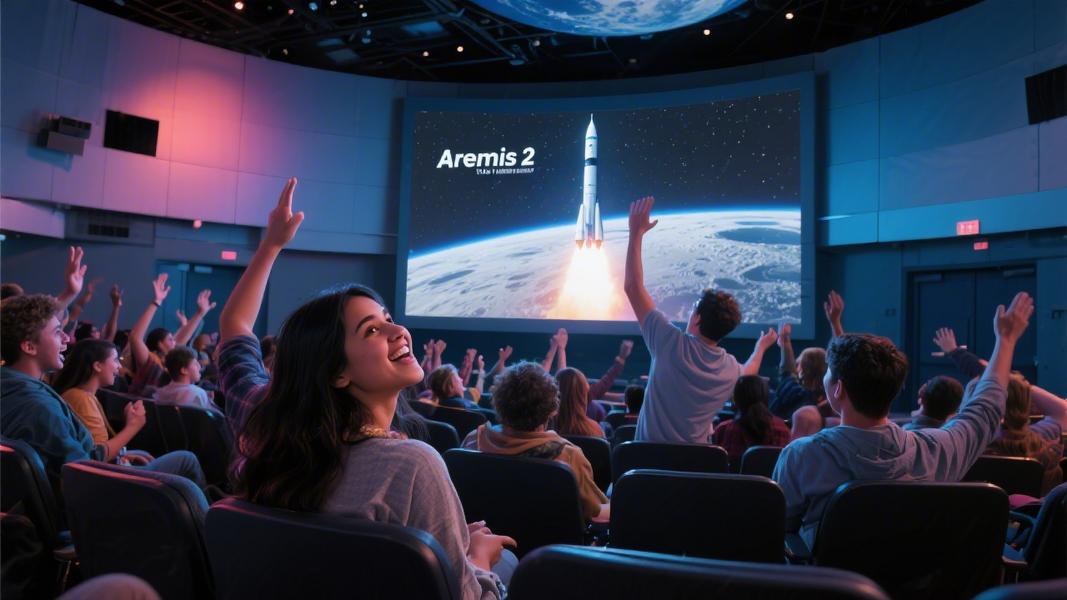
For the first time in more than half a century, human beings are headed back toward the moon — and this time, they’re bringing the whole world along for the ride.
NASA’s Artemis II mission lifted off Wednesday evening, April 1, 2026, marking one of the most significant moments in spaceflight history. It’s not just a return to deep space. It’s a statement — about ambition, about partnership, and about what comes next for humanity beyond low Earth orbit.
A Crew Built for History
Four astronauts are aboard the Orion spacecraft for this lunar flyby. Reid Wiseman commands the mission, with Victor Glover as pilot and Christina Koch rounding out a crew of seasoned NASA veterans. But it’s the fourth seat that’s drawing particular attention — and not just from space enthusiasts.
Jeremy Hansen, 50, from London, Ontario, is serving as mission specialist. He’s a Canadian Space Agency astronaut, a former fighter pilot, and — as of Wednesday evening — the first non-American ever to travel beyond low Earth orbit. That’s not a footnote. That’s a milestone that rewrites the record books entirely.
Think about what that means for a moment. Since the dawn of human spaceflight, every person who has ventured past the boundary of Earth’s immediate neighborhood has carried an American flag on their sleeve. Hansen changes that — permanently. Whatever happens next, his name is already etched into history.
Why This Mission Matters
Artemis II isn’t a moon landing — that’s Artemis III’s job. This is a crewed lunar flyby, a critical shakedown of the Orion capsule and Space Launch System under real deep-space conditions with real human lives aboard. It’s the kind of mission NASA has to get right before it can get to the next one.
Still, the symbolic weight is enormous. The last time astronauts traveled this far from Earth was December 1972, when Apollo 17’s crew splashed down and the curtain fell on a program that had defined a generation. More than 50 years of silence followed. Fifty years of robotic probes, orbital stations, and incremental steps — but no human being looking back at the full disc of Earth from lunar distance.
That changes now.
Canada’s Moment
Hansen’s inclusion is the result of a formal partnership between NASA and the Canadian Space Agency — part of the broader international framework underpinning the Artemis program. But knowing the diplomatic backstory doesn’t make the image any less striking: a kid from London, Ontario, circling the moon.
He will be joined, as broadcast coverage confirmed ahead of liftoff, by Wiseman, Glover, and Koch — three astronauts who collectively bring decades of spaceflight experience to a mission that demands exactly that. There’s no margin for on-the-job learning this far from home.
What Comes Next
A successful Artemis II sets the stage for Artemis III, which would put boots on the lunar surface — specifically near the moon’s south pole, a region scientists believe holds deposits of water ice that could one day support long-term human presence. That’s the bigger picture NASA is working toward, even if Wednesday’s mission is its own complete chapter.
But it’s not that simple. Artemis has faced years of delays, cost overruns, and political headwinds. The program has survived budget battles, a change in administration, and no shortage of skeptics who questioned whether it would ever get this far. Wednesday evening’s launch doesn’t answer all of those questions. What it does is make them considerably harder to ask.
Fifty-three years is a long time to wait. And somewhere over the Pacific, four astronauts are about to find out what the moon looks like up close — one of them for the first time, and all of them for the first time in a very, very long time for the human race.
