
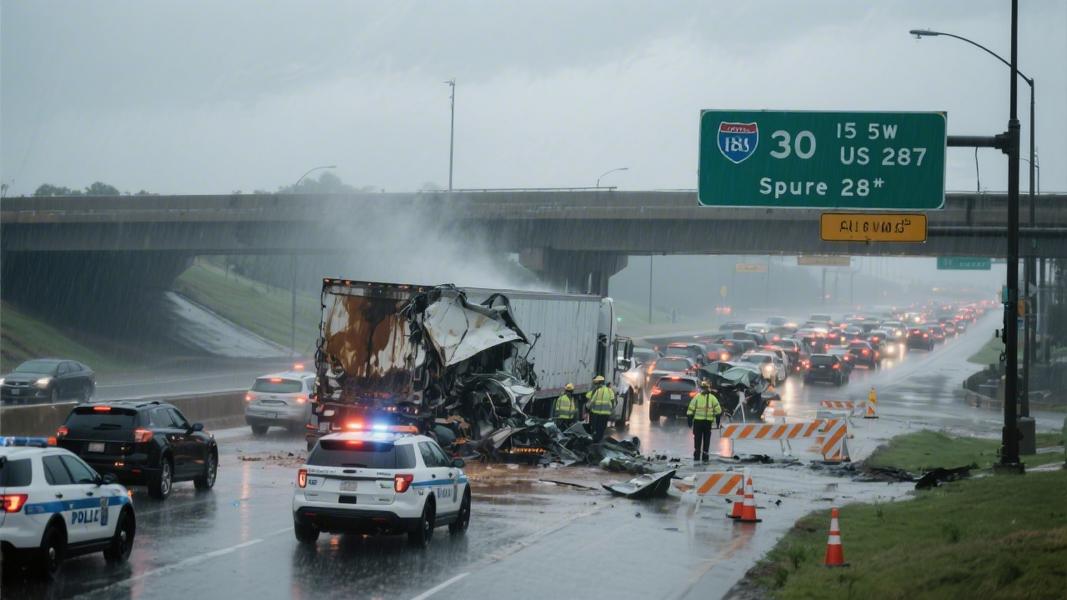
Two major highways in the Dallas-Fort Worth metroplex turned into parking lots — and worse — after a pair of serious crashes struck during a rain-soaked morning commute, leaving investigators piecing together what went wrong on some of the region’s busiest corridors.
The incidents, occurring on Interstate 30 and Interstate 35W, snarled traffic for hours and raised fresh concerns about driver behavior in wet conditions. An 18-wheeler was involved in at least one of the collisions, and a diesel spill complicated cleanup efforts, forcing hazmat crews onto the scene alongside first responders already stretched thin across the two crash sites.
A Morning Commute That Went Sideways — Fast
It’s worth understanding just how quickly these situations can cascade. One moment, traffic is moving. The next, a single vehicle loses control on a slick surface, and suddenly you’ve got a chain reaction that no amount of rush-hour planning can fully absorb. That’s what appears to have happened here — rain-slicked pavement doing what it always does when drivers don’t adjust their speed accordingly.
The 18-wheeler involvement adds a layer of severity that smaller vehicle crashes simply don’t carry. A fully loaded commercial truck can weigh upward of 80,000 pounds. When one of those goes down on an interstate, it doesn’t just block lanes — it reshapes them. The diesel spill reported at the scene meant that even after the immediate emergency passed, the roadway itself remained a hazard, requiring specialized crews and significantly extending closure times.
Context: DFW’s Crash Problem Isn’t New
This didn’t happen in a vacuum. The Dallas-Fort Worth area has seen a troubling pattern of high-profile highway crashes in recent months. Just days earlier, authorities were still processing the aftermath of a wrong-way crash on the Dallas North Tollway on February 16, 2026 — a collision that drew widespread attention and renewed calls for better highway safety infrastructure across North Texas. That incident, like this one, unfolded on a corridor that sees some of the heaviest commercial and commuter traffic in the state.
Then there was the high-speed crash in San Antonio on February 7, 2026 — a reminder that this isn’t strictly a Dallas problem. Texas highways, broadly speaking, have been a recurring flashpoint. The state consistently ranks among the highest in the nation for traffic fatalities, and wet-weather incidents account for a disproportionate share of those numbers. Still, knowing the statistics doesn’t make any individual crash easier to process — especially for the families waiting for word on survivors.
What Investigators Are Looking At
So what actually caused this? That’s the question authorities were working to answer as lanes slowly reopened. Speed in adverse weather conditions is almost always the first variable investigators examine. Following distance is the second. With an 18-wheeler in the mix, federal regulations around commercial driver hours and vehicle maintenance records will likely factor into any formal inquiry as well.
The diesel spill adds a separate but related thread. Depending on volume and spread, a spill of that kind can trigger environmental reporting requirements on top of the standard crash investigation. It’s a bureaucratic reality that tends to surprise people — the legal and regulatory machinery that kicks in after a commercial vehicle incident is considerably more complex than what follows a standard passenger car collision.
The Human Cost, Beyond the Traffic Maps
Here’s the thing about crash coverage that can get lost in the traffic-alert framing: there are real people at the center of every one of these incidents. Commuters frustrated by the backup are one story. The individuals directly involved — drivers, passengers, first responders who arrive on scenes that are still actively dangerous — are another story entirely, and often the more important one.
Emergency personnel responding to a diesel spill on a wet interstate aren’t working in a controlled environment. They’re working in the same conditions that caused the crash in the first place. That’s a detail that tends to get buried under lane-closure updates and estimated reopening times, but it matters. It matters quite a bit, actually.
What Comes Next
Texas Department of Transportation officials and local law enforcement agencies were expected to provide updated information as investigations progressed. Whether any citations or charges follow will depend heavily on what the evidence shows about speed, road conditions, and driver conduct in the moments before impact.
Broader policy conversations — about highway design, commercial vehicle regulations, and wet-weather speed limits — tend to flare up after incidents like this and then quietly fade. The more cynical observers of Texas transportation policy will tell you that’s been the pattern for years. Whether this latest cluster of crashes produces anything more durable remains to be seen.
For now, the roads are open again. But the questions they leave behind aren’t going anywhere quite so quickly.
