
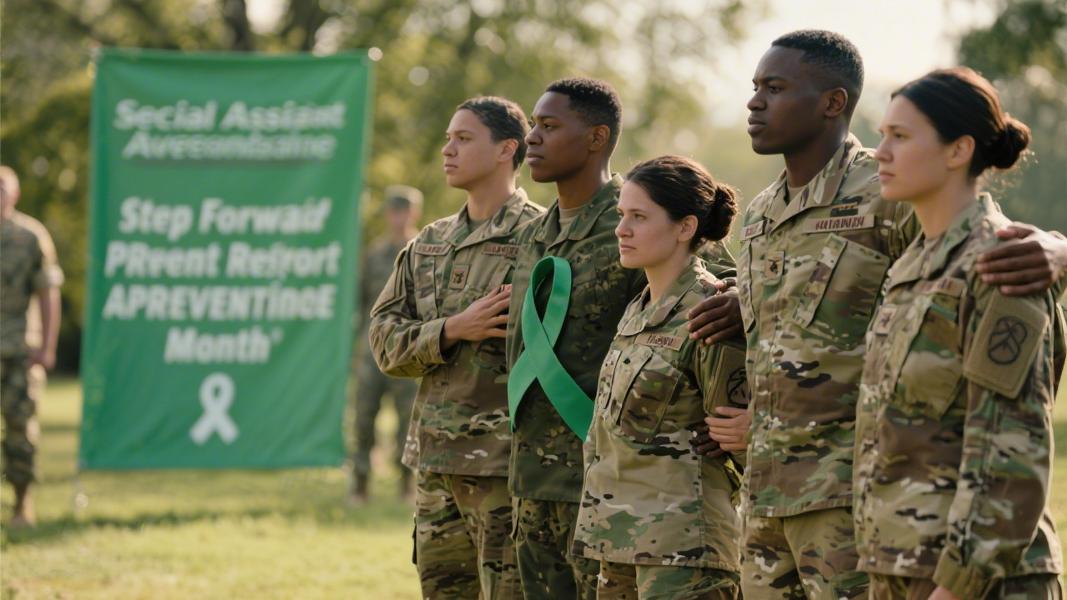
The numbers are hard to ignore — and this April, the Pentagon isn’t trying to.
The Department of War has formally recognized April as Sexual Assault Awareness and Prevention Month, renewing its commitment to confronting one of the military’s most persistent and damaging internal crises. The effort isn’t symbolic window-dressing. Officials say it’s tied directly to something the armed forces care about above almost everything else: readiness.
A Campaign With Teeth — Or At Least a Name
This year’s awareness campaign carries the banner “STEP FORWARD: Prevent. Report. Advocate.” The message is aimed squarely at the Total Force — active duty, reserve, and civilian personnel alike — and calls on every member to confront harmful behaviors before they escalate. It’s a cultural ask as much as a policy one, and senior officials aren’t mincing words about what’s at stake.
“Sexual assault is unacceptable, period, and has no place in our military,” said Anthony J. Tata, under secretary of war for personnel and readiness. “It is contrary to our institutional values, the warrior ethos, and our overall readiness.” That last word — readiness — keeps coming up. It’s not accidental.
Dr. Nate Galbreath, director of the Department’s Sexual Assault Prevention and Response Office, put it in starker terms. “The warrior ethos demands integrity, honor, and courage — on and off the battlefield,” he said. “Sexual assault violates every one of those values.” It’s the kind of statement that reads like a rebuke — because it is one.
The Data: A Dip, But Not a Victory Lap
How bad is it? In fiscal year 2024, the Department received 8,195 reports of sexual assault — a decrease of 320 from the previous year. That’s documented in the Pentagon’s most recent annual report on the subject, and officials were careful not to oversell the progress.
Still, context matters. Back in fiscal year 2017, military services received 6,769 reports of sexual assault involving service members. Defense Secretary James N. Mattis, writing at the time, called prevention “our moral duty.” The number has since climbed — significantly — even as reporting mechanisms improved and stigma, officials argue, has slowly decreased. It’s a complicated picture. More reports can mean more trust in the system, or simply more incidents. Probably both.
Galbreath addressed the readiness dimension directly during a media briefing tied to the FY 2024 report. “DOD remains committed to sexual assault prevention and response,” he told reporters, “and the data that we’ve shown you in this year’s report provides clear evidence of the connection between sexual assault and readiness.” That framing — linking assault not just to justice but to operational capability — represents a deliberate shift in how the Pentagon talks about the issue publicly.
A New Award Enters the Picture
Beyond the awareness campaign, the DoD has announced something new: the first-ever Sexual Assault Prevention Innovation Award, designed to recognize individuals and units making measurable contributions to prevention goals. It’s a move that signals the Department wants to reward proactive culture change, not just compliance.
Army Col. Litonya Wilson, deputy director of DoD’s Sexual Assault Prevention and Response Office, pointed to the collaborative thinking behind it. “Insights from the experts were instrumental in ensuring the department tapped into existing proven prevention strategies,” she noted. The award is meant to institutionalize innovation — to make prevention something units compete to get right, not just survive inspections over.
Service Academies, Oversight, and the Long Road
The Department has also continued its oversight of military service academies, releasing its annual report on sexual harassment and violence covering Academic Program Year 2021–2022. Academies have long been flashpoints in this debate — institutions that shape the next generation of officers, where culture is arguably forged most deeply and, critics say, where old habits die hardest.
That’s the catch, really. Campaigns, awards, and annual reports are tools. But the Pentagon has been issuing them for decades, and the numbers — while recently ticking down — remain stubbornly high. The question officials can’t fully answer in a press release is whether the culture itself is changing, or whether the machinery around it is simply getting more sophisticated.
For now, the banners go up, the theme rolls out, and 8,195 people from last year’s report serve as a reminder that awareness months are only meaningful if the other eleven months follow through.
