
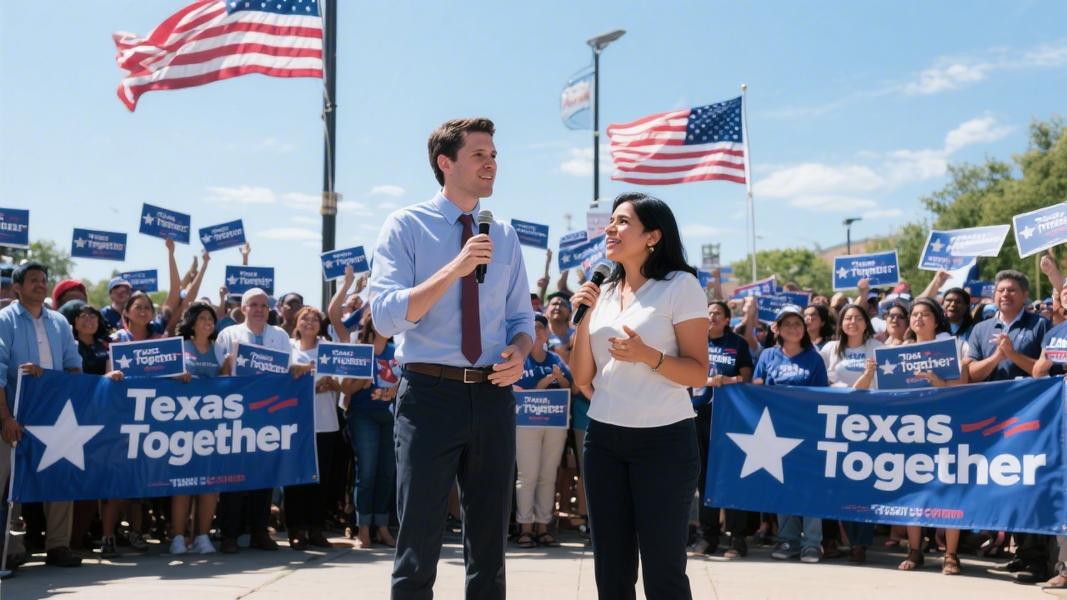
Texas Democrats are done playing it quiet. With joint rallies, surging primary numbers, and a coordinated statewide strategy they’re calling “Texas Together,” the party is making its loudest push in a generation — and this time, they think the math might actually work.
The campaign kicked off last month in Fort Worth, where hundreds of supporters packed a rally to hear from the party’s top nominees: State Rep. James Talarico, running for U.S. Senate, and State Rep. Gina Hinojosa, who’s seeking the governorship. The idea is straightforward, if ambitious — stop running fragmented, candidate-by-candidate campaigns and instead build a unified operation that pools money, energy, and attention ahead of the November 2026 midterms. Democrats haven’t won a statewide race in Texas since 1994. That’s not a typo.
A Flip in Fort Worth Changes the Calculus
Talarico didn’t mince words at the Fort Worth launch. “You shocked the nation by flipping a state Senate seat here in Fort Worth,” he told the crowd. “In November, we’re going to shock the world by flipping a U.S. Senate seat here in Texas.” That line landed — because the flip he’s referencing is real. State Sen. Taylor Rehmet recently flipped a GOP-majority Senate district in Tarrant County, a win that rattled Republican strategists and gave Democrats something they’ve been short on for years: a recent, local proof of concept.
Tarrant County was long considered solid red. The fact that it isn’t anymore — or at least not entirely — is the kind of data point that fuels a broader argument. If a state Senate seat can flip in a suburban Dallas-Fort Worth district, why not a U.S. Senate seat in a midterm environment where the incumbent party is absorbing political headwinds?
The Conditions Are Different This Cycle. Maybe.
That’s the case Democrats are making, anyway. And they’ve got a few things working in their favor. President Trump’s approval ratings have softened in key Texas suburban corridors. On the Republican side, Ken Paxton — still dogged by legal baggage — is viewed by many Democrats as a potential general-election vulnerability if he secures the GOP nomination for Senate. It’s not a sure thing, but it’s a window.
Still, Texas is Texas. It’s a massive, expensive state to run in, and Democrats have convinced themselves before that the map was shifting, only to fall short on Election Night. The enthusiasm has to translate — and that’s where the ground-level numbers get interesting.
Rio Grande Valley Numbers That Are Hard to Ignore
In the Rio Grande Valley — a region that showed unexpected movement toward Republicans in 2020 and 2022 — Democratic primary turnout more than doubled compared to 2024 levels across Cameron, Starr, Hidalgo, and Willacy counties. For a party that watched parts of the Valley drift rightward under Trump, that reversal is significant. One Valley Democrat put it bluntly to reporters: “This is just the official rebuke of the Trump administration and the Republican party.”
Whether that energy holds through November is the real question. Primary enthusiasm and general election turnout are two very different animals. But doubling your numbers in a region you were losing? That’s not nothing.
Big Names, Big Rooms
The Dallas County Democratic Party has been running hot, too. Conventions have drawn strong attendance, and the party has brought in heavy hitters — Governor JB Pritzker of Illinois and Governor Gavin Newsom of California — to stoke turnout and signal that national Democrats are watching Texas closely. One party official noted the mood plainly: “It shows that the parties are energized, that their bases are energized, that folks are really paying attention and keyed into what’s happening in the spring, gearing up for November.”
Pritzker and Newsom aren’t showing up in Dallas for the barbecue. Their presence signals something — either genuine belief that Texas is in play, or at minimum, a desire to make Republicans spend money defending a state they’ve taken for granted.
Austin and Beyond
The Texas Together rally circuit continued in Austin, where Hinojosa was joined by John Bucy and other down-ballot candidates in what organizers framed as a unifying moment for the state party. The goal, according to event organizers, is to build a coordinated infrastructure — not just a series of individual campaigns running parallel to each other with no shared strategy.
That coordination piece is arguably as important as any single candidate or rally. Texas Democrats have historically struggled with cohesion at the statewide level. Running separate campaigns in a state this size burns money fast and leaves voters with no clear, unified message. Texas Together is a direct attempt to fix that — or at least to look like they’re fixing it before November.
The strategy is ambitious, the energy is real, and the structural challenges haven’t gone away. But for the first time in a long time, Texas Democrats aren’t just hoping for a blue wave — they’re trying to build one from the ground up, county by county, rally by rally. Whether that’s enough to end a 30-year drought is the only question that matters come November.
