
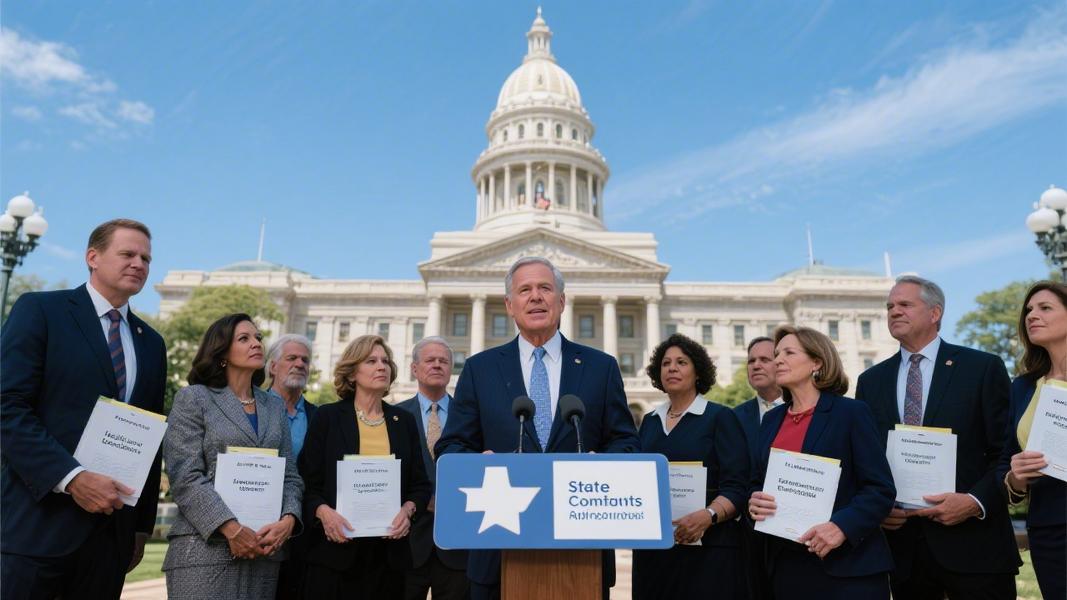
Texas Governor Greg Abbott has been busy — very busy. In a flurry of appointments spanning the final days of March and the first days of April, Abbott reshuffled and reinforced the rosters of nearly a dozen state boards and commissions, touching everything from prison health care to public education to water management.
The moves, announced across several consecutive days, represent one of the more concentrated bursts of gubernatorial appointment activity in recent memory. Taken together, they signal Abbott’s continued effort to stamp his imprint on the administrative machinery of Texas government — and to ensure that key oversight bodies are staffed with aligned, credentialed personnel heading into the latter half of the decade. Most of the terms run through 2029 or 2031, meaning these picks will outlast the current political moment by years.
Prison Health Care Gets a Fresh Look
Among the most consequential moves: Abbott appointed Brandon Cantazaro, M.D. and Robert Suter, D.O. to the Correctional Managed Health Care Committee, while simultaneously reappointing Robert “Bobby” Greenberg, M.D. and Divyansu Patel, M.D. to the same body. All four terms expire February 1, 2029. The committee oversees health care delivery for the roughly 130,000 people incarcerated in Texas state prisons — a sprawling, chronically underfunded system that has drawn persistent scrutiny from advocates and federal monitors alike.
Patel’s reappointment is particularly notable. He was previously appointed in December 2024 to a short-term slot expiring February 1, 2025 — essentially a placeholder. This latest action locks him in for a full four-year stretch, suggesting Abbott’s office sees him as a longer-term fixture on the committee.
That’s not nothing. Correctional health care in Texas has been a flashpoint for litigation and legislative criticism for years, and who sits on this committee matters in ways that don’t always make the front page.
Education Boards See Significant Turnover
Abbott also made a wave of changes to the Special Education Continuing Advisory Committee, appointing Rebecca Faulkner, Felicia Penn, and Kristen Tuttle Urbanovsky, while reappointing Claudia Cavazos, April Estrada, Ed.D., and Amy Litzinger — all for terms running through February 1, 2029. The committee advises the Texas Education Agency on policies and programs affecting students with disabilities, a constituency that’s grown louder and more organized in demanding accountability from state officials.
Separately, Abbott reappointed Aaron Kinsey as Chair of the Texas State Board of Education, extending his leadership through April 1, 2028. Kinsey has been a polarizing but durable force on the board, which has become a recurring battleground over curriculum standards, textbook content, and the boundaries of public school instruction. His continued chairmanship ensures that dynamic isn’t going anywhere. A Houston outlet noted the broader wave of appointments as part of Abbott’s ongoing reshaping of state oversight bodies.
Criminal Justice and Mental Health Advisory Roles Filled
On April 1 — and no, the timing doesn’t appear to be a joke — Abbott appointed Blake Harris, Ph.D. and Stacey Mathews to the Advisory Committee to the Texas Board of Criminal Justice on Offenders with Medical or Mental Impairments, while reappointing Trent Marshall and Casey O’Neal, Ph.D. All four terms run through February 1, 2031. The committee advises on policy for incarcerated individuals whose medical or psychiatric conditions require special consideration — a population that’s both vulnerable and, historically, underserved.
Still, advisory committees are exactly what the name suggests. They advise. Whether their recommendations translate into meaningful policy shifts depends heavily on who’s listening — and right now, that means Abbott’s office and the Board of Criminal Justice itself.
Water, Archives, and the Judiciary
Not all of the appointments carry the same ideological weight, but they’re no less consequential for the communities they affect. Abbott named Philip George to the Upper Neches River Municipal Water Authority Board of Directors for a term through February 1, 2031, and tapped Gary Krause and Eliza Santos McElhaney for the Nueces River Authority Board of Directors — also through 2031. Water rights and river management are, in Texas, never just administrative. They’re political, economic, and increasingly urgent in an era of prolonged drought and population growth.
Abbott also appointed Monte Monroe, Ph.D. and Leslie Recine to the Texas State Library and Archives Commission, with terms running through September 28, 2031. And he reappointed Alfonso Charles as Presiding Judge of the Tenth Administrative Judicial Region — a term that runs four years from the date of qualification, keeping Charles at the helm of a region that encompasses a significant swath of East Texas courts.
The Texas Register has separately documented Abbott’s broader administrative activity in recent weeks, including directives related to health care providers and state capitation payments — a reminder that appointment announcements are just one thread in a much larger administrative tapestry.
The Bigger Picture
What does it all add up to? In isolation, each of these appointments looks routine — the ordinary machinery of state government turning over, terms expiring, new names cycling in. But zoom out, and a pattern emerges: Abbott is methodically seeding boards that will shape Texas policy on health care, education, water, criminal justice, and the judiciary well into the next decade, often with a mix of fresh faces and trusted veterans.
Whether that’s reassuring or alarming probably depends on where you sit. But one thing’s certain — these boards don’t operate in the abstract. The people appointed to them make decisions that affect millions of Texans who’ll never know their names.
That’s how governance actually works. Quietly, on a Tuesday, with a press release most people won’t read.
