
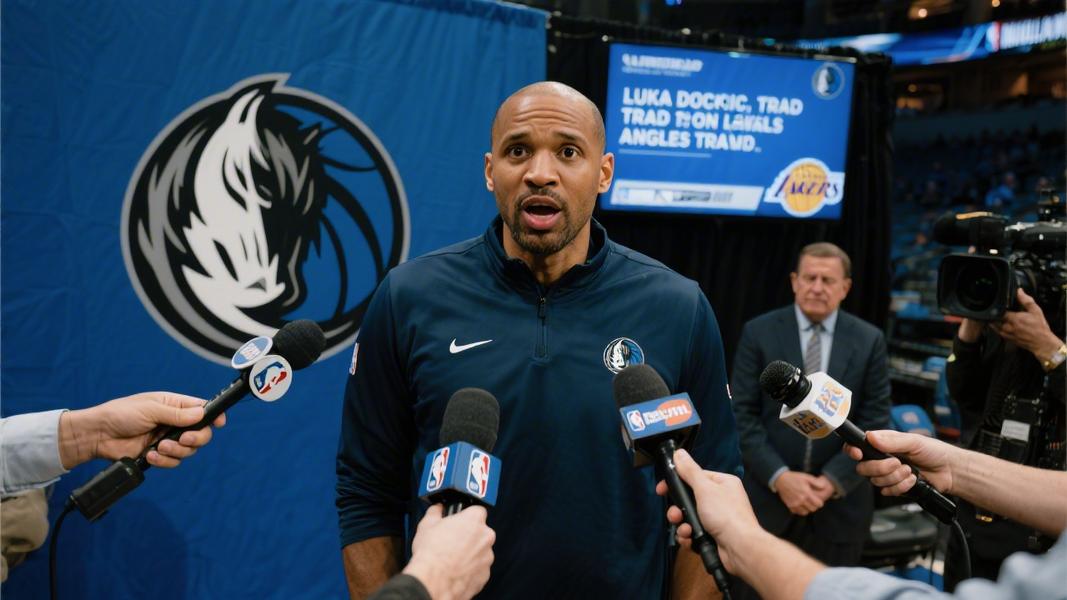
Jason Kidd didn’t see it coming. And when he finally did, he didn’t exactly move to stop it.
The Dallas Mavericks‘ stunning decision to trade franchise cornerstone Luka Dončić to the Los Angeles Lakers in exchange for Anthony Davis sent shockwaves through the NBA — but few were more caught off guard than the man tasked with coaching Dončić every night. Head coach Jason Kidd has now confirmed publicly that he was informed of the blockbuster deal at the absolute last moment, raising serious questions about the organization’s internal communication, its chain of accountability, and what exactly went wrong behind closed doors in Dallas.
Blindsided at the Eleventh Hour
Kidd didn’t mince words when describing how he found out. Pressed by reporters, he said simply: “Eleventh hour. Just got a call to come up to the room and was told about the trade.” That’s it. No advance consultation. No back-and-forth about the franchise’s direction. A phone call, a room, and a fait accompli.
Dončić, it’s worth remembering, is a five-time All-NBA First Team selection and just 25 years old — the kind of generational talent most franchises spend decades trying to find, let alone keep. Trading him for Davis, a player with a long injury history, is the sort of move that demands explanation at every level of an organization. Kidd, apparently, wasn’t part of that conversation until the ink was nearly dry.
Still, what’s almost as striking as the timing is what Kidd did — or didn’t do — once he found out. ESPN’s Tim MacMahon noted that while Kidd acknowledged learning about the deal late, his response was decidedly passive: “J-Kidd says he didn’t know about it until the eleventh hour, I’ll just say my understanding is he didn’t exactly toss himself in front of the oncoming train to try to prevent it from happening.” That’s a pointed observation — and one that’s lingered in the discourse ever since.
The Coach vs. The Decision-Maker
So why didn’t Kidd push back? His answer is carefully constructed. “I’m the coach. I’m not the decision-maker. I’m here to coach the team that’s given to me, and then I’m judged on that by you guys,” he explained. It’s a clean line — almost too clean. There’s something philosophically tidy about it that doesn’t quite square with the chaos of what actually unfolded.
That’s the catch. A head coach of a contending NBA franchise isn’t just a tactician drawing up plays. He’s a relationship manager, a voice in personnel discussions, a cultural steward. The idea that Kidd was entirely walled off from a trade of this magnitude — and then, upon learning of it, simply accepted the outcome — speaks either to a profound dysfunction in the Mavericks’ front office structure, or to a coach who understood exactly where the wind was blowing and chose not to stand against it.
Cuban Complicates the Narrative
Former owner Mark Cuban hasn’t stayed quiet, either. Cuban recently suggested that the responsibility for the trade doesn’t rest solely with general manager Nico Harrison, arguing that “the head coach and general manager didn’t have enough justification for trading Dallas’ best player.” That’s a notable statement — one that implicates Kidd in the decision, or at least in the failure to resist it, even as Kidd himself has drawn a sharp line between coaching and front-office authority.
Kidd, for his part, pushed back on Cuban’s framing. “Blindsided, maybe, that’s a good way to put it,” he said, before adding: “When I found out about it, I just looked at it as this is Cuban, and he has a right to his opinion. But I’m here to tell you the truth… they found out at the 11th hour.” The word “they” is doing a lot of work in that sentence. It suggests a broader circle of people left in the dark — not just Kidd, but others close to the basketball operation.
New Ownership, New Direction
The trade was ultimately approved under new team governor Patrick Dumont, whose family — the Adelson family — took over controlling ownership of the franchise after Cuban’s departure. Whatever the internal politics, the deal reflects a new era of Mavericks leadership, one that was clearly willing to make an aggressive, polarizing move without seeking broad consensus from the coaching staff.
Kidd has been careful not to bite the hand that now feeds him. He expressed clear support for the new regime, saying he believes “we have the best owner in the league.” It’s the kind of statement that closes doors rather than opens them — a deliberate signal that he’s moving forward, not relitigating the past.
What It Means Going Forward
Does any of this matter now? The trade is done. Dončić is a Laker. Davis is in Dallas. The Mavericks are trying to build something new around a 31-year-old big man with a history of soft-tissue injuries, and Kidd is the one who has to make it work on the floor. Whatever was said — or not said — in that room at the eleventh hour, it’s now in the past.
But the questions raised by this saga don’t disappear cleanly. If a head coach can be kept in the dark about the single most consequential personnel decision in franchise history, what does that say about how decisions actually get made in Dallas? And if Kidd knew, even briefly, and still didn’t object — what does that say about him?
Maybe the most honest thing Kidd said in all of this was also the simplest: “I’m the coach.” In the end, that might be exactly as much — and as little — as the job turned out to be.
