
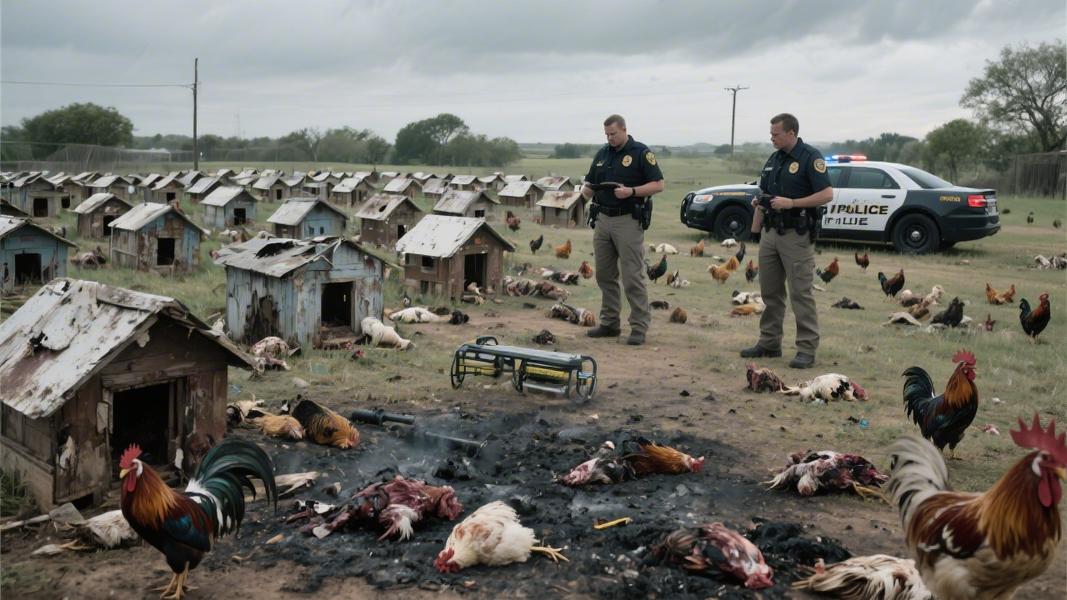
More than 500 birds. Burned feathers. Severed spurs. And a cockfighting operation so sprawling it took multiple law enforcement agencies to dismantle it. North Texas is at the center of a growing crackdown on illegal animal fighting rings — and authorities say they’re just getting started.
Ernesto Rocha Ramirez was arrested after investigators uncovered what they described as a systematic torture operation hidden across Parker County, Texas. Over 200 chicken coops were found on the property, along with dead, burned, and badly injured birds bearing the unmistakable signs of organized cockfighting: live plucking, artificially shortened spurs, and evidence of steroid use to make the animals fight harder and longer. Immigration and Customs Enforcement later detained Ramirez, adding a federal dimension to what had already become a significant local case, as reported by CBS News Texas.
A Massive Seizure, County by County
The Parker County Sheriff’s Office moved quickly. Deputies initially seized 28 roosters and 14 hens, but that was only the beginning. Working alongside Animal Investigations and Response, they eventually recovered an additional 359 birds — a haul that underscored just how large the operation had grown before anyone noticed. Sheriff Russ Authier didn’t mince words. “Whether it swims, flies, walks, or crawls, we take animal cruelty cases very seriously here in Parker County,” he said. “Anyone who disregards that will be held accountable.”
Parker County wasn’t alone. In a separate investigation, the SPCA of Texas and Dallas police descended on a property inside the city, seizing 133 birds in total — 123 roosters, eight hens, and two roosters that were already dead, as documented in footage from the scene. Two major metropolitan counties, hundreds of animals, and what appears to be a deeply entrenched underground network. That’s not a coincidence. That’s infrastructure.
What the Law Actually Says
Here’s the thing about cockfighting in Texas — it isn’t some legal gray area. The state explicitly prohibits it under the Texas Penal Code, and it defines torture broadly: any act that causes unjustifiable pain qualifies, according to legal analysis published by the Texas Tech Law Review. Punishments vary depending on severity. On the lower end, offenders face up to one year in jail and a $4,000 fine. On the higher end — say, for running an organized operation — that climbs to 10 years in prison and a $10,000 fine, as outlined by Dallas County’s animal cruelty division.
Other states take an even harder line. In North Carolina, for example, malicious torture or cruel beating of an animal isn’t just a misdemeanor — it’s a Class H felony. The statute is blunt about it: “If any person shall maliciously torture, mutilate, maim, cruelly beat, disfigure, poison, or kill… any animal, every such offender shall for every such offense be guilty of a Class H felony,” as the state’s animal cruelty code reads. Cockfighting itself carries a separate misdemeanor charge on top of that.
Federal Law Exists. Enforcement Is Another Story.
How bad is the gap between law and reality? Pretty bad, it turns out. Federal statutes prohibit egregious animal cruelty including cockfighting — but between 2015 and 2019, fewer than 200 defendants were charged under those laws nationwide, according to data compiled by the Center for a Humane Economy. That’s across five years, across the entire country. For an activity that animal welfare advocates say operates in the thousands of locations, the prosecution numbers are startlingly thin.
Still, cases like the ones in Parker County and Dallas suggest something may be shifting — at least at the local level. Sheriffs are speaking publicly. Multiple agencies are coordinating. ICE is involved. Whether that momentum translates into sustained enforcement, or whether it fades once the cameras move on, is the real question.
Five hundred birds don’t end up in coops by accident. Someone built this. And for a long time, apparently, someone let it run.
