
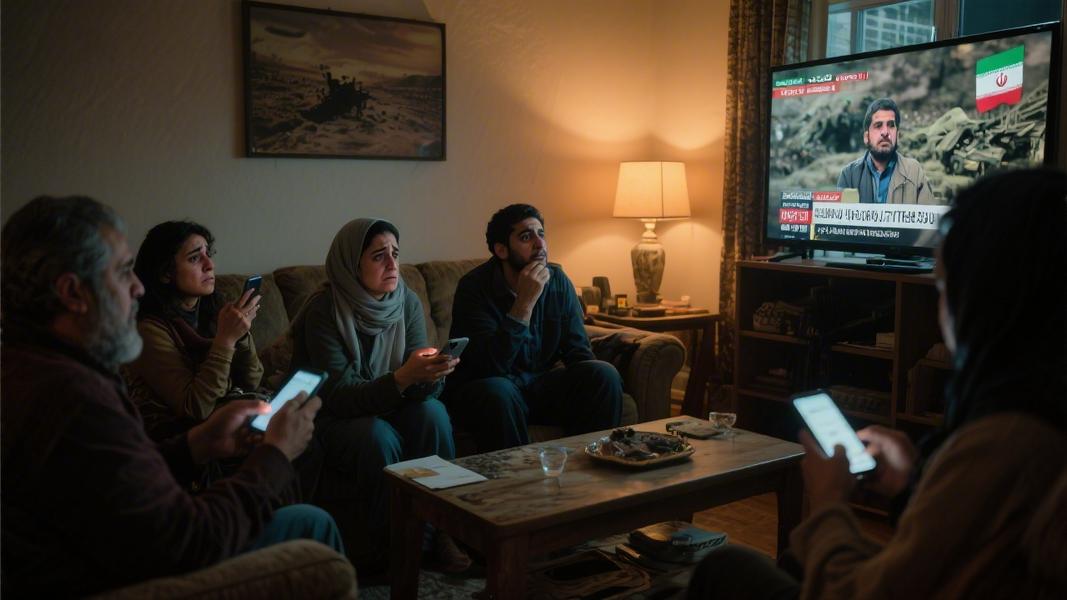
Hundreds of Iranian Americans flooded the streets of Plano and Dallas this weekend, waving flags and chanting for regime change — and for the first time in decades, many of them believe it might actually happen.
The rallies came in the immediate aftermath of a joint U.S. and Israeli military operation dubbed “Epic Fury,” launched early Saturday, which targeted Iran’s leadership structure and, according to multiple reports, killed Ayatollah Ali Khamenei. For North Texas’s Iranian American community — one of the largest in the country — the news landed like nothing they’d experienced in their lifetimes. Some wept. Others danced.
A Country Already on the Edge
To understand why the reaction here was so visceral, you have to understand what’s been happening inside Iran for weeks. Anti-government protests have consumed the country, and the crackdown has been staggering in its brutality. Witnesses say morgues are overwhelmed with the bodies of executed demonstrators. Estimates put the death toll at roughly 20,000. That’s not a protest anymore. That’s a massacre.
Meanwhile, the regime’s grip on information has tightened to the point of near-total blackout. One demonstrator at the Dallas rally described the eerie, one-sided nature of communication with family still in Iran. “There’s one-way communication. They can call me,” she said. “The Iranian regime shut down the Internet, and there’s no access to the Internet, and there is no freedom of speech at all.”
How bad is it economically? Bad enough that the word “collapsed” keeps coming up — not as hyperbole, but as a matter-of-fact description. Erfan Fard, a researcher and analyst who has family still living in Iran, put it plainly: “Right now, based on what my mom says, economically, the country is collapsed totally. Environmentally, Iran is collapsed. Agriculture, industry, all of that is shut down.“
An uprising last month accelerated what was already a freefall. Inflation has been spiking week over week, and analysts say Iran’s economy is essentially non-functional at this point. The country that once exported oil and ambition across the Middle East is now struggling to feed itself.
What Comes Next — If Anything
Still, the military operation hasn’t been without its complications. President Trump posted on Truth Social that he would pause planned follow-on military action for two weeks — contingent on Iran agreeing to reopen the Strait of Hormuz. The move was classic Trump: maximalist pressure paired with a narrow off-ramp. Whether Iran’s fractured leadership structure can even respond coherently to such a demand at this point is, to put it gently, unclear.
Into that vacuum, the National Council of Resistance of Iran has stepped forward, announcing a provisional government built around dissident leader Maryam Rajavi’s 10-point plan. The framework calls for gender equality, freedom of religion, and peaceful coexistence with neighboring nations — a striking contrast to the theocratic model that has governed Iran since 1979. Whether it gains traction inside a country with no functioning internet and ongoing military strikes is another question entirely.
That’s the catch. Hope and chaos are arriving at the same time, in the same country, and nobody really knows which one wins.
“A Long Way to Go”
The Iranian Americans gathered in North Texas this weekend aren’t naive about that tension. Many have spent decades watching regime change feel perpetually just out of reach. But there was something different in the air this time — a cautious, almost disbelieving optimism. One demonstrator captured the complicated sentiment well. “We support the American soldiers,” he said, “that they tried to eliminate the Islamic terrorism, but this is a long way to go. It won’t happen in one night, and I believe it will be a long project for the future of the United States.”
Some in the community also pushed back on criticism of Trump’s rhetoric, arguing that his blunt language has been misread by Western audiences. The Iranian people, one analyst noted, aren’t interpreting it as an attack on their culture or civilization. “He didn’t mean the civilization of Iranians; he was talking about the Islamic Republic,” the analyst said. “I believe he was right on point because the Iranian people, they are following him. They want him to be straightforward regarding the situation in Iran.”
It’s a reminder that the same words can land very differently depending on which side of an ocean — or an oppressive government — you’re standing on.
For now, the flags are still flying in Plano and Dallas. The phones are ringing one way. And somewhere in Tehran, morgues are still filling up. The question isn’t whether Iran is at a turning point — it’s whether anyone will be left standing to turn.
