
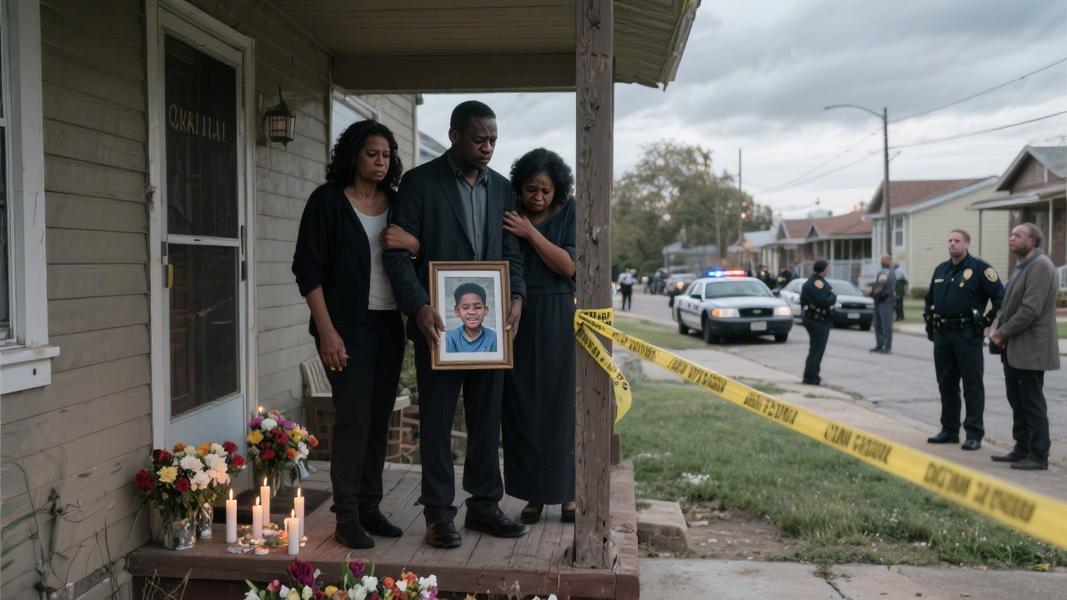
A 13-year-old boy walked up to a front door in Oak Cliff looking to talk to a friend. He never made it home. Now an 18-year-old woman is facing a capital murder charge — and a grieving community is demanding answers that no courtroom verdict can fully provide.
Marcus Reeves Jr., an eighth grader, was shot just before 11 p.m. on March 11, 2026, in the 2000 block of Pin Tail Court in Dallas — a quiet residential stretch near South Hampton Road and Interstate 20. He was found at the scene suffering from gunshot wounds and transported to a hospital, where he clung to life for three more days before dying on March 14. He became the city’s 30th homicide victim of 2026.
What Happened at That Front Door
According to investigators, Reeves had gone to the home of Saryiah Sanford-Griffin, 18, asking to speak with another juvenile who lived there or was known to be there. It was an ordinary reason to knock on a door. What followed was anything but. A witness who happened to be on a video call at the time heard the crack of gunshots and then screaming — including a voice yelling, “Saryiah! You shot him!”
That detail is hard to shake. Someone who was there, in that moment, felt compelled to shout her name. It suggests the shooting wasn’t some chaotic, mistaken-identity scenario. It was witnessed. It was immediate. And it left a boy bleeding on the front step.
“What could a 13-year-old do or have done to be shot in his head?” That question, posed in the aftermath of the shooting, isn’t rhetorical. It’s the kind of question that doesn’t have a good answer — because there isn’t one.
An Arrest, a Lie, and a Capital Charge
Dallas police didn’t move immediately. It took roughly two weeks before Sanford-Griffin was taken into custody. When she was, the charge wasn’t manslaughter or aggravated assault. It was capital murder — the most serious classification under Texas law, carrying the possibility of life in prison or, depending on how prosecutors proceed, the death penalty.
Investigators say she didn’t just pull the trigger. She lied about it. “Dallas police say a young woman shot and killed a 13-year-old boy and then lied about it,” as one account put it bluntly. That alleged deception — whatever form it took — is now baked into the case against her, and it signals that authorities believe this was no accident wrapped in panic. They believe it was a killing, followed by a cover story.
Still, the full picture of what Sanford-Griffin told police, and exactly how investigators unraveled it, hasn’t been made entirely public. What is clear is that the timeline — from the shooting on March 11 to Reeves’ death on March 14 to the arrest roughly two weeks later — suggests a deliberate, methodical investigation rather than a quick collar.
A City Already Reeling
Thirty homicides in fewer than three months. That’s where Dallas stood when Marcus Reeves Jr. was added to the list. It’s a number that should give anyone pause — not as an abstraction, but as a accumulation of individual moments, individual doors knocked on, individual nights that ended wrong.
Oak Cliff, the southwestern Dallas neighborhood where Pin Tail Court sits, has long been a community of working families and deep roots — and, at times, persistent violence. Residents there know the difference between a statistic and a child. Marcus was the latter.
His family’s grief is layered with something else, too: the sheer senselessness of the circumstances. He wasn’t in the wrong place in some broad, abstract sense. He was at a door. Asking to talk to someone. That’s it. And yet the question lingers — why — with no satisfying answer on the horizon.
What Comes Next
Sanford-Griffin now faces the full weight of the Texas capital murder statute. Her case will move through Dallas County’s court system, where prosecutors will have to establish not just that she fired the shot, but that it meets the legal threshold for capital murder — which in Texas can apply when a murder is committed alongside certain other felonies, or involves specific victim classifications. The precise legal theory the DA’s office is pursuing hasn’t been detailed publicly.
Defense attorneys, when assigned or retained, will almost certainly challenge the circumstances of the arrest, the witness accounts, and whatever statements Sanford-Griffin made to police. That’s how the system works. It’s slow, procedural, and often unsatisfying for families who want resolution now.
Marcus Reeves Jr. was 13. He was in the eighth grade. He had, by any reasonable measure, most of his life still ahead of him — high school, whatever came after, the ordinary accumulation of years. None of that gets restored by an arrest, a trial, or even a conviction. As one voice from the community put it, asking what a 13-year-old could possibly have done to deserve a bullet to the head: the answer, of course, is nothing. Absolutely nothing.
