
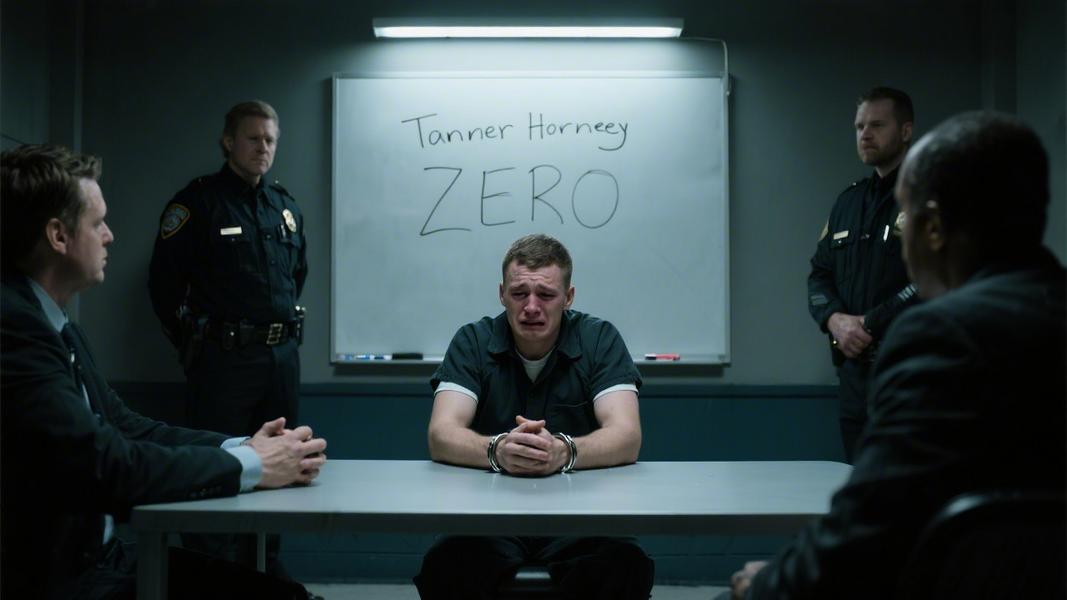
A FedEx delivery driver who murdered a 7-year-old Texas girl while delivering her a Christmas present told investigators he was guided by a “little voice” — and, at times, by an alter ego he called “Zero.”
Tanner Horner is now on trial for the November 30, 2022 kidnapping and murder of Athena Strand, a first-grader from Paradise, Texas. Prosecutors say Horner, then a 31-year-old FedEx contractor, strangled the child and discarded her body in a creek nearly nine miles from her home. He has pleaded guilty to capital murder and aggravated kidnapping. The state is seeking the death penalty.
A Story That Doesn’t Add Up — Until It Does
Horner initially told investigators he’d accidentally struck Athena with his delivery truck, panicked over the prospect of losing his job, and made a series of catastrophic decisions from there. Prosecutors disputed that account entirely. This wasn’t a panicked accident, they argue. It was a kidnapping — deliberate, calculated, and carried out while Horner was delivering a package that had been ordered for Athena herself as a holiday gift.
Details that emerged in court paint a deeply unsettling picture of what happened that afternoon. Horner allegedly told Athena, “Don’t scream or I’ll hurt you.” He weighed 256 pounds. She weighed 67 pounds. Prosecutors didn’t mince words about what that disparity meant: describing in court “what a 256-pound man can do to a 67-pound girl.” He brought, they said, “violence, fear and death.”
Her body was found 72 hours later, nude, in a creek at BoBo Crossing — only after Horner confessed and led investigators there.
Enter “Zero”
Here’s where the case takes a strange, almost cinematic turn. During police interviews, Horner repeatedly referenced an alter ego he called “Zero” — a persona he claimed to have discussed with his wife. Investigators, recognizing an opening, leaned into it as an interview technique. It worked, at least partially.
“If I say too much, Zero is going to hurt me,” Horner told investigators, according to testimony. At one point, when detectives stepped out of the room, he walked to a whiteboard and wrote the name. When they returned and asked about it, he said it wasn’t him — it was Zero. One investigator recalled on the stand: “Throughout the course of these next couple of interviews, the name Zero and that fake person or alter ego comes up.” He added, “I asked him what that was about, and he said it wasn’t him, it was Zero.” Horner, notably, responded more openly when addressed by that name.
Whether this was a genuine psychological phenomenon, a manipulation tactic, or something else entirely is a question the trial has yet to fully resolve. That said, the courts aren’t really entertaining it as a defense — he’s already pleaded guilty.
What Horner Said About Athena
In one of the more jarring moments of his police interviews, Horner described the experience of killing Athena as feeling like a dream — or an out-of-body experience. He said he was guided by a “little voice.” He also called her, with apparent sincerity, “a sweet kid.”
Horner also preemptively denied sexual assault during his interviews — “You’re going to ask if I sexually assaulted her, and I did not” — and he has not been charged with any sexual crimes. Surveillance footage confirmed Athena was alive inside his truck at one point during the ordeal.
Premeditation, Prosecutors Say
One detail prosecutors have highlighted: Horner reportedly took steps to ensure he was assigned the same FedEx truck on the day of the crime. It’s a small thing, maybe. But in a capital case, small things carry enormous weight. That kind of deliberateness, they argue, is evidence of premeditation — and a direct counter to any suggestion this was a spontaneous, panicked tragedy.
A Law Born From Loss
Athena’s death didn’t just devastate her family — it changed Texas law. In the aftermath of the case, the state established the “Athena Alert” system, a public notification mechanism designed to fill the gap before an AMBER Alert’s criteria are officially met. The idea is simple: get information to the public faster, because in cases like this, speed is everything.
It’s a small, hard-won legacy for a child who deserved none of this. And as the trial moves toward its conclusion — with the death penalty squarely on the table — the question isn’t really about guilt anymore. Horner admitted that much. The question now is consequence.
As one prosecutor put it simply, Horner “brought violence, fear and death” to a little girl who was waiting for a Christmas present. Whatever name he gave to that part of himself, the jury will have to decide what to call it.
