
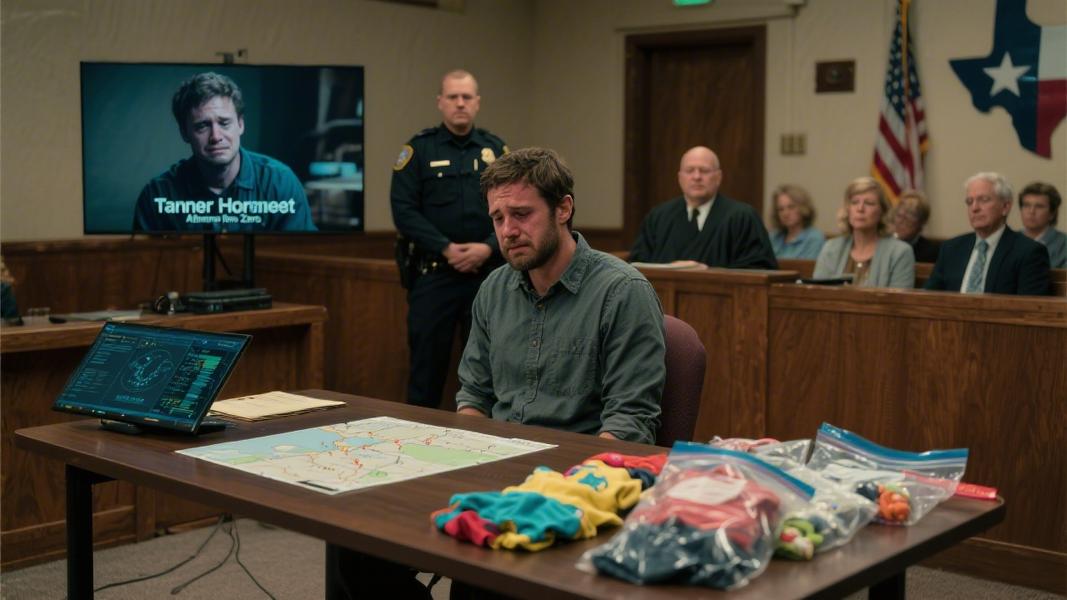
The man who killed seven-year-old Athena Strand didn’t just take her life — he stripped away her dignity, too, and then tried to blame it on someone else entirely. On the third day of testimony in the Tanner Horner capital murder trial, jurors heard some of the most damning and disturbing evidence yet.
Horner, a FedEx delivery driver, pleaded guilty before trial to capital murder and aggravated kidnapping in the 2022 death of Athena Strand, a first-grader from Wise County, Texas. But guilty pleas don’t end the story here — not when the death penalty is on the table. The punishment phase is what this trial is really about, and prosecutors are methodically laying out just how calculated and cruel Horner’s actions were.
A Digital Trail That Led Straight to Horner
Investigators didn’t stumble onto Tanner Horner. They built their case with precision. FBI Special Agent Taylor Paige took the stand to explain how federal agents used cell tower data and a targeted digital dragnet to zero in on their suspect. “We did a geofence for T-Mobile,” Paige testified. “That device became of interest for us. Secondly, there was a phone number from Mr. Horner that was also identified and became more relevant as Command Post started to unfold.”
It’s the kind of digital forensics that has become standard in major investigations — but it’s rarely this clean. Horner’s phone placed him exactly where investigators suspected. From there, the physical evidence did the rest of the talking.
What Was Found — and Where
Athena’s body was recovered unclothed. Her clothing — children’s underwear, socks, and blue jeans — was found in two separate locations: some items recovered from Horner’s backpack, others discovered behind a shed on his property. The detail is clinical on paper. In a courtroom, with jurors looking on, it landed like a stone.
And Horner, according to investigators, had an explanation for that. He allegedly admitted removing Athena’s clothes for the purpose of humiliation — because, he said, he thought it was funny. That word, “funny,” has a way of silencing a room.
‘I Didn’t Do This, But He Did’
How does a man explain the inexplicable? Apparently, he invents someone else to carry the weight of it.
Jurors heard that Horner described an alter ego he called “Zero” — a, in his words, “little devil on my shoulder” — and repeatedly told investigators, “I didn’t do this, but he did.” He spoke of the events as though they were a bad dream, describing memory gaps and symptoms that resembled PTSD. He claimed he’s “not a bad person.” He called Athena being in his path that day the “wrong place at the wrong time” — a phrase that, in context, is almost impossible to sit with.
Still, the dissociation narrative cuts both ways in a courtroom. Defense attorneys may see it as mitigation. Prosecutors likely see it as deflection — a man who knew exactly what he was doing and is now trying to distribute the moral weight of it onto a fictional shoulder-devil.
Negotiations, Self-Harm, and a Desperate Bid for Christmas
The portrait that emerged Wednesday was of a man in profound psychological crisis — though whether that crisis preceded the crime or followed it remains an open question. Horner attempted to hang himself in jail in May 2023. During interrogations, he reportedly begged investigators to shoot him. He also, in one of the more surreal moments documented in the case, attempted to negotiate a deal — offering to tell the full truth in exchange for an ankle monitor and the chance to spend Christmas with his family.
That’s the catch with cases like this. The evidence of guilt is overwhelming — Horner admitted to the crime, pleaded guilty in open court — and yet the punishment phase forces everyone in that courtroom to reckon with the full, complicated, often ugly humanity of the man who did it. Texas prosecutors are seeking the death penalty. The jury will ultimately decide whether Horner’s actions, his state of mind, and his subsequent behavior warrant that outcome.
For Athena Strand’s family, no verdict will undo a November evening in 2022 when a little girl went for a walk and never came home. But in a Wise County courtroom this week, the record of what happened to her is being written in full — and it is not the story of a nightmare, or a devil on anyone’s shoulder. It’s the story of a child who deserved better from the world, and didn’t get it.
