
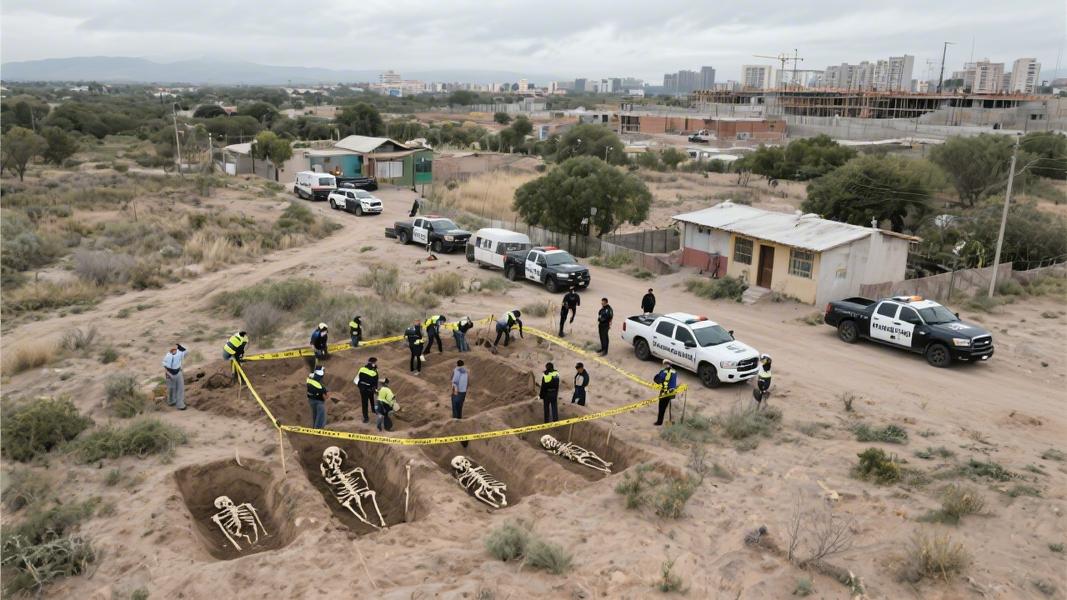
The stadiums are nearly ready. The bodies keep turning up. In the months leading up to the 2026 FIFA World Cup, western Mexico has become the site of a grim and escalating series of discoveries — mass graves, body bags, and clandestine burial sites scattered across the very region that will soon host the world’s most-watched sporting event.
Authorities in Jalisco, Sinaloa, Baja California Sur, and Colima have uncovered dozens of clandestine cemeteries and hundreds of sets of human remains in recent weeks, painting a stark picture of cartel violence that no amount of stadium lights can fully obscure. The discoveries span construction lots, open fields, and urban suburbs — some just kilometers from World Cup venues. It’s a crisis that Mexico’s government has struggled to contain, and one that international scrutiny is now making impossible to ignore.
Graves in the Suburbs
In Ixtlahuacan, a quiet suburb on the outskirts of Guadalajara, skeletal remains belonging to at least 11 people were unearthed from hidden graves in a rural lot. The discovery was jarring in its ordinariness — a nondescript piece of land, unremarkable until it wasn’t. Around the same time, a construction site in nearby Tlajomulco yielded 12 bags of human remains, adding yet another data point to what has become a deeply unsettling pattern across the state.
Jalisco state prosecutor Claudia Trujillo acknowledged that the total number of victims from both sites remains unclear. She noted that the remains in both cases appear to be old — though she declined to specify any timeframe. That kind of careful ambiguity has become something of a signature in official communications here. Answers, when they come, tend to arrive slowly.
Zapopan’s Deeper Problem
Then there’s Zapopan. The municipality, which sits just north of Guadalajara and is home to Estadio Akron — one of Mexico’s designated 2026 World Cup venues — has emerged as a focal point in the crisis. During a construction project, the bodies of 34 people were pulled from a mass grave, located using ground-penetrating radar and cadaver dogs. That discovery alone would have been shocking. It was not alone.
Investigators subsequently found at least 456 bags containing human remains in areas surrounding Estadio Akron itself, according to reporting from stadium and infrastructure outlets tracking the region. An additional 130 bodies were discovered near the stadium commonly associated with Club Deportivo Guadalajara — better known as Chivas — compounding what authorities are now scrambling to characterize as isolated incidents rather than systemic failure. Whether that framing holds up is another matter entirely.
A Pattern That Won’t Stay Buried
How bad is it, really? Across Mexico’s Pacific coast states, the answer keeps getting worse. More than 17 clandestine cemeteries have been uncovered in Sinaloa, Baja California Sur, and Colima in recent months alone, with additional graves reported in other states. Searchers — many of them family members of the disappeared, not law enforcement — have described a process of painstaking, often adversarial investigation.
“If we said left side, they said right side,” one searcher told El País. “Now, with our own investigation, we went kilometer by kilometer, based on anonymous calls that had already come in.” It’s a line that captures something essential about this crisis — the families doing the work that institutions either can’t or won’t, moving methodically through terrain that authorities have often misdirected them away from.
Still, the scale of what’s been found in Jalisco alone has drawn particular attention, given the state’s role in the upcoming tournament. Zapopan’s Estadio Akron is confirmed as a host venue, and the optics of hundreds of body bags surfacing in its shadow have proven difficult for FIFA or Mexican officials to address with any real coherence. Press briefings tend to emphasize the ongoing nature of the investigation. They tend not to dwell on what the investigation keeps finding.
The Reckoning Behind the Spectacle
Mexico has long grappled with the so-called “crisis of the disappeared” — an estimated 100,000 or more people officially listed as missing, a number that human rights organizations argue is almost certainly an undercount. Cartel violence, corruption, and institutional indifference have all contributed to a situation where clandestine graves have become, in the most tragic sense, unremarkable. They surface. Officials respond. The count climbs. The cycle continues.
What’s different now, at least in the short term, is the spotlight. The World Cup brings cameras, tourists, and global attention to a region where that attention has historically been absent or unwelcome. Whether that translates into accountability — real accountability, not press releases — remains the open question. Families of the disappeared have been asking it for years. The world, for a few weeks in the summer of 2026, might finally be listening.
The stadiums will fill. The anthems will play. And somewhere in the soil of Jalisco, the search will go on.
