
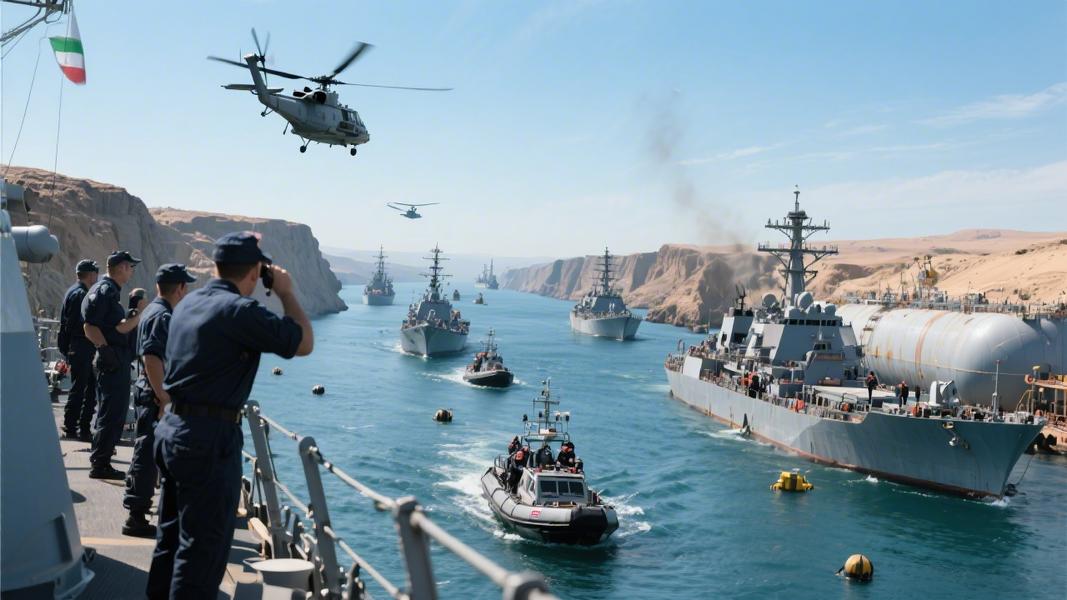
President Trump ordered a full naval blockade of the Strait of Hormuz on Saturday, a dramatic and potentially world-altering escalation after high-stakes diplomatic talks between U.S. and Iranian officials collapsed in Islamabad. One of the most consequential waterways on the planet is now, effectively, a contested zone.
The announcement came hours after negotiations brokered by Pakistan fell apart — talks that had represented the highest-level engagement between Washington and Tehran since the 1979 Islamic Revolution. Roughly a fifth of the world’s oil supply moves through the Strait every day. The implications of what Trump set in motion are difficult to overstate.
The Blockade Order
Trump didn’t mince words. In a statement that sent shockwaves through energy markets and foreign ministries alike, he declared, “Effective immediately, the United States Navy, the Finest in the World, will begin the process of BLOCKADING any and all Ships trying to enter, or leave, the Strait of Hormuz.” That’s not a warning. That’s a directive.
The president also said the U.S. Navy has begun clearing Iranian mines from the waterway, framing it — characteristically — as an act of generosity toward the international community. “We’re now starting the process of clearing out the Strait of Hormuz as a favor to Countries all over the World, including China, Japan, South Korea, France, Germany, and many others,” he wrote. Whether those countries see it that way is another matter entirely.
Beyond the mines, Trump instructed the Navy to go further — targeting ships that have financially cooperated with Tehran. “I have also instructed our Navy to seek and interdict every vessel in International Waters that has paid a toll to Iran,” he announced. That’s a sweeping mandate, one that could ensnare vessels from countries Trump himself named as beneficiaries of the mine-clearing operation.
How It Got Here
The weekend talks in Islamabad were, by any historical measure, remarkable — even before they failed. U.S. and Iranian officials sitting across from each other at that level hasn’t happened in nearly five decades. Vice President JD Vance led the American delegation through what stretched into nearly 24 hours of negotiations, a grueling diplomatic marathon that ultimately produced nothing.
Vance emerged from the talks with a measured but pointed statement. “We leave here with a very simple proposal, a method of understanding that is our final and best offer,” he told reporters. Then came the harder admission — that Iran had chosen to “not accept our terms,” effectively ending direct negotiations and handing the situation back to the military track.
That’s the catch. Diplomacy was the off-ramp. It’s gone now.
The Threat Hanging Over It All
What does Trump do when talks fail? He escalates. And he made the consequences for any Iranian military response brutally clear. “Any Iranian who fires at us, or at peaceful vessels, will be BLOWN TO HELL!” he warned — capital letters and all. It’s the kind of language that makes diplomats wince and generals take notes.
Still, the logistics alone of enforcing a blockade on one of the world’s busiest shipping lanes are staggering. Hundreds of vessels transit the Strait on any given week. Determining which ships have paid Iranian tolls, intercepting them in international waters, and doing all of this without triggering a broader military confrontation — that’s not a simple operation. It’s an enormously complex one, with enormous room for miscalculation.
Global Stakes
The countries Trump listed as beneficiaries of the mine-clearing effort — China, Japan, South Korea, France, Germany — are also among the world’s largest importers of Gulf oil. None of them were consulted before this announcement, at least not publicly. Some of them have their own diplomatic relationships with Tehran. How they respond, and how quickly, could shape the next phase of this crisis as much as anything happening in the Strait itself.
For now, the U.S. Navy is in the water, the mines are being cleared, and the Islamabad talks are a memory. The world’s most critical oil chokepoint is under American blockade — and the question of what happens next doesn’t have a clean answer.
It rarely does when the last diplomat has left the room.
