
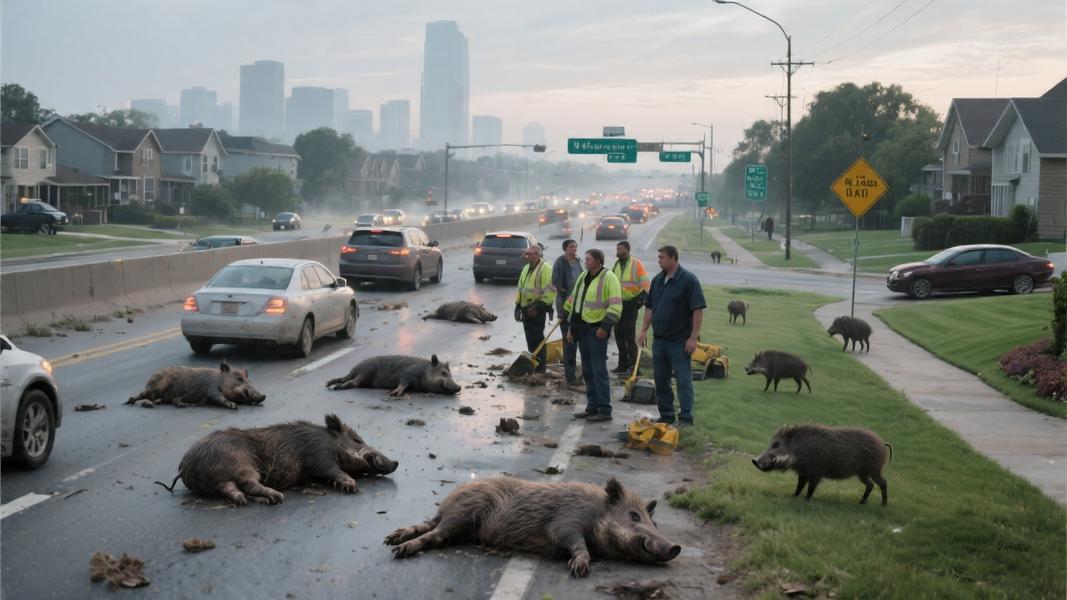
They’ve rooted up suburban parking lots, halted traffic on one of Texas’s busiest interstates, and killed at least one person in recent years. And despite hunters taking roughly 750,000 of them annually in Texas alone, the numbers just keep climbing.
Feral hogs — wild, destructive, and spectacularly hard to kill off — have become one of the most persistent wildlife crises in American history. What began as a colonial-era agricultural convenience has metastasized into a nearly uncontrollable invasion spanning tens of millions of acres, bleeding billions from the economy, and increasingly showing up not just in remote bottomlands, but in backyards, school campuses, and city parks across the Lone Star State. This is the story of how they got here, why they won’t leave, and what — if anything — can be done about it.
Five Centuries in the Making
It starts, as so many American problems do, with European arrival. As one account puts it plainly, “pigs are not native to North America; they were first introduced to the West Indies — what we now know as The Caribbean — by Christopher Columbus in 1493, and then to the continental United States by Hernando de Soto in 1539 along the Florida coast.” De Soto’s expedition essentially seeded the continent. When explorers moved on or colonies collapsed, domesticated pigs were left behind — and pigs, it turns out, don’t need much help going feral. They’re adaptable, they’re prolific, and they have absolutely no interest in waiting around for someone to come back for them.
European settlers and Native Americans then made things considerably worse by practicing open-range farming, letting hogs wander freely across the landscape. That was manageable, more or less, until the 1930s. “In the 1930s, European wild hogs, ‘Russian boars,’ were first imported and introduced into Texas by ranchers and sportsmen for sport hunting. Most of these eventually escaped from game ranches and began free ranging and breeding with feral hogs,” according to Texas Parks and Wildlife Department documentation. The resulting hybrids — tougher, wilder, harder to manage than either parent stock — are now the dominant strain roaming Texas.
The numbers tell a stark story. The U.S. feral hog population grew from an estimated 2.4 million in 1982 to nearly 7 million by 2016. Their northward range expansion, once measured at about 4 miles per year, had accelerated to 7.8 miles per year by 2012. Human-mediated transport — people illegally moving hogs for hunting purposes — remains one of the leading drivers of that spread. Texas responded in 2008 with regulations restricting the live transport of feral hogs, limiting movement only to approved holding facilities for slaughter, directly to slaughter, or in the case of male hogs, to licensed hunting preserves capable of preventing escape.
Texas Is Practically Theirs Now
How bad is it, really? Consider this: “data from 2022 has indicated that feral hogs are established in 253 of 254 counties in Texas,” per Texas A&M AgriLife Extension. The lone holdout is El Paso County, perched on the far western edge of the state, separated from the rest by hundreds of miles of arid terrain. Everywhere else? They’re there.
And increasingly, “there” means the suburbs. A Texas Parks and Wildlife Department representative put it bluntly in recent remarks: “they’re found in almost every county — we estimate that they’re causing upwards of a billion and a half dollars a year across the country, but make no mistake, this is not a rural problem. This is a problem as much in Fort Worth as it is in Fort Davis or Fort McKavett, so communities all across the state are having to contend with the proliferation of feral hogs in communities big and small.”
The examples are piling up fast. On April 15, 2026, southbound I-45 traffic came to a grinding halt near Belt Line Road after a vehicle struck a feral hog, requiring TxDOT cleanup crews to respond. In Mesquite, neighborhood residents have reported repeated sightings — but the city has yet to implement any organized trapping program. In Roanoke’s Fairway Ranch development in Denton County, police have had to increase patrols in response to hog activity. One park official described the scene with palpable disbelief: “we have seen a pack as large as 20 individuals in our parking area — we spotted them about two months ago, and just this morning we noticed damage right here in our picnic area.”
The hogs’ adaptability is, frankly, impressive in the worst possible way. With an annual growth rate estimated between 18 and 21 percent, they can replenish a culled population with unnerving speed. Natural movement expands their range organically. Human transport — legal and otherwise — does the rest.
Predators? There’s Really Only One That Matters
So what eats them? The answer is almost darkly comic. Coyotes, bobcats, and golden eagles will opportunistically prey on young piglets, but they barely register as a population check. It’s really only where feral hogs share territory with American alligators, mountain lions, or black bears that any “frequent intentional predation” occurs — and even then, as wildlife researchers have noted, “it plays a minor role in wild pig mortality.”
That leaves humans. As the Texas Parks and Wildlife Department states flatly: “People. Humans are the most significant predator of wild pigs in the U.S.” Texas hunters take an estimated 750,000 feral hogs per year — a figure that sounds enormous until you realize the population is still growing. In 2017, state lawmakers approved a measure allowing hunters to shoot both wild pigs and coyotes from hot air balloons, adding an almost surreal chapter to the ongoing management saga. Trapping operations, like those run by figures such as Dallas-area processor Coy Hirth, who donated harvested meat during the COVID-19 pandemic in 2020, represent another front. Still, the math is brutal: hunters can’t outpace a species that breeds this fast.
Feral hogs are classified as “unprotected, exotic, non-game animals” under Texas law, meaning they “may be taken by any means or methods at any time of year,” with no seasons or bag limits — though a hunting license and landowner permission are still required, per extension guidelines. That legal flexibility hasn’t been enough.
The Damage Is Staggering — and Sometimes Deadly
Wild pigs, as TPWD notes, are counted among the top 100 worst exotic invasive species in the world. That ranking isn’t hyperbole. The Houston Chronicle once described them as “four-legged fire ants” — and anyone who’s seen what a sounder of hogs can do to a pasture overnight understands the comparison immediately.
A single pig can root through 6.5 square feet of soil per minute. Multiply that by a pack of 20, and you have a tilling operation that would impress a farmer — if it weren’t destroying everything in sight. Rooting churns up native soil structure, creates conditions favorable to invasive plant species, and devastates root systems. Trampling accounts for an estimated 90 to 95 percent of crop damage attributable to feral hogs, while wallowing degrades wetlands and contaminates water sources. They prey on white-tailed deer fawns, lambs, goats, and ground-nesting bird eggs. They carry and spread diseases that pose risks to both livestock and humans.
The economic toll is severe. U.S. agricultural losses were estimated at $1.5 billion in 2007 and had climbed to approximately $2.1 billion by 2020. Texas agriculture alone absorbs roughly $118.8 million in annual losses. And that’s before accounting for urban infrastructure damage — torn-up parks, destroyed landscaping, compromised golf courses and sports fields.
Then there’s the human safety dimension, which most people don’t think about until they have to. In 2019, a 59-year-old caretaker named Christine Rollins was found dead outside a home in Anahuac, Texas, killed by a group of feral hogs in the early morning darkness. It was a rare but chilling reminder that these are not barnyard animals. They’re wild, they’re territorial when cornered, and a pack of them is not something most people are prepared to encounter in a suburban parking lot.
Managing the Unmanageable
That’s the catch. Despite decades of effort, no jurisdiction has found a silver bullet. Texas’s 2008 transport regulations were a meaningful step — requiring that any live hog movement go only to a licensed holding facility, directly to slaughter, or in the case of intact males, to an approved preserve with verified containment infrastructure. The goal was to stop the single most controllable vector of spread: people deliberately moving hogs to new areas for hunting. But it addressed only one piece of a very large puzzle.
Suburban communities have struggled to respond coherently. Mesquite residents dealing with repeated hog incursions have found their city largely without a trapping program. Roanoke has resorted to increased police presence — a solution that would strike most wildlife managers as a stopgap at best. Protecting crops and green spaces from rooting, which discourages re-establishment when land sits fallow, is recommended by researchers but requires sustained effort and expense that many landowners can’t sustain.
There have been genuine bright spots. Meat donation programs, balloon hunting operations, and aggressive trapping on willing private land have all demonstrated localized success. But the broader trajectory hasn’t changed much. Hunters take three-quarters of a million hogs a year in Texas, and the population — still estimated at 2.6 million statewide — keeps growing.
It’s worth sitting with that for a moment. Half a millennium after Hernando de Soto’s hogs first set foot on Florida sand, their descendants are rooting up picnic tables in North Texas suburbs, stopping traffic on major interstates, and defying every systematic effort to contain them. They’ve outlasted colonial empires, westward expansion, and now modern wildlife management. As one wildlife official put it — and it’s hard to argue — this is just as much a Fort Worth problem as a Fort Davis problem. The hogs, it seems, have fully moved in. The question is whether anyone has a real plan to make them leave.
