
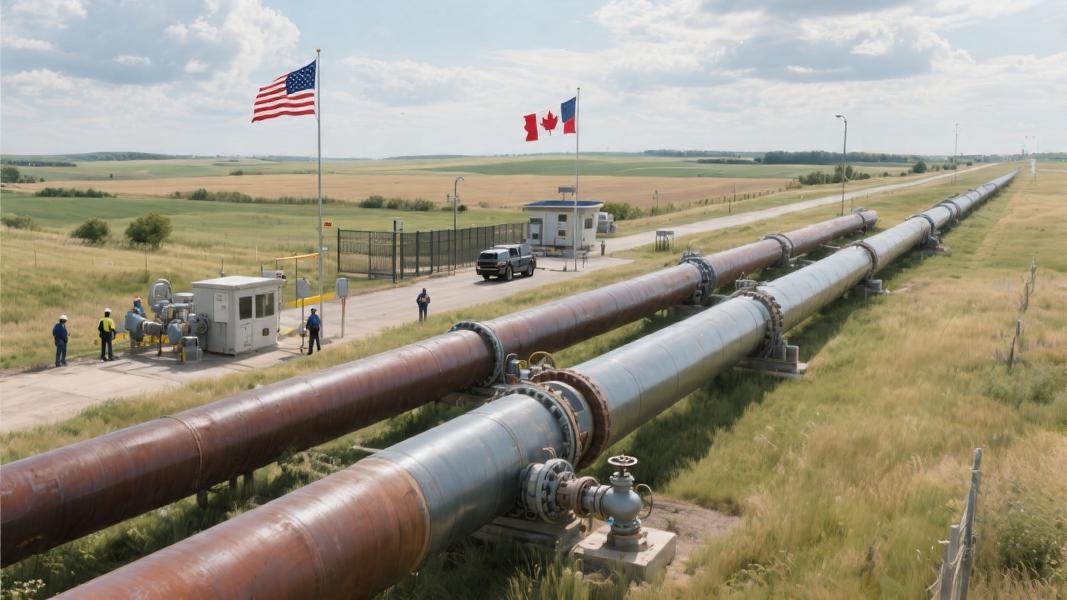
The White House has quietly handed Enbridge Energy one of the more significant border authorizations in recent memory — a fresh Presidential Permit allowing the Canadian pipeline giant to keep operating three crude oil pipelines across the U.S.-Canada boundary in North Dakota, locking in infrastructure that moves millions of barrels of petroleum into the American heartland.
Dated April 15, 2026, the permit authorizes Enbridge Energy, Limited Partnership to operate and maintain three existing pipeline facilities — measuring 26 inches, 34 inches, and 18 inches in diameter — at the international border in Pembina County, North Dakota. The lines carry crude oil and petroleum products southward from Canada, and the new permit effectively replaces an earlier one that had been on the books since December 12, 1991. That’s 35 years of operating history, now refreshed with a stroke of the presidential pen.
What the Permit Actually Says
The language in the document is characteristically formal, as these things tend to be. “By virtue of the authority vested in me as President of the United States of America,” it reads, “I hereby grant this Presidential permit, subject to the conditions herein set forth to Enbridge Energy, Limited Partnership.” Boilerplate, sure. But the legal weight behind it is anything but routine.
The so-called “border facilities” — the segments of pipeline covered under the permit — don’t span the entire network. They stretch only from the international boundary line to the first mainline shut-off valve or pumping station on U.S. soil. That works out to roughly 25 miles for the largest pipeline, 18 miles for the 18-inch line, and just 0.75 miles for the middle one. Short distances, enormous throughput.
Presidential Permits of this kind aren’t handed out casually. The Department of State evaluates them under Executive Orders 13337 and 11423, both of which govern the construction, connection, operation, and maintenance of facilities that import or export petroleum products across U.S. borders. The State Department’s role as gatekeeper means these decisions carry diplomatic weight as much as they carry oil — and the process, as outlined in federal records, involves a full national interest determination before any permit is issued or renewed.
Enbridge’s Long History at This Border Crossing
This isn’t Enbridge’s first rodeo in Pembina County, not by a long shot. The company has been a fixture at this stretch of the North Dakota border for decades, and its relationship with the Presidential Permit process is complicated, layered, and at times contentious.
Back in August 2009, Enbridge received a Presidential Permit for its now-famous Line 67 — also known as the Alberta Clipper — a 36-inch-diameter pipeline that crosses the border in the same general region, ferrying heavy crude from Alberta’s oil sands down into Midwest markets. That permit came with a design capacity of 500,000 barrels per day. Enbridge, being Enbridge, eventually wanted more. The company requested an amendment to push operations up to the pipeline’s full design capacity of 880,000 to 890,000 barrels per day — nearly doubling the originally permitted flow.
That expansion request dragged on through years of regulatory review, environmental scrutiny, and legal challenge. Indigenous groups, environmental advocates, and tribal nations raised serious objections. The documented history of Line 67’s permitting saga reads like a case study in how contentious cross-border energy infrastructure can become when the stakes — economic, environmental, and sovereign — are this high.
Still, Enbridge has consistently navigated these waters. A prior Presidential Permit was published in the Federal Register in November 2017, signaling that the company’s relationship with U.S. regulators — however turbulent at times — has remained intact across multiple administrations, both Democratic and Republican.
Why It Matters Now
So why does a permit renewal in a rural North Dakota county rise to the level of national news? Because the pipelines in question aren’t marginal infrastructure. They’re part of the arterial network that connects Canadian oil production — one of the world’s largest reserves — to American refineries, fuel supplies, and ultimately, consumers at the pump.
The original authorization framework for facilities like these was built on the premise that cross-border energy cooperation serves U.S. national interests. That argument has held across administrations. But it’s never been without critics — particularly as debates over energy transition, Indigenous land rights, and climate commitments have grown louder and more politically charged.
That’s the catch. Enbridge’s infrastructure is deeply embedded in the North American energy system. Pulling permits doesn’t just affect a company’s bottom line — it ripples through refineries in Illinois, fuel prices in Minnesota, and diplomatic relationships with Ottawa. The calculus is rarely clean.
What the April 2026 permit does, at its core, is provide regulatory certainty for operations that were already happening. It’s a renewal, not a green light for something new. But in a political environment where energy policy shifts with the wind, having a freshly signed Presidential Permit — with the force of executive authority behind it — is worth considerably more than the paper it’s printed on.
What Comes Next
Enbridge has not publicly commented on the specifics of the new permit as of publication. The company, headquartered in Calgary, operates one of the longest and most complex crude oil pipeline systems in the world, and its U.S. operations remain a central piece of North American energy logistics.
Whether this permit renewal reignites debate among environmental groups, tribal nations, or congressional critics remains to be seen. The legal and political battles over Enbridge’s broader network — particularly Line 5 in Michigan, which has been mired in a years-long dispute with the state — suggest the company is no stranger to fighting for its operating rights on multiple fronts simultaneously.
For now, the pipelines keep flowing through Pembina County, as they have for more than three decades. A new permit, a new administration’s signature, the same old oil — and a reminder that in American energy policy, the more things change, the more the infrastructure tends to stay exactly where it is.
