
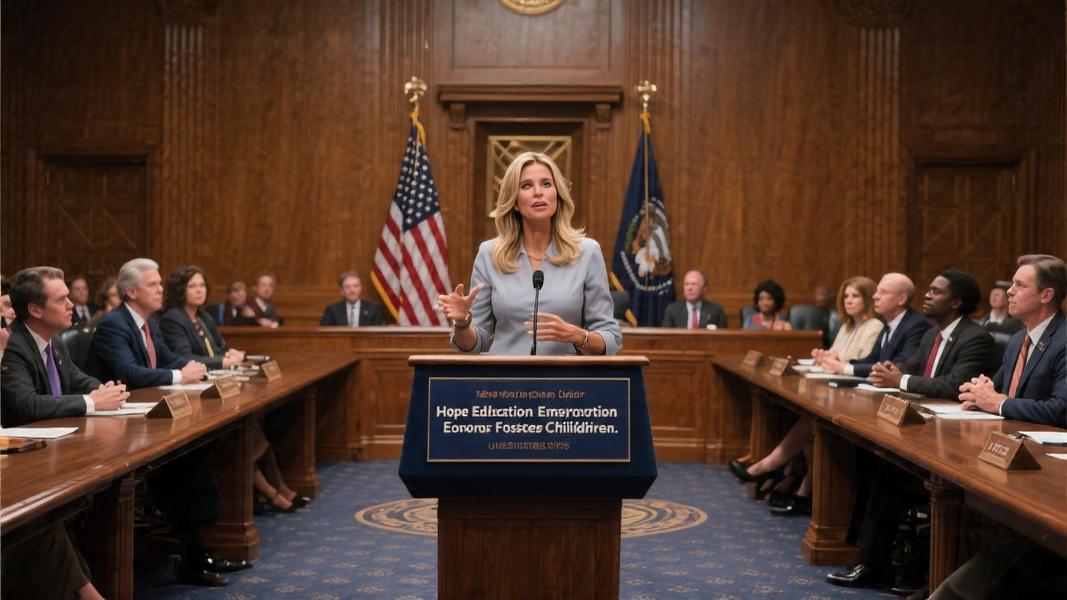
She doesn’t usually do Capitol Hill. But on Tax Day, of all days, First Lady Melania Trump made her way to the House Ways and Means Committee — and she didn’t come empty-handed.
On April 15, 2026, Melania Trump joined lawmakers to push forward sweeping foster care legislation aimed at tackling some of the most persistent and painful failures in the American child welfare system: housing instability, educational neglect, and the quiet catastrophe of young people aging out of government care with nowhere to go. It’s a cause she’s been building toward for years, and Tuesday’s appearance signaled that the effort is now moving from executive action to the legislative arena.
A Moral Argument, Not a Political One
“We are gathered here today, not because America’s children rely on us, but rather because America’s children are our moral equals,” the First Lady told the committee. It was a pointed, almost philosophical framing — and a deliberate one. By grounding the push in moral equivalency rather than charity, she was making a case that resonates well beyond party lines.
The legislative effort builds on a foundation laid five months earlier. On November 13, 2025, President Trump and the First Lady signed the Fostering the Future Executive Order, a directive aimed at strengthening the foster care system and improving outcomes for youth transitioning out of it. “This executive order gives me tremendous pride,” Melania said at the signing. “It is both empathetic, and strategic. I predict this small spark today will ignite a profound and lasting nationwide movement.” President Trump, for his part, called it “a historic executive order to make America’s foster care system better, fairer, and more effective than ever before.”
How Bad Is It, Really?
The numbers are staggering — and they don’t get easier the more you look at them. Nationally, only 3% of former foster youth earn a college degree. Just half finish high school. One in five becomes homeless after aging out of the system, and only half have gainful employment by age 24. Nearly 16,000 young people age out of foster care every single year without a family connection to fall back on, noted Ways and Means Committee Chairman Jason Smith, who praised the executive order as a meaningful step toward changing those trajectories.
Still, numbers like that beg a harder question: what took so long? Foster care reform has been a bipartisan talking point for decades. What’s different now, at least on paper, is the combination of executive muscle and private-sector buy-in that the administration is trying to harness.
From Executive Order to Institutional Infrastructure
The Fostering the Future initiative itself isn’t new. Melania Trump originally launched it in 2021 under her BE BEST platform, building partnerships with more than 20 universities — including Vanderbilt, the University of Miami, LSU, UVA, the University of Texas, Ohio State, and the University of Alabama — to deliver technology education to foster youth. That groundwork, it turns out, was the early architecture for something larger.
The November executive order directed the Department of Health and Human Services to formally establish the initiative within 180 days, weaving in commitments from federal agencies, the private sector, academic institutions, and nonprofits to create educational and employment pathways. An online resource hub is also in development, and HHS pledged laptop donations to help bridge the digital divide — a gap that disproportionately leaves foster youth behind in an increasingly credential-driven economy.
HUD Secretary Scott Turner was direct about the stakes. “The President’s Executive Order is a nationwide commitment to uplift youth exiting foster care — from housing stability to career development,” he said, adding that HUD and the Treasury Department are planning roundtables focused on financial literacy programs. That’s a detail worth watching — financial literacy rarely makes headlines, but it’s often the difference between a young adult building stability and spiraling back into crisis.
Legislation as the Next Frontier
The April 15th committee appearance signals that the White House wants more than executive action — it wants statutory staying power. Executive orders can be reversed. Legislation, once enacted, is considerably harder to undo. That’s presumably the point. The First Lady’s framing of new foster care legislation as “a moral imperative” wasn’t accidental rhetoric; it was a call to codify.
Chairman Smith, whose committee oversees federal spending on social programs, has been a vocal ally. Whether the full House — and the Senate — move with the same urgency is a different question entirely. That’s the catch with foster care reform: it tends to generate bipartisan sympathy and then stall in the machinery of competing legislative priorities.
But the White House is pressing forward, and the First Lady’s direct engagement with Congress suggests this isn’t just a ribbon-cutting cause. It’s a legislative campaign — one that, if it succeeds, could reshape what it means to age out of foster care in America.
Sixteen thousand young people a year are doing it right now, mostly without a safety net. That’s not a statistic. That’s a generation.
