
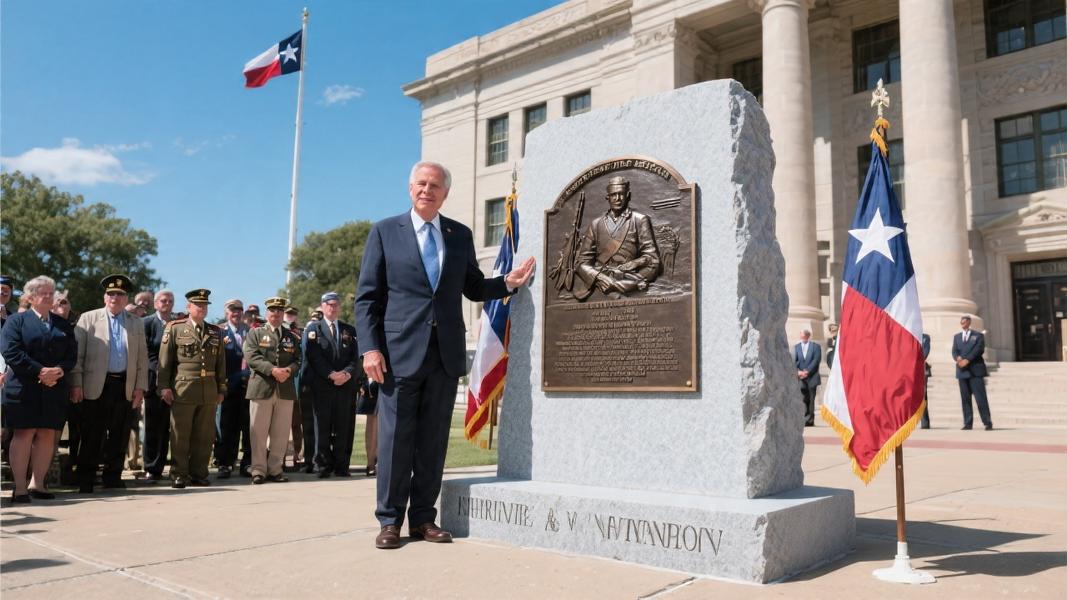
They fought before Texas was even a dream — and now, at last, they have a monument to prove it.
Tucked within the grounds of the Texas State Cemetery, a granite monument stands as a quiet but deliberate tribute to 32 men who carried muskets, crossed frozen rivers, and helped birth a nation — long before the Lone Star ever flew. The Texas Society of the Daughters of the American Revolution Patriot Monument was dedicated on March 16, 2009, honoring patriots with documented Texas ties who served in the American Revolution. It’s a niche piece of history, sure — but it’s also a reminder that the roots of Texas run deeper than most people think.
A Revolution Before the Republic
Most Texans anchor their origin story to 1836 — the Alamo, San Jacinto, the declaration of independence from Mexico. That’s the founding myth, burnished and retold across generations of schoolchildren. But some of the men who later shaped Texas, or whose descendants did, were already veterans of a different revolution entirely. They’d already done this once before.
The monument recognizes 32 individuals with ties to what would eventually become the state of Texas. Whether they settled here after the war, had family who did, or simply left enough of a paper trail to connect them to this land — they’re counted. They’re named. They’re remembered.
The Women Behind the Stone
Who builds this kind of monument? The Daughters of the American Revolution, that’s who — an organization that has spent well over a century doing exactly this kind of painstaking genealogical and historical preservation work. The Texas Society chapter didn’t just commission a plaque and call it a day. This was a deliberate act of historical reclamation, placing Texas into a narrative that often centers on the Eastern Seaboard and leaves the South and West as footnotes.
Still, it’s easy to walk past a monument without really seeing it. That’s the quiet tragedy of public memorialization — the stone outlasts the story, and eventually people stop asking what it means.
Why It Still Matters
Here’s the thing about monuments like this one: they’re not just for the dead. They’re a message sent forward in time, a bet placed on the idea that future generations will care enough to look down and read the names. The Texas State Cemetery — already home to governors, senators, and war heroes — gives this particular monument a serious address. It’s not a forgotten corner of a county park. It belongs to the state, literally and figuratively.
That said, 32 names is a small number. Researchers and genealogists associated with the DAR have long noted that documentation from the Revolutionary era is incomplete at best, deliberately destroyed at worst. The men listed here are the ones they could prove. How many others are lost to time, their service unrecorded and their Texas connections undocumented? Nobody knows. That uncertainty is its own kind of history.
More than two centuries after Yorktown, a stone in Austin carries their names forward. It’s not much — but then again, neither was a ragged colonial army facing the most powerful military on earth. And look how that turned out.
