
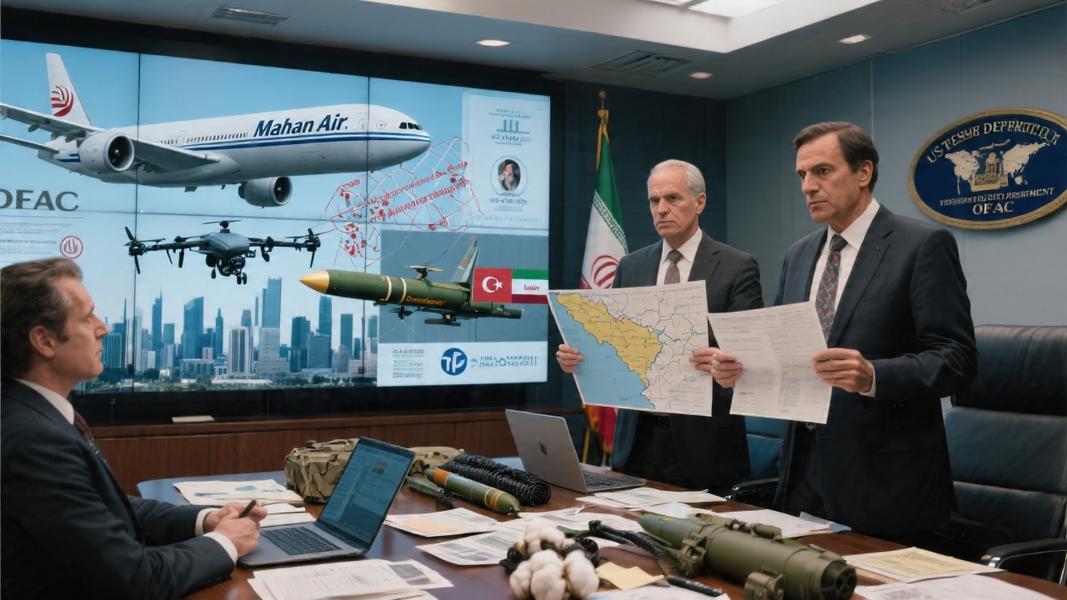
The United States is turning up the financial heat on Iran’s weapons machine — and this time, the dragnet stretches from Tehran to Istanbul to Dubai.
The Treasury Department’s Office of Foreign Assets Control announced sweeping new sanctions targeting 14 individuals, entities, and aircraft spread across Iran, Türkiye, and the United Arab Emirates. The designations are aimed squarely at dismantling the procurement and logistics networks that keep Iran’s drone and ballistic missile programs running — programs that have supplied weapons used against civilians in multiple conflict zones. This isn’t a one-off move. It’s part of a broader, sustained campaign the Trump administration is calling Economic Fury.
“The Iranian regime must be held accountable for its extortion of global energy markets and indiscriminate targeting of civilians with missiles and drones,” Treasury Secretary Scott Bessent said in a statement. “Under President Trump’s leadership, as part of Economic Fury, Treasury will continue to follow the money and target the Iranian regime’s recklessness and those who enable it.”
Shahed Drones and the Servomotor Trail
One of the more granular threads in the new designations involves the unglamorous but critical world of industrial components. Kamal Sabah Balkhkanlu, Mohammad Vahidi, and Danial Khalili have been designated for their support to Pishgam Electronic Safeh Company and its CEO Hamid Reza Janghorbani — a firm that, according to OFAC, procured thousands of servomotors for Shahed-136 UAVs, the loitering munitions that have become a grim fixture of modern warfare. Those drones are operated by the IRGC Aerospace Force Self Sufficiency Jihad Organization, according to analysts tracking the network.
It’s a reminder of how sophisticated — and how mundane — weapons supply chains can get. Servomotors aren’t exotic. They’re the kind of precision components found in industrial machinery worldwide. Which is exactly what makes them so hard to track and so easy to obscure.
Cotton Linters, Rocket Fuel, and a Turkish Firm
Then there’s the case of Emti Fiber Textile Import Export Trade Limited Company, a Türkiye-based firm that completed hundreds of shipments of cotton linters to Iran’s Pardisan Rezvan Shargh. Cotton linters, for context, aren’t just a textile byproduct — they can be chemically processed into nitrocellulose, a key ingredient in solid propellant rocket motors used in ballistic missiles. Treasury’s designation makes the connection explicit, detailing how the supply chain feeds directly into Iran’s missile propulsion capabilities.
That’s the catch with dual-use materials. The line between civilian commerce and weapons procurement isn’t always obvious — and that ambiguity has long been exploited.
On a parallel track, Hamidreza Roknifard and Mostafa Roknifard — chairman and vice chairman of Adak Pargas Pars Trading Company — were designated for facilitating the procurement of sodium perchlorate, another ballistic missile propellant precursor, on behalf of Parchin Chemical Industries, a sanctioned defense manufacturer with deep ties to Iran’s missile program. The designation adds two more names to what is becoming a recognizable pattern: family-linked trading companies serving as cutouts for IRGC-affiliated procurement.
Mahan Air’s Shadow Network
Perhaps the most operationally significant portion of the new package targets entities connected to Mahan Air, the Iranian carrier that U.S. officials have long accused of ferrying weapons and military personnel under commercial cover. The Treasury identified a web of facilitators including Sepehr Kaveh Kish International Trading Company, individuals GholamAbbas Ataei Aghdam, Jamshid Hosseinzadeh, and Mohammad Hossein Mahdian, along with Saman Air Services Company and Dubai-based Chabok FZCO. Two specific Boeing 777 aircraft — registration codes EP-MTE and EP-MTB — were also designated for their alleged role in transporting UAV systems and weapons.
Sanctioning the planes themselves is a pointed signal. It’s not just about cutting off money — it’s about grounding the logistics.
The Legal Architecture Behind the Designations
The new actions were issued under Executive Order 13382, which targets proliferators of weapons of mass destruction and their support networks, and E.O. 13224, which addresses terrorist financing. They also align with National Security Presidential Memorandum 2, the Trump administration’s framework for maximum economic pressure on Tehran, and feed directly into the Economic Fury initiative.
The practical consequences are significant. All U.S.-held property of the designated individuals and entities is immediately blocked, and American persons are prohibited from transacting with them. But the reach extends beyond U.S. borders: foreign financial institutions that knowingly facilitate transactions for these parties risk secondary sanctions — a provision that puts banks in Europe, Asia, and the Gulf on notice. Analysts note this secondary sanctions threat has historically been one of the most effective levers in the U.S. economic pressure toolkit.
Targeting the Missile Assembly Line
Zoom out and a clearer picture emerges. Several of the newly designated networks were procuring materials specifically for MODAFL subsidiaries — Iran’s Ministry of Defense and Armed Forces Logistics — including the Aerospace Industries Organization and the Shahid Bakeri Industrial Group, both of which are central to Iran’s solid-fueled ballistic missile program. Solid-fueled missiles are faster to launch and harder to detect on short notice — a capability Iran has been steadily expanding.
So what does it all add up to? Treasury isn’t just going after individuals who signed a few suspicious invoices. The designations, taken together, map out a multinational industrial ecosystem — one that runs through Turkish textile firms, Dubai-based front companies, and Iranian trading houses — all quietly feeding a weapons program that has reshaped conflicts from Ukraine to the Middle East.
Whether these sanctions meaningfully degrade that ecosystem, or simply push it further underground, remains the open question that every round of designations leaves unanswered.
