
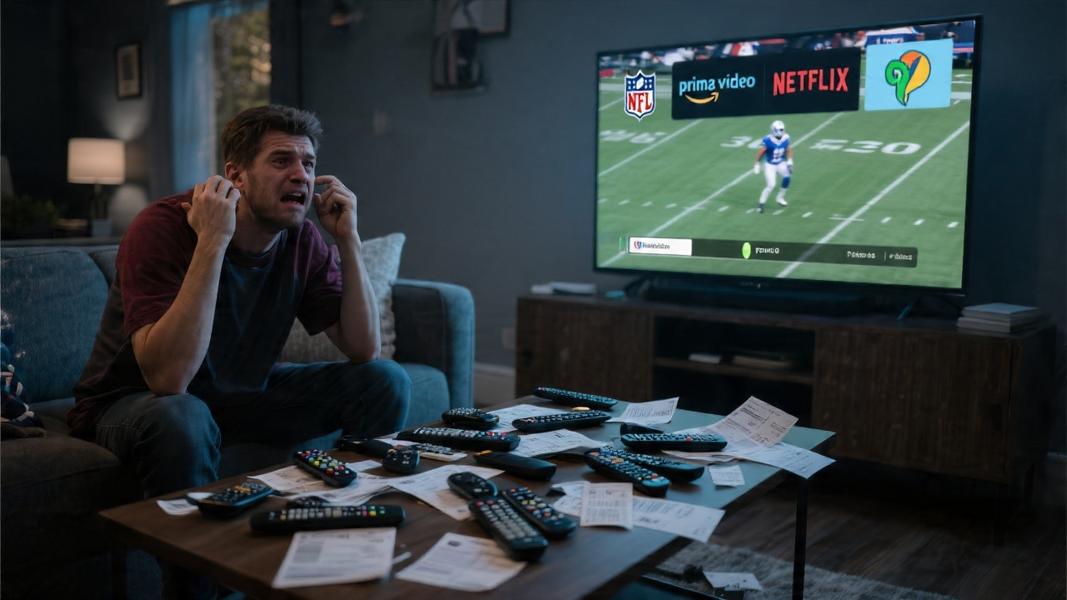
American sports fans are fed up — and now the federal government is paying attention. The Federal Communications Commission has launched a formal public inquiry into the rapid migration of live sports away from free over-the-air television and onto a growing constellation of subscription streaming platforms, a shift that critics say is pricing millions of ordinary viewers out of their own national pastime.
The FCC’s move marks one of the most significant federal examinations of sports broadcasting rights in years. At its core, the inquiry asks a deceptively simple question: should Americans have to pay — sometimes handsomely — just to watch a game their parents watched for free? The answer, at least from the public, appears to be a resounding no.
A Flood of Complaints — and a Commissioner Who’s Listening
FCC Commissioner Olivia Trusty hasn’t been shy about where she stands. In remarks that reported widespread concern, Trusty cited the sheer volume of public pushback the agency has received. “Indeed, more than 8,000 people have submitted comments at the FCC — with 98% of those comments expressing frustration with the streaming migration trend and their hope that broadcast will remain the pre-eminent platform for watching their favorite team,” she said.
That’s not a small sample. Eight thousand people taking time to file formal regulatory comments about a sports broadcasting issue is, by Washington standards, a genuine groundswell. Most federal comment periods struggle to generate a fraction of that engagement. The fact that 98% are singing the same tune makes the signal hard to ignore.
The Price Tag That Started the Conversation
How bad has it gotten? According to the FCC’s own findings, NFL games alone aired across 10 different services in 2025 — and fully subscribing to all of them would cost a viewer more than $1,500 per year. That’s not a cable bundle from 2005. That’s a car payment.
The fragmentation is the real story here. It’s one thing to lose a game to a single premium channel. It’s another to watch the same league scatter its schedule across a dozen platforms, each with its own monthly fee, its own login, its own app that crashes during the fourth quarter. Fans aren’t just frustrated — they’re exhausted.
The FCC Steps Into the Arena
Still, federal regulators don’t typically wade into sports rights disputes without careful footing. The FCC’s public notice, which formally asked for comment on sports rights and broadcasting — “Today, the FCC asks for comment on sports rights and broadcasting,” as the agency noted — signals that the commission is at least willing to examine whether existing broadcast rules are keeping pace with a media landscape that looks almost nothing like it did a decade ago.
Among the specific areas under review are blackout restrictions — the longstanding rules that can prevent local fans from watching their own team if a game isn’t sold out — and whether those rules, originally designed for a broadcast-only world, make any coherent sense in the streaming era. The commission is also exploring what tools, if any, it has to push live sports back toward free over-the-air television.
Leagues, Money, and the Uncomfortable Truth
But it’s not that simple. Sports leagues aren’t moving to streaming out of spite — they’re following the money, and the money is staggering. Streaming platforms have been willing to write checks that traditional broadcast networks simply can’t match, and leagues have fiduciary obligations to their owners and stakeholders that don’t bend easily to public sentiment or regulatory pressure.
That said, there’s a longer-term tension buried in this arrangement. The NFL, NBA, and MLB built their cultural dominance — and their billion-dollar valuations — on the back of mass audiences that free broadcast television delivered for generations. Whether streaming can replicate that reach, or whether leagues are slowly trading their broadest audience for their most lucrative one, remains an open and genuinely consequential question.
What Comes Next
The FCC’s inquiry is still in its early stages, and any regulatory action — if it comes at all — would face significant legal and political hurdles. Sports broadcasting rights are private contracts, and the government’s ability to dictate their terms is limited. But the inquiry itself sends a message, and in Washington, messages matter.
For now, millions of fans are left doing the math — figuring out which subscriptions to keep, which games to skip, and whether the sport they grew up watching on a Saturday afternoon is slowly becoming something only certain people can afford to see. The FCC may not have an answer yet. But at least, for the first time in a while, someone in a position of authority is asking the question out loud.
