
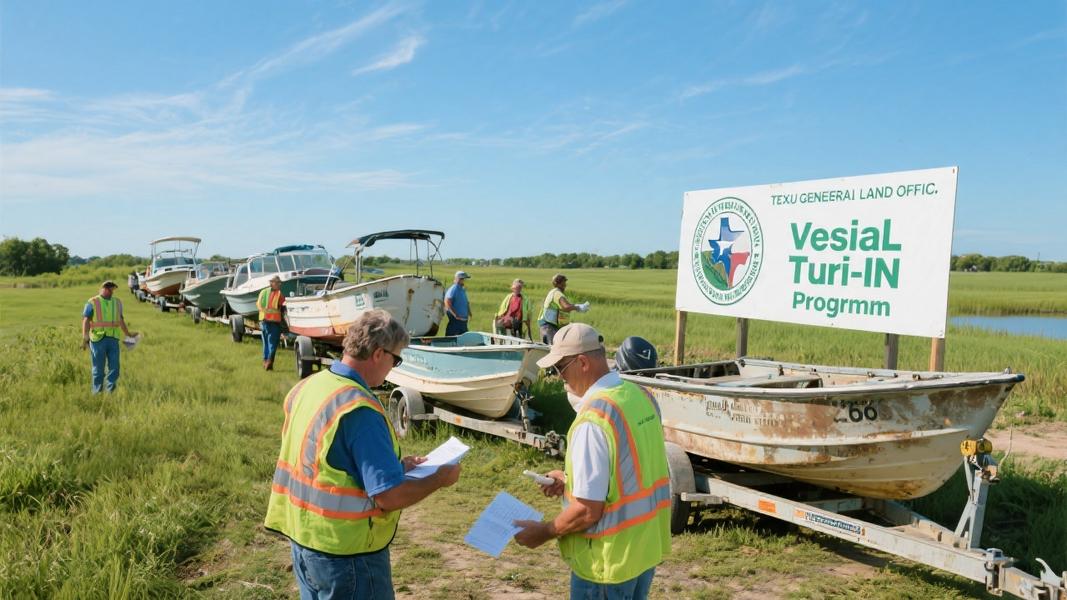
Abandoned boats don’t just look bad — they’re an environmental headache that can cost taxpayers a small fortune to clean up. Now, Orange County residents have a rare chance to hand over their unwanted vessels for free, no questions asked.
Texas Land Commissioner Dawn Buckingham is urging residents to take advantage of the state’s Vessel Turn-In Program (VTIP), with drop-off dates scheduled for May 2, 5, 7, and 9, 2026, running from 10:00 a.m. to 6:00 p.m. The Texas General Land Office (GLO), in partnership with Orange County and the Texas Parks and Wildlife Department (TPWD), is footing the bill — meaning vessel owners pay absolutely nothing to offload boats that might otherwise sit rotting on a waterway for years. Announced by the GLO, the event is part of a broader push to keep the Texas coast clean and navigable.
How It Works — And Who Qualifies
The drop-off point is the Orange County Collection Station at 11265 FM 1442, Orange, TX 77632. But not every rusty hull qualifies. Eligible vessels must be no longer than 26 feet, owned by county residents who can provide proof of ownership, free of any liens, and cleared of waste before arrival. Once a boat is dropped off, the GLO covers the removal of fuel, oil, and batteries, while TPWD handles ownership verification on-site. Orange County then provides the drop-off infrastructure and landfill access — a genuine three-agency operation, which is either impressively coordinated or a sign of just how serious the abandoned-vessel problem has gotten. Probably both.
Why does any of this matter? Consider the cost. Removing an abandoned vessel from a waterway runs roughly $1,000 per linear foot. A beat-up 20-foot skiff left to decay in a bayou isn’t just an eyesore — it’s a potential $20,000 liability for taxpayers. Multiply that across hundreds of boats scattered along the Texas coast and the numbers get ugly fast. The VTIP essentially lets owners surrender vessels before they become someone else’s problem, and the state absorbs the disposal costs rather than scrambling for emergency removal funds later.
A Program With a Track Record
This isn’t a pilot experiment. Since launching in 2015, VTIP has hosted 49 events, removing 1,928 boats totaling a staggering 31,407 linear feet of hull. That’s nearly six miles of abandoned watercraft pulled off Texas waterways. The program has also recovered thousands of gallons of fuel and oil — hazardous materials that, left unchecked, leach directly into coastal ecosystems.
Orange County, in particular, has proven to be fertile ground for the effort. Last year’s event — held across five days in April 2025 — saw residents relinquish 71 boats measuring over 876 linear feet. That haul also included 7 batteries, 16 fire extinguishers, and 10 trailers. It’s the kind of turnout that suggests the demand is real — and that plenty of residents have been waiting for exactly this opportunity.
Free Disposal, No Catch
Still, it’s worth spelling out what “free” actually means here. There’s no fee to participate. Owners simply show up during event hours, demonstrate they own the vessel, and hand it over. The GLO and its partners handle everything from there — hazardous material extraction, transport, and disposal. For someone sitting on a decomposing boat with no easy way to get rid of it, that’s a genuinely significant offer. Private disposal of an inoperable vessel can cost hundreds to thousands of dollars depending on size and condition.
The GLO has been clear that the program exists to prevent the far costlier alternative: state-funded emergency removal after a vessel has already been abandoned in a waterway, contaminating water and blocking navigation. Prevention, in this case, is dramatically cheaper than cleanup.
Eleven years in, nearly two thousand boats removed, and the line keeps forming. That’s not just a government program doing its job — that’s a quiet reminder of how much unwanted debris accumulates along a coastline when people don’t have an easy, affordable way out. Give them one, and they’ll use it.
