
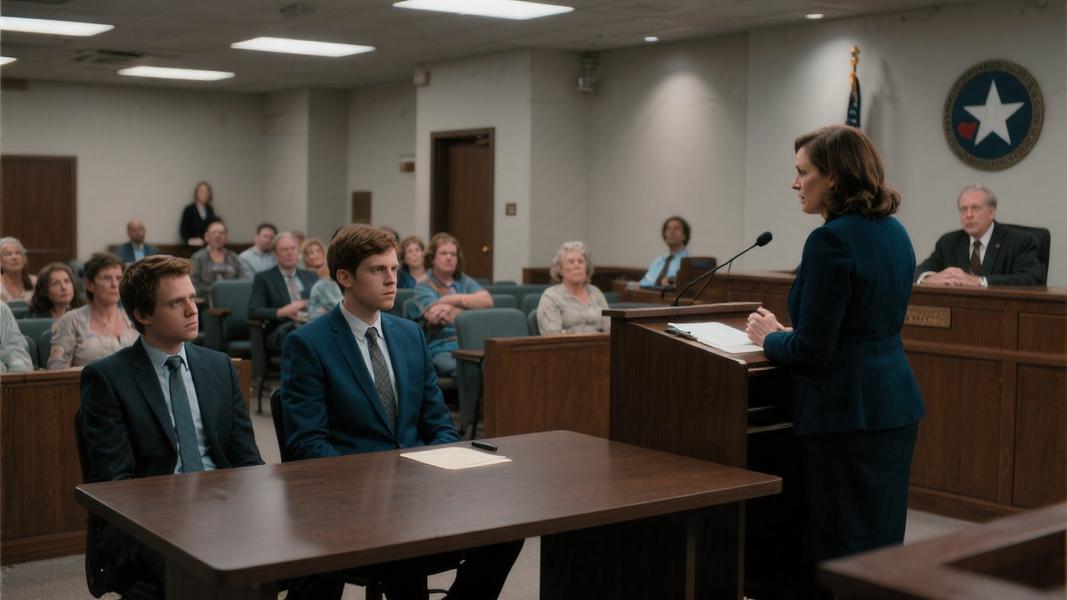
The man accused of abducting and killing seven-year-old Athena Strand in November 2022 had one of the worst social cognition evaluations a forensic speech pathologist had ever administered. That was the stark testimony that opened Day 12 of Tanner Horner‘s capital murder trial in Texas.
Horner, a FedEx delivery driver, has already confessed to strangling Athena and dumping her body near Boyd, Texas. The guilt phase is largely settled. What’s at stake now is whether he lives or dies — and his defense is leaning heavily on a constellation of neurological and developmental factors they argue make executing him constitutionally and morally wrong.
A Devastating Evaluation
Dr. Fritz, a speech language pathologist brought in by the defense, didn’t mince words on the stand. Horner, she testified, struggled profoundly with the basic mechanics of human interaction — not just small talk, but the foundational social contracts most people never consciously think about. “He was one of the worst, if not the worst evaluations I’ve ever given,” she said. “Mr. Horner has significant difficulty with social appropriateness. So, inappropriate use of humor. He sort of lacks in his understanding and use of those speech acts — the inability to form an appropriate way of asking for something, or asking for clarification, or offering an apology.”
How bad is that, exactly? Bad enough that Fritz identified what’s called alexithymia — a clinical difficulty feeling and processing one’s own emotions — a trait commonly associated with Autism Spectrum Disorder. She also noted significant deficits in empathy and perspective-taking. But she was careful not to let the diagnosis become a blanket excuse. “If your cause to action is to abduct a child and kill them because you think they may have seen you do cocaine,” she said, “you are definitely not understanding their perspective.” She added, almost reluctantly, that the situation could hypothetically function as a triggering event for someone on the spectrum — but the framing was clinical, not exculpatory.
Perhaps the most chilling detail Fritz offered was about how Horner’s language changed during the abduction itself. At first, she noted, it was “cautious, easy and not scary.” Then it shifted — dramatically. “His language became highly disrespectful and horrific toward Athena,” she testified. She said she didn’t see the kind of emotional dysregulation typically present in autistic individuals before a violent episode, but that something clearly unraveled as the crime unfolded. That’s not a defense. It’s a portrait.
Voices From His Past
The defense also called Pastor Gary, who recalled a moment from Horner’s high school years that stuck with him. During a music competition, Horner’s drumstick broke mid-performance. The reaction was immediate and intense. “It put him into a panic,” the pastor recounted. “I think a lot of it was due to his autism a little bit, but also just letting the team down.” Horner ran from the room as soon as the routine ended, visibly distressed — but, the pastor was quick to note, “he wasn’t violent toward anybody. He was really just upset with himself.” The two prayed together after Horner’s arrest, the pastor added quietly.
Then there was Beth, a speech pathologist who worked with Horner nearly two decades ago. She described a young man who couldn’t read social cues, struggled with routine changes, had difficulty identifying his own emotions, and couldn’t reliably tell the difference between teasing and bullying — all hallmarks of Asperger’s syndrome. Her conclusion, delivered with the weight of professional certainty: “This young man should have never been in that truck by himself.”
A Mother’s Anguish
Horner’s own mother took the stand and broke down. She disclosed a history of substance abuse during the early part of her pregnancy — a detail the defense flagged as relevant to his neurological development. But her most raw moment had nothing to do with mitigation strategy. “I’m so mad at him,” she said through tears. “I want to just tear his a– up. She was just a baby.” There’s no clean way to process a mother testifying against her son’s execution while simultaneously expressing rage at what he did. It was, by any measure, a brutal few minutes in that courtroom.
Lead, Autism, and the Death Penalty
The defense’s broader case against capital punishment rests on two pillars. First, Horner’s Autism Spectrum Disorder, which his attorneys argue diminishes his moral blameworthiness in a way the law must reckon with. Second — and perhaps more concrete — is the evidence of severe childhood lead exposure. Defense experts presented data showing Horner’s blood lead level as a child measured 12.1 micrograms per deciliter — roughly 24 times higher than the average of 0.5 micrograms for children his age. That level, they argued, is consistent with significant and lasting brain damage.
It’s not a new legal strategy — pointing to damaged neurology in capital cases has a long precedent — but the combination of documented lead poisoning, an ASD diagnosis, and a battery of expert testimony makes this one harder to dismiss outright. Defense experts argued that Horner’s mental state was fundamentally compromised long before he ever climbed into that delivery truck.
What the Medical Examiner Found
Still, none of that context softens what Dr. Jessica Dwyer, the medical examiner, described on the stand. Her findings were clinical and devastating: Athena Strand died from a combination of blunt force injuries, smothering, and strangulation. Dr. Dwyer testified that she believes the child suffered. There are no words adequate to that finding, and the defense knows it. Whatever the jury ultimately decides about Tanner Horner’s brain chemistry or developmental history, they will carry that image with them into deliberations.
The question the jury must now answer isn’t whether Horner did it — he did, and he said so. It’s whether the broken architecture of a man’s mind, shaped by lead and neurology and a childhood that left him ill-equipped for the world, is enough to pull him back from the edge of a death sentence. As Dr. Fritz put it, he couldn’t understand another person’s perspective. The jury, in the end, will have to understand his.
