
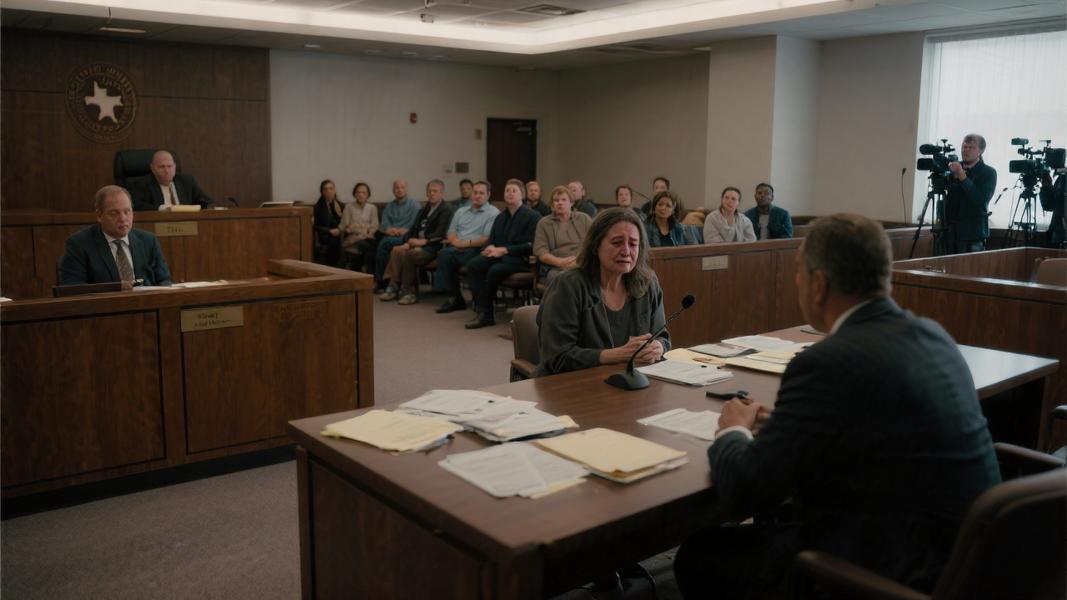
A Texas courtroom spent its twelfth day steeped in some of the most difficult testimony imaginable — experts dissecting the mind of a man who abducted and killed a 7-year-old girl, while her family sat just feet away.
Tanner Horner has already pleaded guilty to capital murder and kidnapping in the 2022 death of Athena Strand, the Wise County child he snatched while delivering a FedEx package to her home on November 30, 2022. What’s left for the jury to decide is whether he lives or dies. And so the battle has shifted — from facts to psychology, from guilt to moral weight — in a penalty phase that has drawn competing portraits of who, exactly, Tanner Horner is.
One of the Worst Evaluations She’s Ever Given
The defense called Dr. Fritz, a speech language pathologist, to the stand Wednesday. Her assessment of Horner wasn’t subtle. “He was one of the worst, if not the worst evaluations I’ve ever given,” she testified. “Mr. Horner has significant difficulty with social appropriateness. So, inappropriate use of humor. He sort of lacks in his understanding and use of those speech acts — the inability to form an appropriate way of asking for something, or asking for clarification, or offering an apology.”
How bad is that, exactly? Bad enough, she suggested, that it speaks to something deeper than mere personality. The defense has argued throughout the penalty phase that Horner suffers from Autism Spectrum Disorder, and that his diagnosis should reduce his moral blameworthiness — effectively undercutting the retributive and deterrent rationale for a death sentence.
Dr. Fritz also addressed what may be the central question haunting this case: what kind of thinking leads a man to abduct and kill a child because he feared she’d seen him use cocaine? “If your cause to action is to abduct a child and kill them because you think they may have seen you do cocaine, you are definitely not understanding their perspective,” she said. “And at the same time, it hypothetically could be a triggering event.” It’s a clinical answer to a question most people can barely bring themselves to ask.
Alter Egos, Suicide Notes, and a Mother’s Confession
Still, Dr. Fritz stopped short of diagnosing Horner with multiple personality disorder. She believes he used an alter ego he called “Zero” not as evidence of a fractured psyche, but as a narrative tool — a way of telling his story at a remove. She also pointed to his suicide note as evidence of genuine remorse, a detail the defense is leaning on heavily.
Then came Horner’s mother. She took the stand and offered testimony that was, in its own way, shattering. She admitted to using drugs — “anything I could get my hands on,” she said — before discovering she was eight or nine weeks pregnant with Tanner. She said she tried to stop when she found out. What the jury does with that information is another matter entirely.
The Prosecution’s Answer
The state isn’t buying the autism argument. Not even close. Dr. Michael Rambula, called as a rebuttal witness for the prosecution, reviewed Horner’s records and interviewed him personally. His conclusion: Horner is not autistic. The competing expert testimony puts the jury in the uncomfortable position of deciding which doctor to believe — and what that belief means for a man’s life.
Prosecutors, for their part, have not let the courtroom forget what this case is actually about. They described Athena as a “warrior” who fought her attacker — a detail that lands differently when you know what the medical examiner found. Dr. Jessica Dwyer testified that Athena died from a combination of blunt force injuries, smothering, and strangulation, and that she believed the child suffered.
The prosecution also told jurors that Horner made sure he had the same FedEx delivery truck each day — a detail they framed as evidence of premeditation, not impulse. And they reminded the jury of the first words Horner ever said to Athena Strand: “Don’t scream or I’ll hurt you.” They also asked jurors to consider, plainly, what “a 200-pound man can do to a 67-pound child.”
What Comes Next
The trial’s penalty phase is now in its final stretch, with both sides having laid out their competing visions of Tanner Horner — broken product of a chaotic upbringing, or cold and calculating predator. Maybe both things are true. The jury will have to live with whichever answer they arrive at.
Athena Strand would have turned 9 years old this past year. She never got the chance to ask for clarification, offer an apology, or say anything at all — the very social skills Dr. Fritz spent a day testifying that her killer lacks.
