
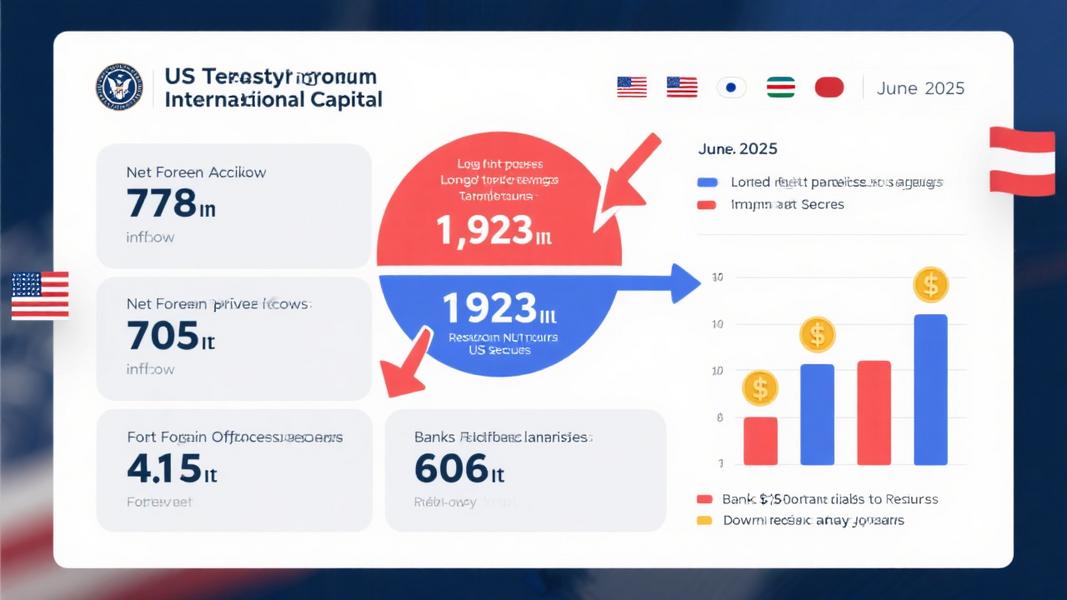
U.S. Treasury reports a significant $77.8 billion net inflow of foreign capital in June 2025, marking a sharp decline from May’s robust figures. The latest Treasury International Capital (TIC) data reveals a complex picture of international investment patterns as global markets navigate mid-year adjustments.
The Treasury Department announced the June figures on Thursday, showing that while foreign interest in U.S. securities remains strong, the total represents a substantial drop from the $311.1 billion inflow recorded in May. The June numbers reflect a combination of $7.3 billion in net foreign private inflows and a much larger $70.5 billion from official foreign institutions.
Foreign Investment Patterns
What’s driving these capital movements? Foreign investors significantly increased their holdings of long-term U.S. securities, with net purchases totaling $192.3 billion in June. Private foreign investors accounted for $154.6 billion of this total, while foreign official institutions contributed $37.7 billion.
At the same time, U.S. residents weren’t sitting idle. They increased their holdings of long-term foreign securities with net purchases of $41.5 billion, continuing a trend of diversification into international markets.
“The overall picture shows continued confidence in U.S. markets despite some monthly volatility,” said a market analyst familiar with Treasury data. “When adjustments like estimated foreign portfolio acquisitions through stock swaps are included, the net foreign purchases of long-term securities reached $150.8 billion for June.”
Short-Term Securities and Banking Flows
The short-term securities market tells a different story. Foreign residents increased their holdings of U.S. Treasury bills by $9.8 billion, but their overall holdings of dollar-denominated short-term U.S. securities and other custody liabilities actually decreased by $12.4 billion.
Perhaps most notably, banks’ own net dollar-denominated liabilities to foreign residents fell by $60.6 billion. This significant banking outflow offset much of the positive movement in securities markets, contributing to the relatively modest overall net inflow figure for the month.
Market watchers note that these fluctuations aren’t unusual during mid-year adjustments, though the magnitude of the drop from May’s figures has raised some eyebrows.
Data Limitations
There’s a catch to interpreting these figures, however. The Treasury Department acknowledges that TIC data, while comprehensive, can’t always accurately attribute ownership of U.S. securities. When securities are held in custodial accounts in third countries or managed by foreign portfolio managers, the true ownership may not be reflected in the reported data.
“These figures give us an important snapshot, but they’re not perfect,” explained an economist specializing in international capital flows. “The complex web of global financial intermediaries means we’re always working with a slightly blurred picture.”
These limitations haven’t stopped analysts from drawing conclusions about the health of U.S. markets and their continued appeal to foreign investors, despite increasing global competition for capital.
The Treasury Department will release the next set of TIC data, covering July 2025, on September 18. Until then, market participants will be closely watching other economic indicators for signs of whether June’s lower inflows represent a temporary adjustment or the beginning of a new trend in international capital movements.
