
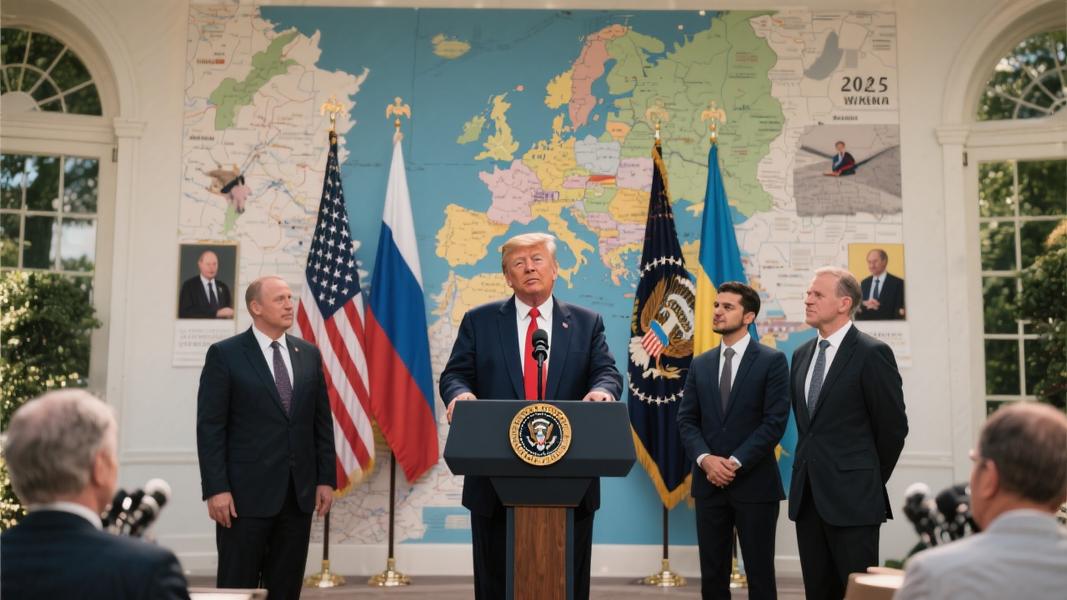
Secretary of State Marco Rubio declared Sunday that the Trump administration is aiming for a comprehensive peace agreement to end the Russia-Ukraine conflict, not merely a temporary ceasefire, following the high-stakes summit between President Trump and Russian President Vladimir Putin in Alaska.
“It was agreed to by all that the best way to end this conflict is through a full peace deal. There’s no doubt about that,” Rubio stated during a media briefing. “What we’re aiming for here is not a ceasefire — what we ultimately are aiming for is an end to this war.”
Trump as Mediator: The Only Leader Who Can Bring Putin to the Table
The diplomatic push continues Monday as Ukrainian President Volodymyr Zelensky arrives in Washington for talks with Trump, a visit that comes on the heels of what Trump characterized as a “very successful” meeting with Putin. The quick succession of high-level meetings underscores the administration’s determination to broker an end to a conflict that has dragged on for more than three years.
Rubio emphasized America’s unique position in the peace process. “This is not our war. The United States is not in a war. Ukraine is in a war, and we’ve been supporting Ukraine,” he explained. “We happen to be in the role of the only country in the world with the only leader in the world that can actually bring Putin to a table to even discuss these things.”
Special Envoy Steve Witkoff, who participated in the Alaska summit, expressed optimism about the discussions, noting that “robust security guarantees” had been agreed upon that he described as “game-changing.”
Difficult Compromises Ahead
Can both sides really come to terms after years of brutal conflict? That’s the challenge facing negotiators, with Rubio acknowledging the difficult realities of peace-making.
“The only way to reach a deal is for each side to get something and each side to give something — and that’s been very difficult. If it was easy, this wouldn’t have been going on for three and a half years,” Rubio remarked. “That’s why Zelensky is coming tomorrow… We are trying to find what can we get to that both sides can agree on.”
Putin himself has called the Alaska summit “timely and very useful,” suggesting that addressing the “root causes” of the war “should be the basis of a settlement.”
According to Witkoff, Russia has shown signs of flexibility that weren’t evident during the previous administration. “We began to see some moderation in the way [Russia is] thinking about getting to a final peace deal — and so we feel that that’s encouraging,” he noted.
Behind-the-Scenes Diplomacy
Rubio pushed back against calls for public disclosures about specific demands made during the talks with Putin. “Of course, concessions were asked — but what utility would there be of me going on a program and telling you we wagged our finger at Putin and told him you must do this and you must do that? It’s only going to make it harder and less likely that they’re going to agree to these things,” he argued.
“As much as everyone would love it to be a live pay-per-view event, these discussions only work best when they are conducted privately in serious negotiations,” Rubio added.
Following the Alaska summit, Trump immediately placed a late-night call to Zelensky and European leaders to discuss the path forward. “In order for us to get a peace agreement, Ukraine has to be a part of it. They have to be included; they have to be involved,” Rubio insisted. “That’s why the President called him on the phone immediately… That’s why President Zelensky will be traveling to Washington tomorrow.”
Ukraine’s Role and Media Misconceptions
Witkoff emphasized that while Trump is acting as mediator, the territorial decisions ultimately rest with Ukraine. “The President, as a mediator, was looking for ways to solve the crisis. He understands that it is for the Ukrainians to decide how they might land swap, how they might make a deal with the Russians on different territories there,” he clarified.
Rubio took aim at what he characterized as misleading media narratives about Zelensky’s visit. “This is such a stupid media narrative that they’re coming here tomorrow because Trump is going to bully Zelensky into a bad deal,” he said. “We’ve been working with these people for weeks. They’re coming here tomorrow because they chose to come here tomorrow. We invited them to come.”
The administration has also resisted calls for additional sanctions against Russia, with Rubio warning that such moves would undermine Trump’s unique position: “There’s only one leader in the world that has any chance of bringing these two sides together… that’s President Trump, and you forfeit that role the minute you put additional sanctions on.”
The Path to Peace
Witkoff reported that following the summit, all parties recognized significant progress. “We were on the phone with President Zelensky moments after the Alaska summit ended… Everybody recognized on that telephone call — and there were various European leaders — how much progress we had made in demonstrating that the Russian Federation was going to make significant accommodations well beyond we thought before that summit started.”
Still, the road ahead remains challenging. Rubio acknowledged the uncomfortable compromises that peace will require: “In order for there to be a peace deal — this is just a fact, we may not like it, it may not be pleasant, it may be distasteful — but in order for there to be an end to the war, there are things that Russia wants that it cannot get and there are things that Ukraine wants that it’s not going to get. Both sides are going to have to give up something in order to get to the table.”
Despite these challenges, Rubio credited Trump for prioritizing peace in a conflict he inherited: “What the President deserves a lot of credit for is the amount of time and energy that his administration is placing on reaching a peace agreement for a war that’s not a war that started under him. It’s on the other side of the world… He has made it a priority of his administration to stop wars or prevent them.”
As Zelensky arrives in Washington Monday, the world will be watching to see whether Trump’s unorthodox approach to diplomacy can achieve what has eluded his predecessors — bringing an end to Europe’s largest land war since World War II.
