
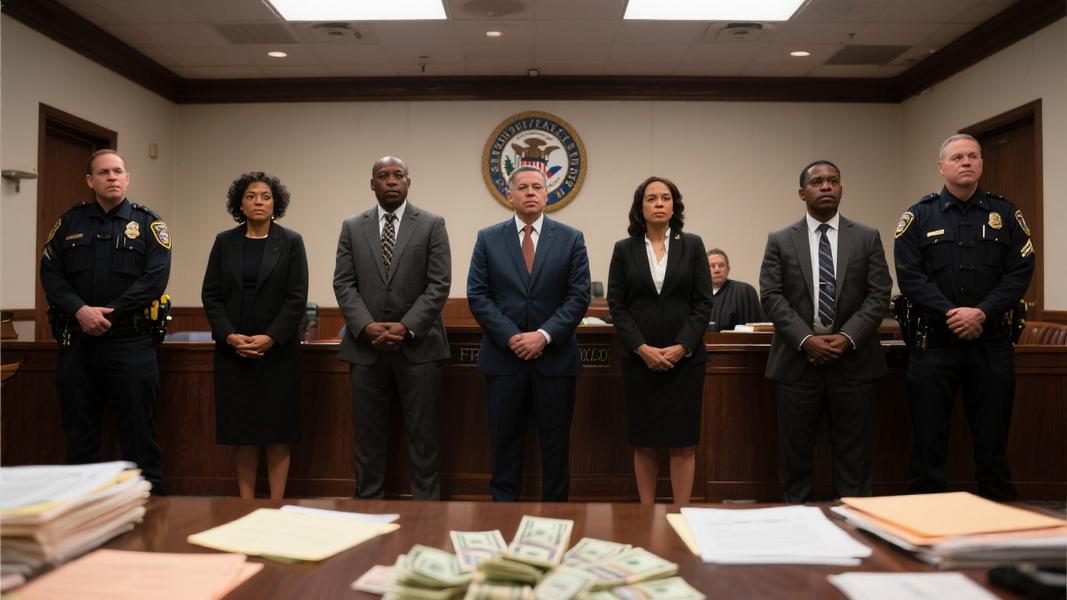
Eight Sentenced in $17 Million COVID Relief Fraud Scheme
A Tennessee man has been sentenced to nearly two years in prison, becoming the final defendant punished in a sprawling fraud case that siphoned over $17 million from pandemic relief programs designed to help struggling businesses.
Frederick Smith, 56, of Cordova, Tennessee, received a 23-month prison sentence for his role in the scheme, federal prosecutors announced on Tuesday. His sentencing marks the conclusion of a case that has seen eight defendants collectively sentenced to 96 months in prison and 45 months of home detention after pleading guilty to wire fraud charges.
Web of Deception
The operation wasn’t just brazen — it was systematic. Court documents reveal the defendants obtained funds from the Economic Injury Disaster Loan (EIDL) program and Paycheck Protection Program (PPP) by submitting applications riddled with false statements about their businesses’ employee counts, revenues, and monthly payrolls. The fraudulent applications were primarily prepared by Rodrick Flowers alongside other co-conspirators, according to authorities who investigated the case.
How did they use the illicit windfall? Not for business expenses as required by program rules. Instead, prosecutors say the funds were diverted to unauthorized personal expenses — exactly the type of abuse that critics warned about when these emergency programs were rapidly deployed during the pandemic’s economic fallout.
“This case represents one of the more significant COVID relief fraud schemes we’ve prosecuted,” said Acting Assistant Attorney General Matthew R. Galeotti in a statement. “The defendants exploited programs meant to be a lifeline for struggling businesses during an unprecedented crisis.”
Varying Sentences
The punishments handed down varied significantly among the defendants. Flowers, 49, of Memphis, received the harshest sentence at 58 months in prison — more than double Smith’s term. Jarvys Jones, 40, of West Memphis, Arkansas, was sentenced to 12 months behind bars.
Other defendants received lighter sentences. Mary Payne, 63, of Memphis, was ordered to serve six months in prison followed by five months of community confinement and five months of home detention. Cleveland Wells, 67, and LaTonya Herman, 46, both of Memphis, received just one month in prison each, followed by five months of home detention.
The remaining defendants — Brian Mays, 41, of Olive Branch, Mississippi, and Krystall Sherrod, 36, of Memphis — avoided prison entirely but were sentenced to 18 months and 12 months of home detention, respectively, as detailed in court records.
The case highlights the ongoing efforts to prosecute pandemic-era fraud, which has become a priority for the Department of Justice. Multiple agencies collaborated in the investigation, including the Treasury Inspector General for Tax Administration, the Federal Housing Finance Agency Office of Inspector General, and the Federal Deposit Insurance Corporation Office of Inspector General.
While the $17 million scheme is substantial, it represents just a fraction of the estimated billions in fraudulent claims made against COVID relief programs. The unprecedented scale and speed of pandemic aid distribution created vulnerabilities that opportunistic fraudsters were quick to exploit.
For small business owners who struggled to obtain legitimate relief during the pandemic’s darkest days, these sentences may offer little consolation. But they send a clear message that the government continues to pursue those who diverted emergency funds from their intended purpose — even years after the programs have ended.
