
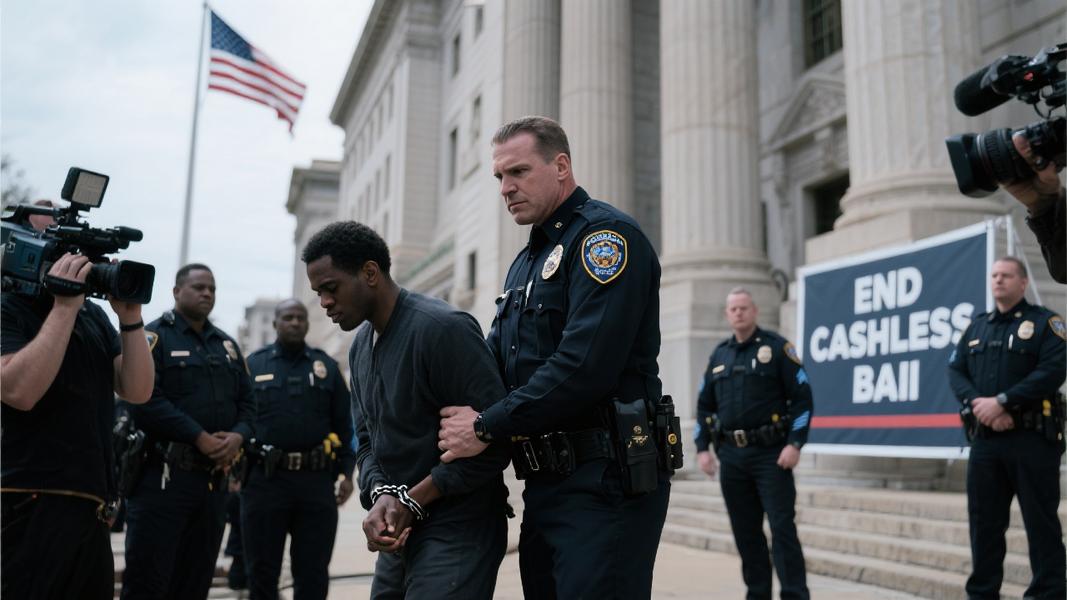
President Trump has signed an executive order targeting Washington D.C.’s cashless bail system, directing federal law enforcement to hold arrestees in federal custody “to the fullest extent” permitted by law and pursue federal charges whenever possible for those deemed threats to public safety.
The order, signed on August 25, 2025, instructs members of the D.C. Safe and Beautiful Task Force to maximize federal detention for arrestees in the District and seek pretrial detention for defendants who pose safety risks, according to a White House statement.
Crackdown on Cashless Bail
At the heart of the order is a directive for the Attorney General to determine whether D.C. continues to maintain what Trump calls a “cashless bail policy” for crimes including murder, rape, carjacking, assault, burglary, and looting. If such policies remain in place, the administration is instructed to take “appropriate actions” – potentially including decisions about federal funding, services, or approvals for the District.
“Every place in the country where you have no-cash bail is a disaster,” Trump said, specifically pointing to New York and Chicago as examples. “Bad politicians started it, bad leadership started it. But that was the one thing that’s central. No-cash bail. Somebody murders somebody and they’re out on no-cash bail before the day is out.”
The order is part of a broader strategy following Trump’s August 11th declaration of a “crime emergency” in Washington, D.C. That declaration serves as the legal foundation for what the White House describes as “all necessary and lawful measures” to end cashless bail policies and ensure pretrial detention for suspects deemed dangerous.
Mixed Research on Bail Reform
But does the research support Trump’s characterization of cashless bail systems? The picture is more nuanced than either supporters or critics might suggest.
Some studies indicate that eliminating money bail increased recidivism for certain groups – specifically people charged with nonviolent felonies, those with recent criminal history, and individuals with recent violent felony arrests. However, the same research found decreased recidivism for misdemeanants and people without recent criminal history, suggesting a complex relationship between bail policies and public safety outcomes.
The executive order takes aim directly at D.C.’s pretrial release system, claiming it creates conditions where “law enforcement must arrest the same individuals multiple times, and dangerous criminals are sometimes rapidly released.” This, the order argues, endangers “American citizens visiting our Nation’s capital, Federal workers discharging their duties to our Nation, and citizens of the District of Columbia trying to live their lives safely.”
Federal Authority Over D.C.
The administration is leveraging Section 740 of the District of Columbia Self-Government and Governmental Reorganization Act to enable the Attorney General to request that D.C.’s Mayor update Metropolitan Police Department policies that might lead to the pretrial release of defendants considered dangerous.
Critics may question whether this represents federal overreach into local governance. Washington, D.C. has long operated under a unique status — technically not a state but granted certain self-governance rights while remaining ultimately under congressional authority.
The executive order instructs that if D.C.’s cashless bail policy remains intact, the administration will “take appropriate actions, which may include Federal funding decisions, services, or approvals,” raising the specter of financial pressure on the District to change its policies.
As this policy takes effect, the question remains whether the federal government’s intervention will achieve its stated goal of improving public safety in the nation’s capital, or whether it represents a shift in the delicate balance of power between federal authorities and the District’s local government.
