
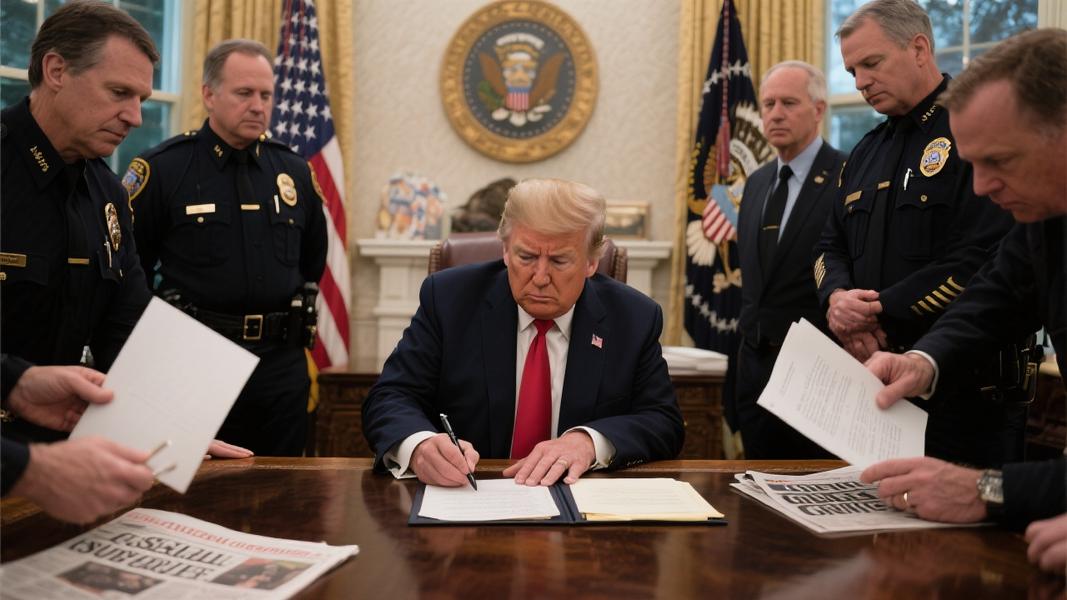
President Trump has signed a sweeping executive order targeting cashless bail policies across the nation, marking a significant shift in federal pressure on state and local criminal justice systems.
The order directs the Attorney General to identify jurisdictions that have “substantially eliminated cash bail” for serious crimes, with the explicit threat of suspending or terminating federal funding to those areas. It represents one of the administration’s most aggressive moves yet to influence local law enforcement policies from Washington.
D.C. as the Testing Ground
Washington, D.C. — already under direct federal control following Trump’s mobilization of the National Guard earlier this month — will serve as the first target for the policy reversal. “We’re ending it. But we’re starting by ending it in D.C., and that we have the right to do through federalization,” Trump stated before signing the order.
The president has taken the unusual step of assuming direct control of the D.C. Metro Police Department, with National Guard troops now authorized to carry service weapons under what officials describe as strict rules of engagement. The White House claims this intervention has already led to a period with no murders in the district.
Ironically, D.C. was among the first American cities to embrace cashless bail, having introduced such policies in the 1990s over civil rights concerns. Now it finds itself at the center of a dramatic policy reversal.
The Crime Argument
What’s driving this push? The executive order cites a 2023 study from Yolo County, California that found its “Zero Bail” policy resulted in a 163% increase in crime and a 200% increase in violent crime compared to cases where bail was posted.
Trump has been characteristically blunt about his views on the issue: “When I’m reelected, I will crack down on the left-wing jurisdictions that refuse to prosecute dangerous criminals and set loose violent felons on cashless bail… If you kill somebody, there’s no bond. Don’t worry about it. Go ahead. Kill somebody else. These people are crazy, I’ll tell you,” he declared.
The administration points to several high-profile cases as evidence of cashless bail’s dangers. In one particularly troubling example, a suspected member of the notorious Tren de Aragua gang, freed without bail after an attempted murder charge in New York, was subsequently arrested in Miami for drug trafficking, released again, and finally detained for alleged sex-trafficking of a minor across multiple states.
Other cases highlighted include a repeat offender with 47 prior arrests and 28 convictions who was released without bail, as well as convicted killers and homicide suspects freed in major cities like New York and Rockford.
Law Enforcement Impacts
“Our brave law enforcement officers risk their lives to arrest dangerous criminals, only to be forced to arrest the same individuals, sometimes for the same crimes, while they await trial on the previous charges – a waste of public resources and obvious threat to public safety,” the executive order argues.
Under the order, the Attorney General has 30 days to compile a list of jurisdictions that have “substantially eliminated cash bail as a potential condition of pretrial release from custody for crimes that pose a clear threat to public safety and order, including offenses involving violent, sexual, or indecent acts, or burglary, looting, or vandalism.”
The move has set up what will likely be a contentious legal battle. Civil liberties groups have long advocated for bail reform, arguing that traditional cash bail systems disproportionately impact low-income defendants who cannot afford to pay for their pretrial freedom.
But for now, at least in Washington, D.C., the policy pendulum is swinging decisively back toward stricter pretrial detention — with the weight of federal authority behind it.
