
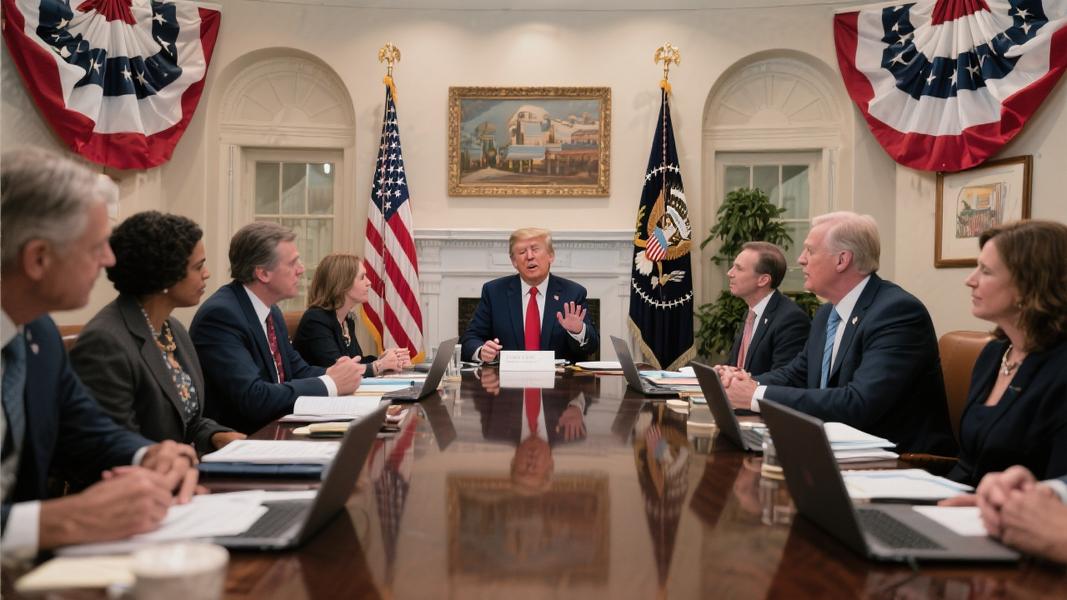
The Trump administration is painting a portrait of resurgent American prosperity eight months into its second term, with Cabinet members touting everything from record-low illegal border crossings to revitalized rural economies during a pre-Labor Day meeting at the White House.
In what amounted to a victory lap ahead of the holiday weekend, President Trump gathered his full Cabinet on Monday to highlight what officials described as transformative economic gains for American workers. The meeting showcased a series of bold claims from administration officials — from multi-decade lows in fuel prices to a dramatic reversal in wage growth that began almost immediately after Trump’s January inauguration.
Economic Turnaround Takes Center Stage
The president opened the session by highlighting what he characterized as rising blue-collar wages, unprecedented private sector job growth, increased domestic steel production, and landmark tax cuts achieved in his first eight months back in office.
U.S. Trade Representative Jamieson Greer provided perhaps the most striking economic claim, stating that median weekly earnings had fallen 2.1% in the last quarter of 2024 under President Biden, but jumped 3.3% in the first quarter of Trump’s term. “That’s why we’re doing the trade policy we’re doing. It’s to help the workers of the United States,” Greer said.
Labor Secretary Lori Chavez-DeRemer reported steady unemployment rates and the addition of “more than two million net jobs for native-born Americans” under Trump’s leadership. She emphasized that 84% of jobs have been produced by the private sector, crediting the administration’s signature legislation — nicknamed the “One Big Beautiful Bill” — for expanding Pell Grants and childcare while reducing taxes.
Small Business Administrator Kelly Loeffler characterized the bill as delivering “the largest tax cut in American history for working families,” claiming the average family of four would save about $10,000 in take-home pay annually. The legislation also increases the Child Tax Credit and standard deduction, she said.
Immigration and Public Safety Claims
Some of the boldest assertions came from Secretary of Homeland Security Kristi Noem, who claimed the administration has achieved “three months in a row now with zero illegal aliens coming into our country” — a remarkable turnaround from the record-high border crossings that defined much of the previous administration.
Noem also stated that 1.6 million people who were in the country illegally have “voluntarily” returned to their home countries, though she didn’t specify the timeframe or circumstances surrounding these departures.
Is America safer? That’s what several Cabinet members insisted. Vice President JD Vance emphasized that “public safety is not just something that should belong to the wealthy. It should belong to every working man and woman in the United States of America — and because of the work of this Administration, that is happening.”
Attorney General Pam Bondi pointed to ongoing efforts to combat drug trafficking, particularly fentanyl and methamphetamines brought in by transnational criminal organizations. “It’s killing our kids and we have to stop that — and that’s what you’ve been doing, not only in D.C., but around the country at your leadership,” she told the president.
Rural America and Infrastructure
Several Cabinet members focused on initiatives targeting rural communities. Secretary of Agriculture Brooke Rollins described the administration’s signature legislation as “the greatest investment in rural America in history… A game-changer, a country saver.”
Meanwhile, Health and Human Services Secretary Robert F. Kennedy, Jr. announced what he called “the biggest infusion in history” for rural hospitals and communities, increasing funding by 50%. “We can’t survive as a nation if we don’t honor our rural communities,” Kennedy said.
Transportation Secretary Sean Duffy indicated plans to speed up infrastructure projects by removing what he described as bureaucratic obstacles. “We want to take the money that Congress gives us and actually deploy it and put these men and women to work building the great projects of this country,” Duffy said, adding that the department has “got rid of the DEI, we’ve got rid of the ‘green'” to move projects faster.
Defense and Intelligence Shifts
The meeting also revealed significant policy shifts in defense and intelligence agencies. Secretary of Defense Pete Hegseth declared that the military, “the largest employer in America,” has moved away from what he characterized as “social justice” and “political correctness” that had been “seeping into the ranks” under previous administrations.
“Now, it is only merit-based, gender-neutral, colorblind, the best of the best from the top to the bottom. That is our expectation,” Hegseth said.
Director of National Intelligence Tulsi Gabbard made a cryptic but notable comment about recent revelations: “We’ve exposed some of the worst examples of the weaponization of Intelligence in the last several weeks. I will continue down that mission and that path — wherever it leads.”
CIA Director John Ratcliffe added that “the CIA workforce at the Trump CIA is grateful to be focused on what it’s supposed to be, which is helping you prevent and end wars and to make America safer.”
Deregulation Push
Several officials highlighted ambitious deregulation efforts. Interior Secretary Doug Burgum credited the administration’s success to “lower taxes, way lower deregulation, record amounts of investments that’s coming into this country,” adding, “we’re going to be seeing lower interest rates. All of those things coming together is a gift to the working people.”
EPA Administrator Lee Zeldin made perhaps the boldest regulatory promise: “In one agency, in one year, we’ll do more deregulation than entire federal governments have done across all agencies across entire presidencies.”
Office of Management and Budget Director Russ Vought quantified the effort, claiming the administration has planned 245 deregulatory initiatives across agencies. “That comes out to 30-for-1, so we are making incredible strides,” he said.
Commerce Secretary Howard Lutnick used the meeting to allege that the previous administration had attempted to disburse $7.4 billion in CHIPS Act funding just four days before Trump took office. “They set up… a make-believe not-for-profit. They signed contracts to wire them $7.4 billion,” Lutnick claimed. “We stopped the payment. We’ve got the money.”
As Labor Day approaches, the administration’s messaging suggests it’s betting that economic issues — particularly those affecting blue-collar and rural Americans — will remain central to its political strategy. Whether the data will ultimately support the sweeping claims made during Monday’s Cabinet meeting remains to be seen.
