
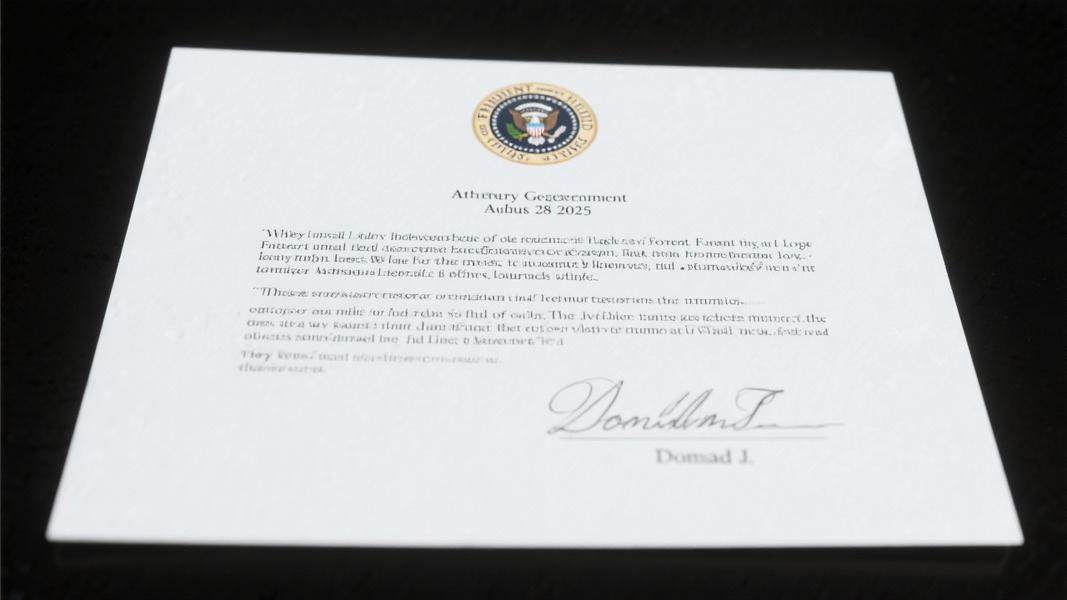
President Trump has launched a sweeping investigation into potential misuse of federal grant money for lobbying or partisan activities, marking his administration’s latest effort to tighten control over billions in government funding.
In a memorandum issued August 28, Trump directed Attorney General to investigate whether federal grant funds are being used illegally for lobbying or partisan political activities. The directive specifically references federal statute 31 U.S.C. 1352, which prohibits using federally appropriated funds to lobby government officials.
“I hereby direct the Attorney General, in consultation with the heads of executive departments and agencies, to investigate whether Federal grant funds are being used to illegally support lobbying activities,” Trump stated in the memo. The Attorney General must report progress within 180 days.
Broader Crackdown on Federal Grant Spending
The investigation comes on the heels of an August 7 Executive Order that fundamentally reshapes federal grant oversight. That order, titled “Improving Oversight of Federal Grantmaking,” requires agency heads to designate senior political appointees to review all discretionary grants and funding announcements.
These appointees will be tasked with ensuring grants align with “agency priorities and the national interest” — a significant shift from previous practice where career officials and subject matter experts typically managed the grant review process.
Why the sudden focus on grant oversight? The administration has signaled concerns about ideological bias in federal funding decisions.
“Federal law places strict limitations on the use of Federal grant funds, and in many instances prohibits grantees from lobbying with appropriated funds or supporting political candidates or parties with grant funds,” the memorandum notes.
New Termination Powers
Perhaps most significantly, the Executive Order mandates that agencies must include termination-for-convenience clauses in all discretionary grant agreements. These provisions would allow the government to end grants if they no longer support agency or national priorities.
According to analysis by Crowell & Moring, this requirement effectively concedes “that it lacks authority to terminate grants for these reasons based on the current terms in most agreements.”
Within 30 days of the EO’s release, agency heads must review existing grants and submit reports to the Office of Management and Budget detailing what percentage of current awards include such termination clauses.
Controversial Funding Restrictions
The Executive Order goes further by explicitly prohibiting grant funding for certain initiatives. What’s off-limits?
Funding is “expressly prohibited for grants deemed to relate to race, gender identity, undocumented immigrants, or ‘initiatives that compromise public safety or promote anti-American values,'” according to a Crowell & Moring analysis.
The EO also takes aim at the role of experts in the grant-making process. It specifically prohibits senior appointees from “ministerially ratify[ing] or routinely defer[ing] to the recommendations of others in reviewing [funding opportunity announcements] or discretionary awards,” as explained by law firm Venable.
Instead, political appointees must “substantively” participate in funding decisions — a shift that critics worry could politicize what has traditionally been a merit-based process.
Shifting Power Dynamics
The combined effect of the memorandum and Executive Order represents a significant realignment of federal grant oversight. The EO explicitly states that “discretionary awards must, where applicable, demonstrably advance the President’s policy priorities.”
This marks a departure from previous administrations’ approaches, which typically deferred to congressional appropriations language and agency expertise in determining funding priorities.
For the thousands of organizations that rely on federal grant funding — from universities and hospitals to local governments and nonprofits — these changes could introduce new uncertainty into an already complex process. As implementation unfolds over the coming months, many will be watching to see how strictly these new rules are interpreted and enforced.
