
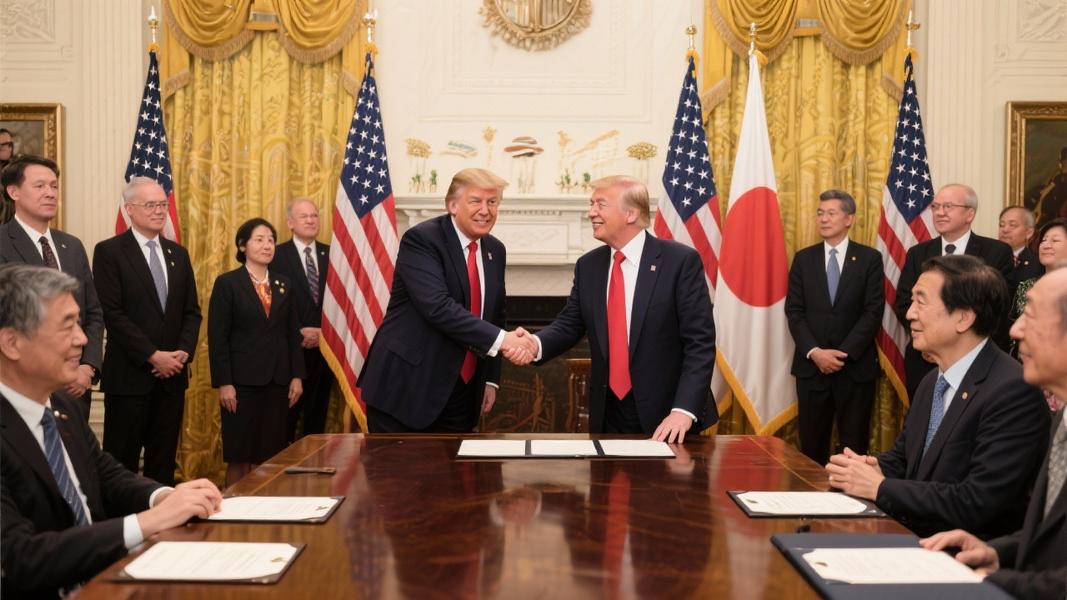
President Trump has signed a landmark trade agreement with Japan that gives American businesses unprecedented access to Japanese markets while imposing a 15% tariff on most Japanese imports to the United States. The deal, part of a broader trade strategy, includes over $15 billion in market access for U.S. producers and a massive $550 billion Japanese investment commitment targeted at critical American industries.
Agricultural Windfall and Energy Purchases
The framework agreement delivers immediate benefits to American farmers, with Japan committing to purchase $8 billion in U.S. agricultural goods including corn, soybeans, and fertilizers. The deal also includes a 75% increase in American rice purchases, according to a White House statement detailing the agreement’s provisions.
Beyond agriculture, Japan has agreed to make “stable and long-term incremental purchases of U.S. energy, including liquified natural gas, totaling $7 billion per year,” the administration announced.
Perhaps most striking is the breakthrough on automotive trade. After decades of restrictions, Japan will now recognize U.S. automotive standards and lift longstanding barriers to American vehicles, creating “billions of dollars in increased market access for U.S. automakers,” according to the White House fact sheet. The agreement also ensures Japan will provide Clean Energy Vehicle subsidies for American cars, potentially addressing a longstanding trade imbalance in the automotive sector.
The $550 Billion Investment
What’s the real game-changer here? Japan’s historic $550 billion investment commitment to fund projects across the United States in sectors deemed critical for national security. These investments will target industries including semiconductors, pharmaceuticals, metals, critical minerals, shipbuilding, energy infrastructure, and advanced technologies like artificial intelligence and quantum computing.
“Japan’s historic $550 billion investment commitment to President Trump will be invested in U.S. projects selected by President Trump, creating hundreds of thousands of U.S. jobs, dramatically expanding domestic manufacturing, and securing American prosperity for generations,” the administration explained.
The investments are expected to create “hundreds of thousands of U.S. jobs” while expanding domestic manufacturing capacity in sectors critical to economic and national security.
Tariff Structure and Additional Commitments
In exchange for these concessions and investments, the United States will apply a baseline 15 percent tariff on nearly all Japanese imports, including automobiles and auto parts. The deal includes “separate sector-specific tariff treatment” for certain industries including steel, aluminum, copper, aerospace products, and pharmaceuticals.
The agreement also includes provisions for Japanese purchases of U.S.-made commercial aircraft and defense equipment. Additionally, Japan will now “accept for sale in Japan United States-manufactured and United States-safety-certified passenger vehicles without additional testing,” according to the presidential order implementing the agreement.
Both countries have committed to aligning their economic and national security interests, with plans to strengthen supply chain resilience, combat non-market policies and duty evasion, and cooperate on investment security and export controls.
Part of a Broader Trade Strategy
The Japan agreement represents just one piece of Trump’s aggressive trade agenda. The administration has recently secured deals with several major trading partners, including what it calls a “massive deal” with the European Union.
That EU agreement includes commitments for the EU to purchase $750 billion in U.S. energy and invest $600 billion in the United States by 2028, while accepting a 15% tariff rate on their goods entering the U.S. market.
The administration has also finalized a trade deal with the United Kingdom providing “billions of dollars of increased market access for American exports,” alongside agreements with Indonesia, the Philippines, South Korea, Vietnam, and others designed to “protect our industries, open foreign markets, and encourage foreign investment in American industries,” the White House noted.
Administration officials frame these agreements as fulfilling Trump’s promise to address what they view as decades of unfair trade practices that have disadvantaged American workers. “Since Day One, President Trump challenged the assumption that American workers and businesses must tolerate unfair trade practices that have disadvantaged them for decades and contributed to our historic trade deficit,” the White House declared.
While the deals represent significant shifts in America’s trade relationships, economists and industry groups are still analyzing the long-term implications of the tariff structures and whether the promised investments and market access will materialize on the ambitious timeline outlined by the administration.
