
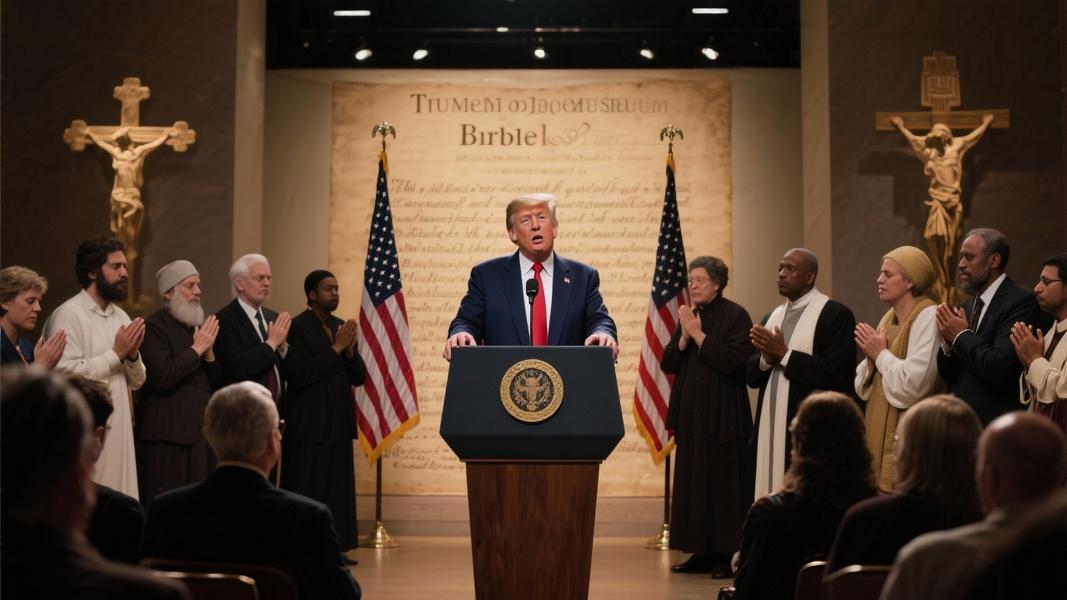
President Donald Trump is doubling down on faith as a cornerstone of American identity, launching several religious initiatives and challenging long-held interpretations of church-state separation during a major address to religious leaders.
“When faith gets weaker, our country seems to get weaker. When faith gets stronger… good things happen for our country,” Trump declared at the event, where he outlined his administration’s religious agenda ahead of next year’s 250th anniversary of the Declaration of Independence.
Faith at the Center
The speech marked a decisive pivot toward religious themes in Trump’s second term, as he announced plans for new Department of Education guidance protecting prayer in public schools. It’s a move certain to energize his evangelical base while alarming church-state separation advocates.
“I am pleased to announce this morning that the Department of Education will soon issue new guidance protecting the right to prayer in our public schools,” Trump stated, framing the initiative as part of a broader effort to restore religious expression in public life.
Central to Trump’s vision is the “America Prays” initiative, which has already enlisted more than 70 faith organizations and churches nationwide. The campaign aims to foster community transformation through coordinated prayer efforts leading up to the semiquincentennial celebrations.
“Think about the miracles that would take place over the next year… the transformation that you and I could witness in communities all across the land,” Trump suggested, inviting “America’s great faith communities to pray for our nation, for our people, and for peace in the world.”
Institutional Changes
Beyond rhetoric, Trump has established concrete institutional changes to advance his religious agenda. The White House Faith Office, led by longtime Trump spiritual adviser Paula White, was created in February 2025 to protect religious liberty and assist faith-based organizations.
He’s also formed a Religious Liberty Commission chaired by Texas Lieutenant Governor Dan Patrick through an executive order earlier this year. But what exactly does this commission aim to accomplish? According to Trump, it’s part of a broader initiative to defend what he calls “God-given rights.”
“America has always been a nation that believes in the power of prayer and we will never apologize for our faith — ever, ever, never, never,” Trump emphasized. “We will never surrender our God-given rights. We will defend our liberties, our values, our sovereignty, and we will defend our freedom.”
Church and State
The president’s approach represents a significant challenge to traditional interpretations of the separation of church and state, with Trump explicitly stating that “we’re bringing religion back to our country.”
During his address, Trump took aim at Virginia Senator Tim Kaine, criticizing him for questioning the notion that rights derive from a divine source.
“The need for this commission has never been more clear than it was last week when the ineffectual Senator from Virginia — a man named Tim Kaine — stated that the notion our rights come from our Creator is ‘extremely troubling’ to him,” Trump asserted. “It’s this Declaration of Independence that proclaims we’re endowed by our creator with the right to Life, Liberty, and the Pursuit of Happiness. The Senator from Virginia should be ashamed of himself.”
Trump also highlighted what he characterized as religious persecution in education, sharing the story of a 12-year-old student allegedly forced to read material contradicting his religious beliefs. “Last year, in fifth grade, Shay was forced to read a book to a Kindergarten student promoting a message of radical gender ideology that is contrary to his religious beliefs and ours,” Trump recounted.
Education Initiatives
Beyond prayer in schools, Trump is advancing religious values through educational policy. “As part of our tax cuts, we’ve created a massive tax credit for school choice scholarships so that you can send your child to a school that shares your values,” he explained.
The administration is also targeting what it perceives as bias in higher education. “I’m also taking action against anti-semitic and anti-Christian bias in our institutions of higher learning,” Trump added.
Throughout his address, Trump repeatedly connected faith to national identity and prosperity. “To have a great nation, you have to have religion. I believe that so strongly,” he affirmed. “There has to be something after we go through all of this — and that something is God.”
As the nation approaches its 250th birthday, Trump’s faith initiatives represent more than policy — they reflect a fundamental vision of American identity. “We are One Nation Under God,” he insisted, “and we always will be.”
