
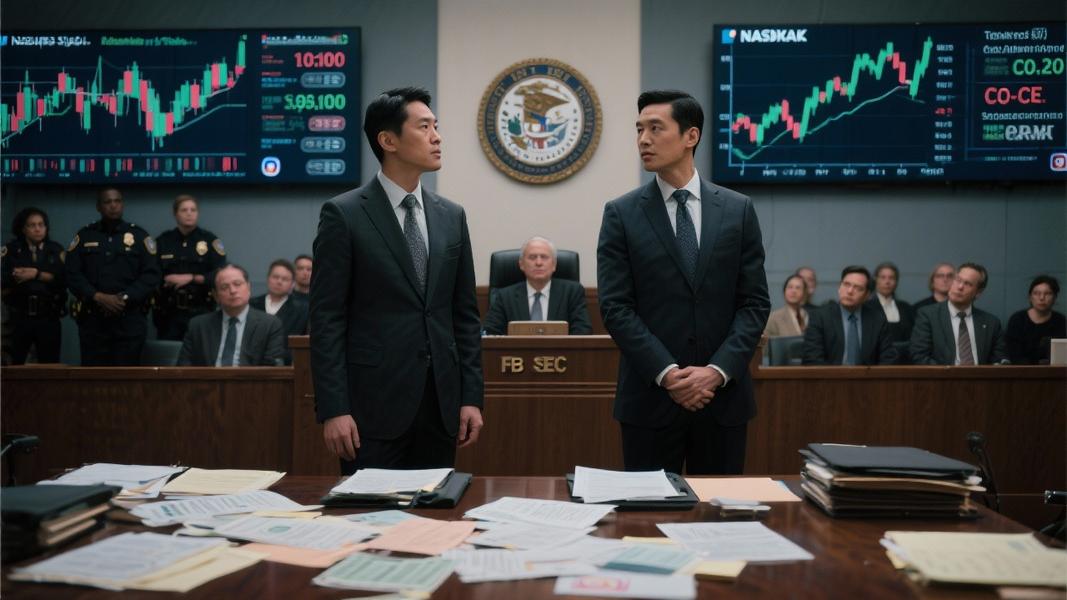
Federal authorities have indicted two men in a massive securities fraud scheme that bilked investors out of more than $100 million through an elaborate pump-and-dump operation involving a Chinese display technology company’s stock.
Lai Kui Sen, co-CEO of Ostin Technology Group (OST), and financial advisor Yan Zhao (who used aliases Hank Shi and Hank Shu) face multiple charges including conspiracy to commit securities fraud and wire fraud after allegedly orchestrating a sophisticated social media campaign to artificially inflate OST shares between April and June 2025, according to a federal indictment.
The Anatomy of a Pump-and-Dump
The scheme’s breathtaking scale involved distributing over 70 million OST shares to fifteen co-conspirators through what prosecutors describe as “non-bona fide securities transactions.” In plain language: the shares were handed out without payment, creating a massive pool of stock that could later be dumped on unsuspecting investors.
“In one of these transactions, these co-conspirators paid nothing to OST for more than 70 million OST shares,” the Justice Department revealed.
What followed was a coordinated social media blitz where conspirators allegedly impersonated legitimate investment advisors to create the illusion of market momentum and investor interest in OST stock. The timing appears strategic — on April 14, 2025, OST entered a Securities Purchase Agreement to sell approximately 9 million Class A ordinary shares at $0.55 per share with warrants, as documented in SEC filings.
Devastating Collapse
The house of cards eventually collapsed. On June 26, 2025, OST’s stock price imploded, losing over 94% of its market value in a single day — a staggering loss of more than $950 million in market capitalization.
But that wasn’t the end of the nightmare for investors who had been caught in the scheme. The stock continued its free fall in subsequent days, plummeting from around $0.45 on June 27 to ultimately bottom out at approximately $0.08 per share — representing a catastrophic 99% loss from peak to trough.
“Ultimately, according to the indictment, unwitting investors suffered significant losses when, on June 26, 2025, OST lost over $950 million in market capitalization, representing over 94% of its value,” the Justice Department stated.
International Dimensions
Who exactly is Ostin Technology Group? The company is registered in the Cayman Islands with its principal operations in China, manufacturing display modules for consumer electronics, commercial displays, and automotive applications. OST traded publicly on NASDAQ and operated through a variable interest entity (VIE) investment structure — a complex arrangement often used by Chinese companies to gain access to U.S. capital markets while navigating Chinese regulations on foreign ownership.
The international scope of the scheme prompted the FBI to publicly seek victims of the fraud. Agents confirmed that fraudsters had impersonated U.S. financial professionals to artificially pump OST’s stock price, suggesting the scam spanned international borders and involved operators based in East Asia.
How did authorities catch on? The investigation was a collaborative effort between the FBI, SEC Office of Inspector General, and DOJ Criminal Division, with FINRA’s Market Abuse Group making the initial referral — highlighting the growing coordination between regulatory agencies to combat sophisticated cross-border financial crimes.
Legal Consequences
The defendants now face serious legal jeopardy. If convicted, Sen and Zhao could receive maximum sentences of up to 25 years for securities fraud, 20 years for conspiracy and wire fraud, and an additional 20 years for Title 15 securities fraud.
“The defendants targeted American retail investors through a predatory pump and dump scheme to take advantage of the artificial inflation of the price of OST shares,” said Acting Assistant Attorney General Matthew R. Galeotti in a statement.
U.S. law enforcement officials emphasized their commitment to protecting American investors from foreign fraud schemes. “Securities fraud by foreign actors not only exploits fair investment practices, but also defrauds American investors and harms U.S. markets,” added FBI Assistant Director Jose A. Perez.
The case serves as a stark reminder of the vulnerabilities in today’s interconnected financial markets, where social media manipulation and cross-border schemes can rapidly separate investors from their money before regulators can intervene — leaving ordinary investors holding virtually worthless shares and regulatory agencies playing catch-up in an increasingly complex financial landscape.
