
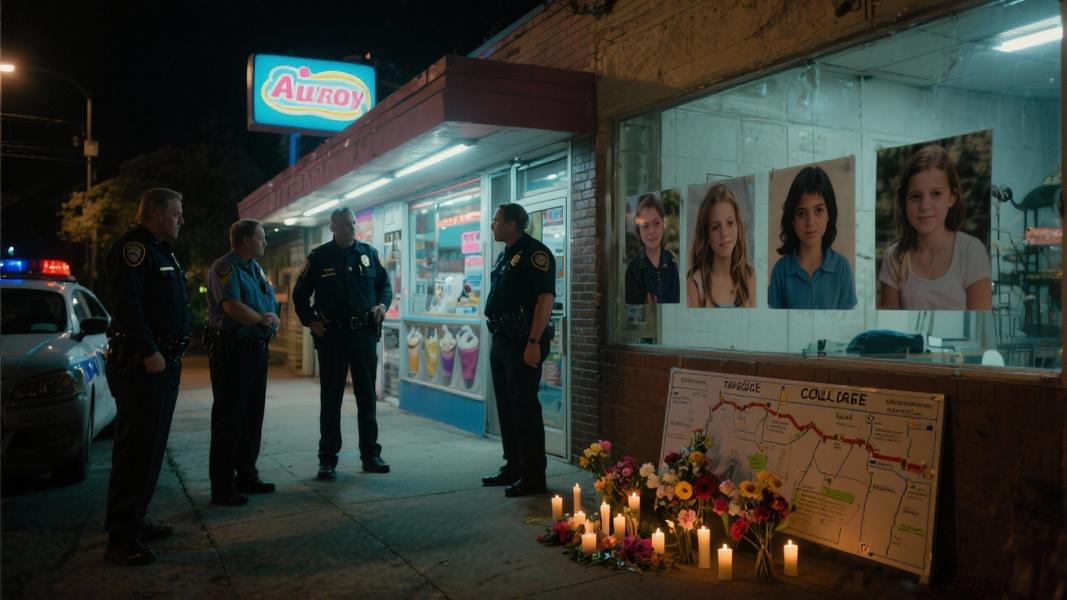
After more than three decades of mystery, investigators believe they’ve finally cracked one of Austin’s most notorious cold cases. Texas Attorney General Ken Paxton announced Monday that his Cold Case and Missing Persons Unit has identified Robert Eugene Brashers as the suspected killer in the horrific 1991 yogurt shop murders that left four teenage girls dead.
The breakthrough brings new hope for closure in a case that has haunted the Texas capital for generations. Brashers, who died by suicide during a police standoff in 1999, has been linked to the murders through advanced DNA testing techniques that weren’t available when the crimes were committed.
A Crime That Shocked Austin
The brutal killings occurred on December 6, 1991, at an I Can’t Believe It’s Yogurt shop in north Austin. The victims — Jennifer Harbison, 17, her sister Sarah Harbison, 15, Eliza Thomas, 17, and Amy Ayers, 13 — were closing the shop when they were attacked.
What investigators discovered was nothing short of horrific. “The four girls have been gagged, tied up with their own clothing, and shot in the head. Investigators would learn that at least one of the victims had been sexually assaulted. The yogurt shop had also been set on fire, destroying potential evidence,” according to case documents from the investigation.
The fire was likely an attempt to destroy forensic evidence, complicating investigators’ efforts from the start. Despite this, biological evidence was recovered from at least one victim — evidence that would ultimately prove crucial decades later.
How DNA Finally Cracked the Case
For years, the case seemed unsolvable. Previous suspects were charged but later released when DNA evidence didn’t match. The investigation stalled repeatedly, becoming one of Texas’s most infamous cold cases.
Could advanced forensic technology finally provide answers? It appears so. “34 years later, Austin police say they have identified the suspect as Robert Eugene Brashers, using a wide range of DNA testing. He died by suicide in a separate incident with police in 1999,” investigators confirmed.
Brashers won’t face justice in court, but his identification brings a measure of resolution to families who’ve waited more than three decades for answers. The suspect was already dead when investigators connected him to the crime — he took his own life during a 1999 police standoff in Missouri, long before he became a suspect in the Austin murders.
“My team has worked tirelessly on this case for years, and this development is a testament to their dedication and hard work,” said Attorney General Paxton in Monday’s statement. The announcement comes after years of renewed investigation by the Cold Case and Missing Persons Unit.
A Killer’s Dark History
The identification of Brashers isn’t just significant for the Austin case — it connects dots across multiple states. Authorities have now linked him to a string of violent crimes throughout the 1990s, including murders and sexual assaults in Missouri, South Carolina, and Tennessee.
This pattern of violence raises troubling questions. How did Brashers manage to commit crimes across state lines without being caught? And why did it take so long to connect these cases?
The answer lies partly in the limitations of forensic technology at the time and the challenges of cross-state information sharing before modern database systems were fully implemented.
While the identification brings some closure, it also opens wounds for the victims’ families who have endured decades of uncertainty. For the tight-knit community that rallied around them, the news represents both an answer to long-standing questions and a reminder of an unimaginable loss.
The case stands as a testament to the value of cold case units and advancing DNA technology. Even decades later, justice — or at least answers — may still be possible for families of victims in unsolved cases.
