
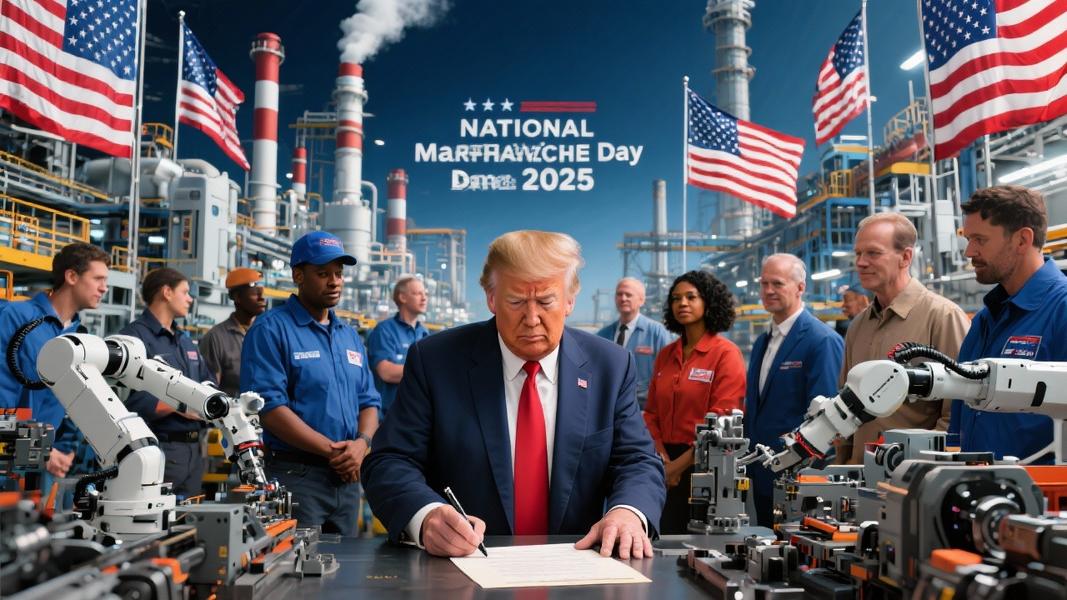
In a sweeping proclamation celebrating American manufacturing this month, the White House has painted a glowing picture of industrial resurgence under the second Trump administration — even as key economic indicators tell a more complicated story about the sector’s actual performance.
President Trump’s proclamation declares manufacturing “the foundation of our prosperity, the strength of our communities, the safeguard of our independence, and the engine of our greatness,” while touting $5 trillion in new investments secured during his first 100 days back in office. The administration claims these investments created more than 450,000 new jobs and set “the stage for a new era of American manufacturing dominance.”
Rhetoric vs. Reality
But the triumphant language comes against a backdrop of troubling data. Manufacturing employment has actually declined by 10,000 jobs over the past six months through June 2025, with the sector now employing 12,750,000 workers — down 89,000 compared to June 2024.
“By placing reciprocal tariffs on foreign nations whose trade policies threaten our economy, we are protecting American manufacturing from the unfair practices that have hollowed out our manufacturing base in past decades,” the proclamation states, adding that these tariffs have “brought in billions of dollars in revenue” that will be “invested in communities from coast to coast.”
The administration also celebrates the passage of the “One Big Beautiful Bill Act,” which enacted “100 percent immediate expensing for new factories and industrial improvements,” positioning the U.S. as “the investment capital of the world.”
What’s actually happening on factory floors across America? The U.S. manufacturing Purchasing Managers Index (PMI) has been shrinking since February 2025, falling below the critical 50-point threshold that separates growth from contraction.
Tariffs and Trade Tensions
Central to the administration’s manufacturing strategy are tariffs aimed at raising revenue and incentivizing domestic production. “After 4 years of decline and stagnation, we are cutting red tape, rejecting the failures of the Green New Scam agenda, and pursuing bold reforms that save taxpayers billions of dollars every year,” the proclamation asserts.
Yet some of these policies appear to be creating new disruptions. A 25 percent tariff on cars from Canada and Mexico introduced earlier this year has severely disrupted the North American automotive supply chain, forcing companies like Stellantis to scale back operations, leading to temporary shutdowns and workforce reductions at plants across the Midwest.
“Already, my Administration has brought in billions of dollars in tariff revenue,” the proclamation touts, though it doesn’t address the immediate impact on domestic manufacturers caught in cross-border supply chains.
The Automation Factor
There’s another dimension to the manufacturing story that doesn’t appear in the White House proclamation: productivity is rising even as employment falls. Manufacturing sector labor productivity increased 2.5 percent in Q2 2025, with output rising 2.4 percent while hours worked actually declined slightly.
This paradox — more production with fewer workers — points to the accelerating role of automation and artificial intelligence in manufacturing. The proclamation does acknowledge this trend, noting that “through a whole-of-government approach to workforce development, my Administration is also harnessing artificial intelligence to accelerate productivity, revitalize manufacturing, create new industries, and ensure no American workers are left behind.”
Technologies like machine vision, robotics, and real-time analytics are enabling manufacturers to increase output while minimizing labor requirements. This technological transformation may explain why manufacturing output rose for a fourth consecutive month in September 2025, even as companies reported declining new orders and a buildup of unsold finished goods.
Looking Ahead
Can manufacturing truly become “the engine of our greatness” again as the proclamation suggests? That remains an open question. While the administration’s focus on reshoring production and strengthening supply chains addresses real vulnerabilities exposed during the pandemic, the sector faces structural challenges that tariffs alone can’t solve.
The sector’s momentum has clearly slowed through August 2025, with sustained contraction in key indicators and growing employment losses, despite strategic investments and AI adoption.
For now, the manufacturing sector appears caught between competing forces: policy initiatives designed to revitalize domestic production, global trade tensions that disrupt established supply chains, and technological changes that boost productivity while potentially limiting job growth. As one administration official put it off the record, “We’re building the plane while flying it.”
