
U.S. and Australia Forge $1 Billion Critical Minerals Alliance to Counter China’s Dominance
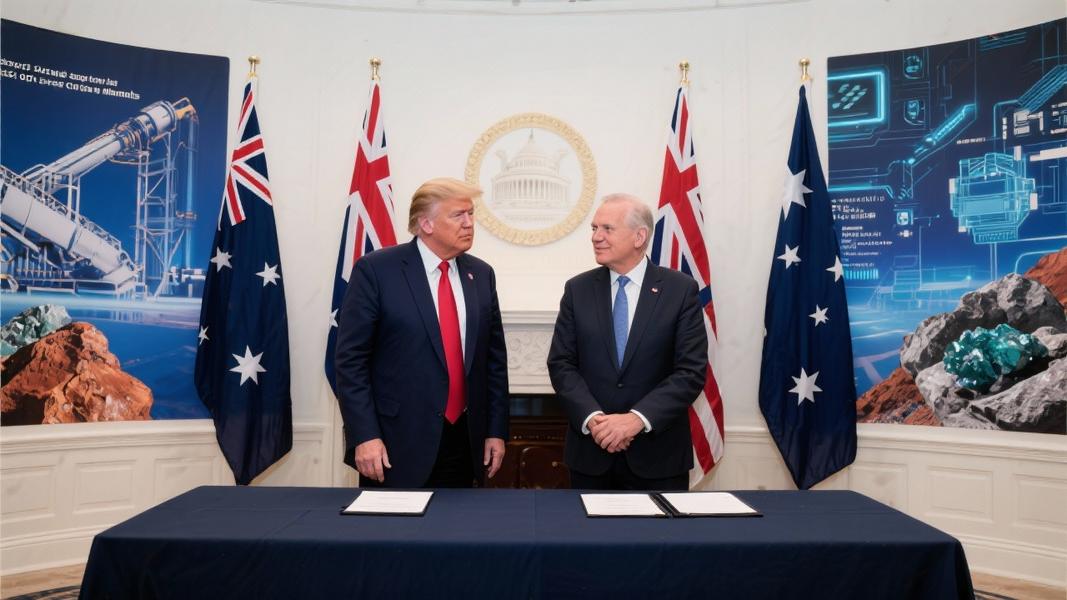
In a move that could reshape global supply chains for essential materials, the United States and Australia have signed a landmark framework agreement committing at least $1 billion to secure critical minerals and rare earths vital to both nations’ defense and commercial industries. The deal, inked by President Donald Trump and Prime Minister Anthony Albanese on October 20 in Washington, represents the most ambitious effort yet to break China’s stranglehold on these strategic resources.
“We’re taking back control of our supply chains,” President Trump told reporters after the signing ceremony. “This agreement ensures America and Australia — not China — will lead the future of technology and defense manufacturing.”
Breaking China’s Monopoly
The framework establishes a joint U.S.-Australia Critical Minerals Supply Security Response Group led by the U.S. Secretary of Energy and Australia’s Minister for Resources. This high-level team will identify priority minerals, assess supply vulnerabilities, and develop coordinated plans to accelerate production and processing.
Why now? The timing reflects growing anxiety in Western capitals about China’s dominance in processing rare earths — elements crucial for everything from smartphones to fighter jets. Beijing currently controls approximately 85% of global processing capacity for rare earth elements, giving it enormous leverage over global technology supply chains.
Under the agreement, both countries pledged to deploy “economic policy tools and coordinated investment to accelerate development of diversified, liquid, fair markets for critical minerals and rare earths.” This includes a commitment to provide that billion-dollar financing within six months to support projects in both nations.
Australia’s Big Bet
Australia has already put serious money behind its minerals strategy, with Prime Minister Albanese’s government committing approximately $18 billion in government-led initiatives to support critical mineral investments.
Former Australian Prime Minister and current U.S. Ambassador Kevin Rudd highlighted Australia’s $3.4 billion Critical Minerals Facility and a $1.1 billion investment in the Iluka lithium processing project — “the first ex-China processing facility for lithium in the world.”
“This isn’t just about economic security — it’s about national security,” Rudd explained at a recent CSIS event. “We’re creating resilient supply chains that can’t be weaponized against us.”
Price Floors and Market Protection
Perhaps the most controversial element of the framework is its approach to market intervention. Both countries have agreed to “protect their respective domestic critical minerals and rare earths markets from non-market policies and unfair trade practices,” including through price floors or similar measures.
Australia has already begun talks with miners about contributing to a strategic minerals reserve worth approximately $777 million. The proposal under consideration includes possible price floors, government-backed loans, offtake guarantees, and direct investment in Australian projects.
The U.S. has made similar moves, with the Department of Defense forming a public-private partnership with MP Materials Corp. that includes a $150 million loan to expand the Mountain Pass rare earth operation in California. Reports indicate the U.S. government has also set minimum prices for rare earths products from Mountain Pass.
Critics argue these interventions distort markets, but supporters counter that China’s decades of subsidies and environmental laxity have already created deeply unfair playing fields that require correction.
Cutting Red Tape
Both countries also committed to accelerating permitting processes for critical minerals projects — a longtime industry complaint. The agreement states the participants “are taking measures to accelerate, streamline, or deregulate permitting timelines and processes” for mining, separation, and processing “consistent with applicable law.”
Environmental groups have expressed concern about potential regulatory rollbacks. “We can’t sacrifice environmental protections in the name of supply chain security,” said Sierra Club President Ramón Cruz in a statement. “There must be guardrails.”
Legally Non-Binding
Despite its ambitious scope, the framework technically does not create legally binding obligations under domestic or international law. The document explicitly states it “sets out a policy and programmatic action plan that does not constitute or create rights or obligations under domestic or international law.”
This non-binding nature gives both countries flexibility but also raises questions about accountability if either side fails to follow through on commitments.
The framework also commits both nations to use economic and diplomatic tools to “review and deter critical minerals and rare earths asset sales on national security grounds” — a clear signal that Chinese acquisitions of Western mining assets will face heightened scrutiny.
Additionally, the countries pledged to invest in minerals recycling technology to further reduce dependence on new mining.
As the world races toward electrification and advanced technologies, the minerals at the heart of this agreement will only grow more essential. Whether this U.S.-Australia alliance can successfully challenge China’s entrenched position remains to be seen — but for the first time in decades, there’s a coordinated plan backed by serious money to try.
