
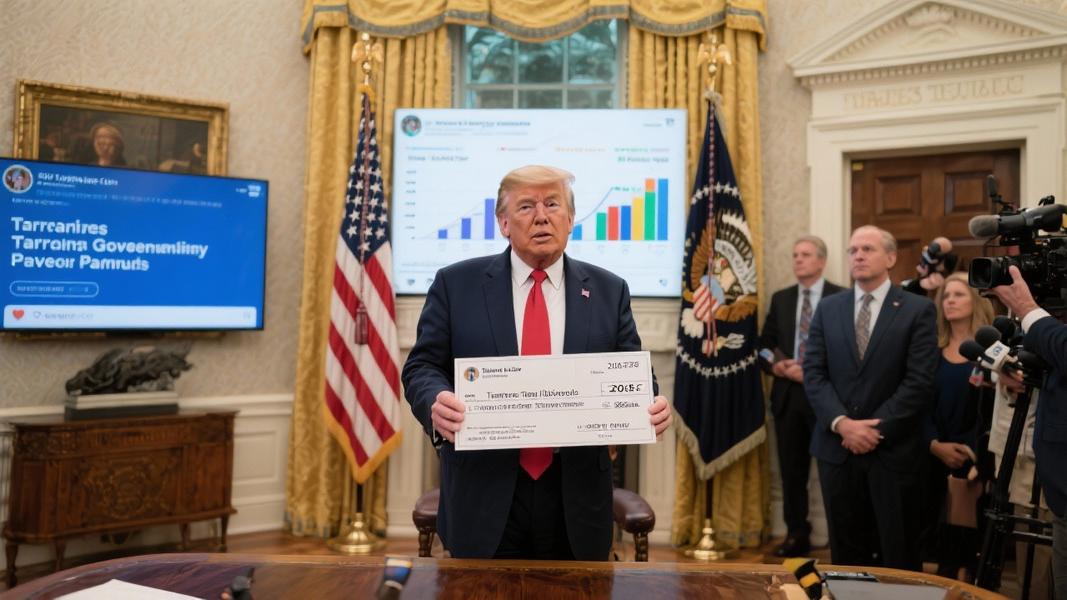
President Trump’s $2,000 tariff dividend proposal has hit a major roadblock: basic math. The ambitious plan, announced on Truth Social last weekend, promised to deliver cash payments to Americans from new tariff revenues while excluding high-income individuals.
But financial analysts and budget experts have quickly pointed out that the numbers simply don’t add up. Trump’s tariffs are projected to generate between $200-300 billion annually, while the dividend payments would cost approximately $600 billion per year if distributed similarly to COVID-era stimulus checks, estimates the Committee for a Responsible Federal Budget.
A Surprising Announcement
The proposal caught even Trump’s own Treasury Secretary off guard. Scott Bessent, appearing on ABC’s “This Week,” admitted he hadn’t discussed the dividend plan with the president and suggested the payments might actually take the form of tax cuts rather than direct government checks to Americans.
“It’s clear that the revenue coming in would not be adequate,” explained John Ricco, an analyst with the Budget Lab at Yale University, who calculates that Trump’s tariffs will bring in far less than what would be needed for the proposed payments.
The fiscal implications are stark. If implemented as described, these $2,000 dividends could increase the federal deficit by an estimated $6 trillion over ten years — roughly twice the amount Trump’s tariffs are expected to generate during that period.
Tariffs Bring In Cash, But Not Enough
Tariff revenue has indeed surged under the Trump administration. Collections reached $195 billion in the fiscal year ending September 30, a dramatic 153% increase from the $77 billion collected in fiscal 2024. But that still represents less than 4% of federal revenue — barely making a dent in the $1.8 trillion federal budget deficit for fiscal 2025.
Where would the rest of the money come from? That’s the question economists and budget experts are asking. The administration has yet to provide details on how it would bridge this substantial funding gap.
And there’s another complication: the tariffs themselves face a serious legal challenge. The Supreme Court recently heard arguments about the Trump administration’s use of national emergency powers to impose tariffs without congressional approval. Justices appeared skeptical of this approach, which bypasses Congress’s constitutional authority to levy taxes, including tariffs.
Legal Uncertainty Clouds Dividend Plan
If the Supreme Court strikes down the tariffs, the administration may find itself refunding money to importers who paid them rather than sending dividend checks to American families. This legal uncertainty casts further doubt on the viability of the dividend proposal.
Mainstream economists also point to a fundamental misunderstanding about who actually pays tariffs. Contrary to popular belief, tariffs are paid by U.S. importers, who typically pass these costs on to American consumers through higher prices. In effect, the tariff “dividend” could be giving Americans back their own money after they’ve already paid higher prices for goods.
“The dividend plan misses the mark,” criticized the Tax Foundation. “If the goal is relief for Americans, just get rid of the tariffs.”
Despite these challenges, the proposal highlights the administration’s focus on making its economic policies tangible to average Americans. The $2,000 figure echoes the popular COVID-era stimulus checks that provided direct relief during the pandemic.
But without a clear funding mechanism or legal certainty, Trump’s tariff dividend plan may remain more promise than policy — a check that, for now at least, the Treasury can’t cash.
