
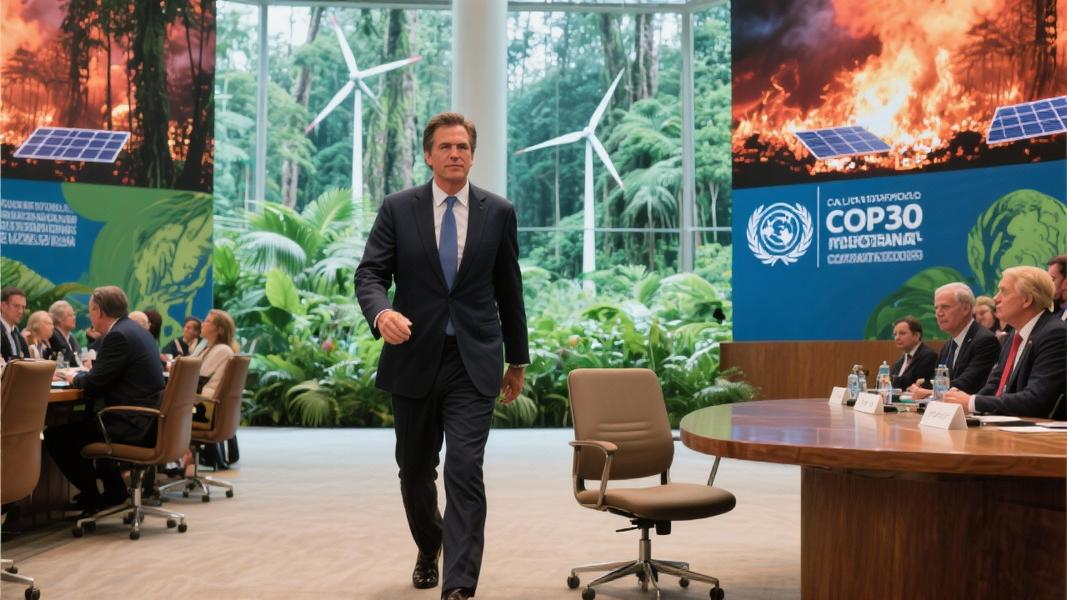
California Governor Gavin Newsom lashed out at the Trump administration Tuesday, calling its absence from global climate negotiations “doubling down on stupid” as the U.S. stands virtually alone among major nations in skipping the COP30 talks in Brazil.
Speaking in a wide-ranging interview with The Associated Press from Belem, Brazil, Newsom warned that America is surrendering economic advantage to international competitors — particularly China — by retreating from climate leadership and green energy development.
“This idea that somehow we can put up walls, we can put up barriers, we could put up tariffs, we put up our middle fingers and just turn our back is lunacy,” Newsom said. “And every other country in the world understands that. That’s why every other country in this world is moving in a different direction.”
America’s Empty Chair
The United States joins just three other nations — Afghanistan, Myanmar, and San Marino — in having no official representation at the climate summit, a striking absence for the country that has historically emitted more heat-trapping carbon dioxide than any other nation over the past century. Several U.S. governors and mayors are attending independently, attempting to maintain American presence despite federal disengagement.
Newsom, whose state has positioned itself as a climate policy leader, didn’t mince words about the economic consequences of the administration’s approach. “We’re ceding cheap energy, green energy, infrastructure, supply chain manufacturing. We’re ceding economic power to other countries, notably China, taking advantage of that absence,” he warned. “And they’re going to clean our clock economically unless we wake up to the economic imperative and opportunities of low carbon regrowth.”
The Trump administration has aggressively dismantled environmental regulations, including blocking California’s plan to ban new gas-powered car sales within a decade, while cutting subsidies to renewable energy and courting funding from fossil fuel industries.
White House Pushback
Is the administration concerned about ceding ground to competitors? Apparently not.
White House spokesperson Taylor Rogers fired back at Newsom, dismissing his climate advocacy as promoting a “Green New Scam” and defending Trump’s energy policies as beneficial to consumers through lower prices.
“Governor Newscum flew all the way to Brazil to tout the Green New Scam, while the people of California are paying some of the highest energy prices in the country. Embarrassing!” Rogers stated. “President Trump will not allow the best interest of the American people to be jeopardized by the Green Energy Scam.”
The heated exchange highlights the stark divide in American climate policy that has persisted through multiple administrations, with states like California increasingly charting their own course on emissions reductions and clean energy development.
California’s Climate Reality
For Newsom, climate change isn’t theoretical. His state has warmed 1.8 degrees Fahrenheit over the past three decades and receives nearly 7 inches less rain compared to 1995 levels. California has battled record-breaking wildfires, including two January 2025 blazes that tore through Los Angeles neighborhoods.
“If you don’t believe in science, and a lot of people apparently don’t, you have to believe in your own eyes,” Newsom argued. “Nighttime temperatures, record-breaking heat globally, acidification of our oceans, impacts on our coral reefs.”
The governor described California as “one of the most blessed and cursed states in the world that’s on the tip of the spear of the impacts of climate change,” facing what he called “the simultaneous crisis of wildfires, drought, and floods stacked on top of each other.”
Energy Demands of an AI Future
Despite championing renewable energy, Newsom has made pragmatic adjustments to meet California’s growing power needs, particularly from data centers and AI companies establishing operations in the state. His administration extended the operation of California’s last nuclear plant beyond its planned closure date, while simultaneously expanding solar power capacity and battery storage.
The state is also investing in nuclear fusion technology as a potential long-term solution to the enormous energy demands of artificial intelligence infrastructure — a move that reflects the complex balancing act between immediate energy needs and long-term climate goals.
International climate negotiation analyst Alden Meyer from European think tank E3G acknowledged that while federal absence from COP30 is problematic, the participation of state and local leaders provides important representation.
“But it is very positive that we have these other leaders from the United States that are here in Belem,” Meyer noted.
As climate talks continue without official U.S. participation, the contrasting approaches of federal and state climate policies underscore a fundamental question facing the nation: whether America can maintain economic competitiveness while stepping back from the global energy transition that other major economies are rapidly embracing.
