
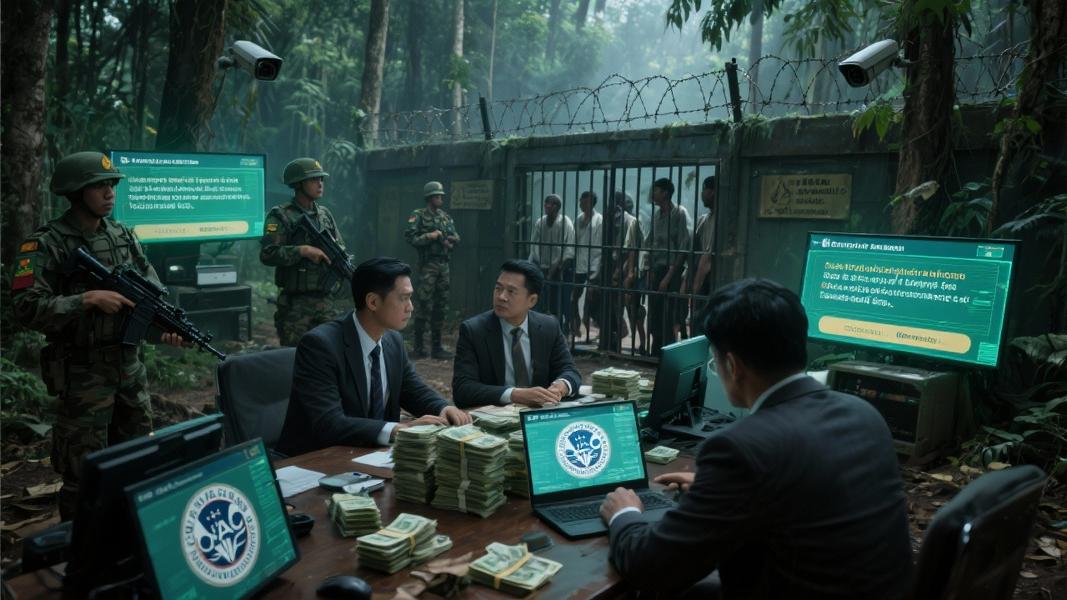
American families have lost over $10 billion to Southeast Asian cyber scam operations in 2024 alone, as criminal networks based in Burma continue to expand their fraudulent schemes targeting U.S. citizens. The Treasury Department is fighting back with a new wave of sanctions.
The Department’s Office of Foreign Assets Control (OFAC) has designated the Democratic Karen Benevolent Army (DKBA), along with four of its senior leaders, for supporting cyber scam centers in Burma that defraud Americans through fake investment schemes. The sanctions also target companies and individuals linked to Chinese organized crime groups collaborating with the DKBA.
“Criminal networks operating out of Burma are stealing billions of dollars from hardworking Americans through online scams,” said Under Secretary of the Treasury for Terrorism and Financial Intelligence John K. Hurley. “These same networks traffic human beings and help fuel Burma’s brutal civil war. The Administration will keep using every tool we have to go after these cybercriminals—wherever they operate—and to protect American families from their exploitation.”
A Growing Criminal Enterprise
The DKBA isn’t the first armed group in Burma to face Treasury Department sanctions. Just last month, OFAC sanctioned the Karen National Army (KNA) as a transnational criminal organization, along with its leader Saw Chit Thu and his two sons. The KNA controls territory in eastern Myanmar’s Karen State and has been profiting from similar cyber scam centers.
How bad is it? The financial damage is staggering. U.S. government estimates show Americans lost at least $10 billion to these Southeast Asian scam operations in 2024 — a 66 percent increase over the previous year. That’s billions siphoned from retirement accounts, college funds, and family savings.
These scam operations typically begin with the recruitment of workers under false pretenses, who are then coerced through debt bondage and violence to perpetrate online frauds. The schemes often involve convincing victims to invest in fake virtual asset platforms that promise high returns but ultimately steal their money.
Brutal Conditions Inside Scam Compounds
The DKBA provides security for and permits the operation of scam compounds such as Tai Chang in Karen State. The conditions inside these facilities are horrific, with DKBA soldiers filmed beating handcuffed scam workers. Rescued victims have reported being subjected to electric shocks, being hung by their arms inside dark rooms, and other brutal treatment.
Among those sanctioned were senior DKBA leaders Saw Steel (commander-in-chief), Saw Sein Win (adjutant general), and Saw San Aung (chief of staff). OFAC also designated Chamu Sawang, director of Trans Asia International Holding Group, for directly benefiting from revenue generated by these scam compounds.
The illicit revenue funds not just the DKBA’s ongoing activities but also enables its partnership with Chinese organized crime in drug, human, arms, and wildlife trafficking, as well as money laundering operations.
A Strike Force Takes Shape
In response to the growing threat, the U.S. has established a Scam Center Strike Force involving the FBI, Department of Justice, U.S. Secret Service, and other agencies to investigate, disrupt, and prosecute these Southeast Asian scam centers.
“The Scam Center Strike Force will work collaboratively with OFAC, the Department of State, and other agencies to use all tools available to the government to disrupt scam centers at the highest levels through sanctions, seizures, and criminal prosecution of individuals; securing U.S infrastructure against use by scammers; and supporting and protecting U.S. victims of these scams through public education and restitution,” Treasury officials explained.
The strike force will focus primarily on operations in Burma, Cambodia, and Laos, which have become epicenters for these criminal enterprises.
Chinese Criminal Organizations Involved
The Treasury Department also targeted Trans Asia International Holding Group Thailand Company Limited and Troth Star Company Limited, both linked to Chinese organized crime. These companies have collaborated with Burma armed groups to develop scam compounds including Tai Chang, Huanya, and KK Park near Myawaddy in Karen State — major hubs for scams targeting U.S. victims.
Trans Asia, based in Mae Sot, Thailand, serves as a front for China-based transnational criminal organizations to invest in scam centers, according to Treasury officials.
This isn’t the Treasury’s first action against such networks. Previous sanctions have targeted the Prince Group in Cambodia, the Huione Group for money laundering virtual currency scam proceeds, Funnull Technology Inc. in the Philippines, and the L.Y.P. Group in Cambodia.
The Huione Group has laundered proceeds of cyber heists carried out by North Korea and for transnational criminal organizations in Southeast Asia perpetrating virtual currency investment scams.
Complex Web of Armed Groups
Adding to the complexity is the Karen Border Guard Force (BGF), a pro-regime militia formed after splitting from the DKBA. Led by Saw Chit Thu, who has been sanctioned by OFAC, the UK, and EU, the BGF has been implicated in scam operations and human trafficking in Karen State.
Burma’s regime has shown some signs of friction with these groups. The regime’s Central Bank of Myanmar has blacklisted the Chit Linn Myaing Toyota Company — reportedly owned by Saw Chit Thu — along with 196 other companies for “failing to deposit foreign currency earnings from exports.”
Despite this, Thai authorities’ efforts to prosecute these networks have seen little progress, with insufficient evidence cited as a barrier to moving forward with cases.
As these criminal enterprises continue to evolve and expand, American consumers remain at risk. The Treasury Department’s actions represent just one front in what’s becoming an increasingly complex battle against transnational cyber fraud — one that shows no signs of slowing down as billions continue to flow from American victims to armed groups and criminal syndicates operating with virtual impunity in Southeast Asia.
