
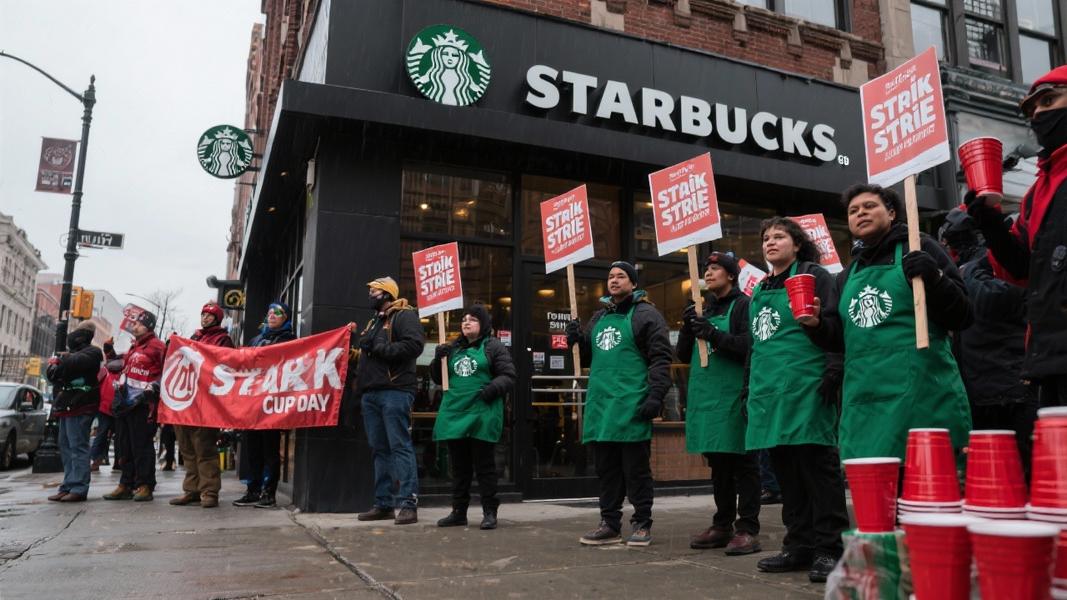
Starbucks workers from dozens of unionized stores walked off the job Thursday, disrupting one of the coffee giant’s most profitable promotional days and escalating a labor dispute that has been brewing for years.
More than 1,000 baristas at 65 U.S. locations went on strike during Starbucks’ annual Red Cup Day — when customers line up for free reusable holiday cups with drink purchases. The workers, organized under Starbucks Workers United, are demanding better pay, improved staffing levels, and an end to what they call anti-union tactics by the company, which hasn’t reached the bargaining table since April, union leaders say.
No Contract, No Coffee
“We’re proud of our work, but we’re tired of being treated like we’re disposable,” said Dochi Spoltore, a barista who joined picket lines outside stores. The walkout came after union members authorized the action with a 92% vote.
Michelle Eisen, a spokesperson for Starbucks Workers United, didn’t mince words about the union’s intentions: “No contract, no coffee is more than a tagline—it’s a pledge to interrupt Starbucks operations and profits until a fair union contract and an end to unfair labor practices are won.”
The timing wasn’t coincidental. Red Cup Day, which Starbucks has celebrated since 2018, typically drives significant foot traffic as customers seek the collectible cups with holiday drink purchases. By targeting one of the chain’s busiest promotional days, workers aimed to maximize visibility and leverage in the stalled negotiations.
A Tale of Two Narratives
The coffee giant, for its part, has pushed back against the union’s characterization of working conditions. Starbucks contends it offers “the best wage and benefit package in retail,” with compensation averaging $30 per hour when benefits are included. Those perks include up to 18 weeks of paid family leave and full tuition coverage for four-year college degrees.
Sara Kelly, a Starbucks spokesperson, claimed it was the union that walked away from bargaining earlier this year, not the company. She stressed that Starbucks remains “ready to talk” and believes they “can move quickly to a reasonable deal.”
But what’s happening behind the scenes? The labor dispute has intensified since Brian Niccol took over as CEO following the departure of Laxman Narasimhan. Under Niccol’s leadership, Starbucks closed 59 unionized stores in September 2025 as part of what the company described as a broader reorganization campaign — a move the union views as retaliation.
Growing Pains or Growing Movement?
Despite the closures, the unionization effort has continued to gain traction. Currently, around 550 company-owned U.S. Starbucks locations are unionized, with more having voted to organize since the movement began in 2021 at a Buffalo, New York, store.
The company has shown some signs of recovery under Niccol’s leadership. Starbucks reported that same-store sales rose 1% in the July-September quarter — the first increase in nearly two years. The CEO has introduced new hospitality standards and store redesigns aimed at improving the customer experience.
Todd Vachon of the Rutgers School of Management and Labor Relations noted that the strike strategy might be particularly effective for a retail business like Starbucks. “Unlike manufacturers, retail industries depend on the connection between their employees and their customers. That makes shaming a potentially powerful weapon in the union’s arsenal.”
For customers caught in the middle, Thursday’s strike meant longer lines at non-unionized locations and, in some cases, a choice between crossing picket lines or forgoing their morning caffeine fix. The union distributed its own “Union Red Cups” at some picket locations, offering a symbolic alternative to the company’s promotion.
As holiday shopping season approaches — traditionally a crucial period for retailers — the question remains whether this labor action will be enough to bring Starbucks back to the bargaining table, or if customers will see more disruptions before their peppermint mochas and gingerbread lattes are served with labor peace.
